Exhibitions
Baselitz: The world right side up
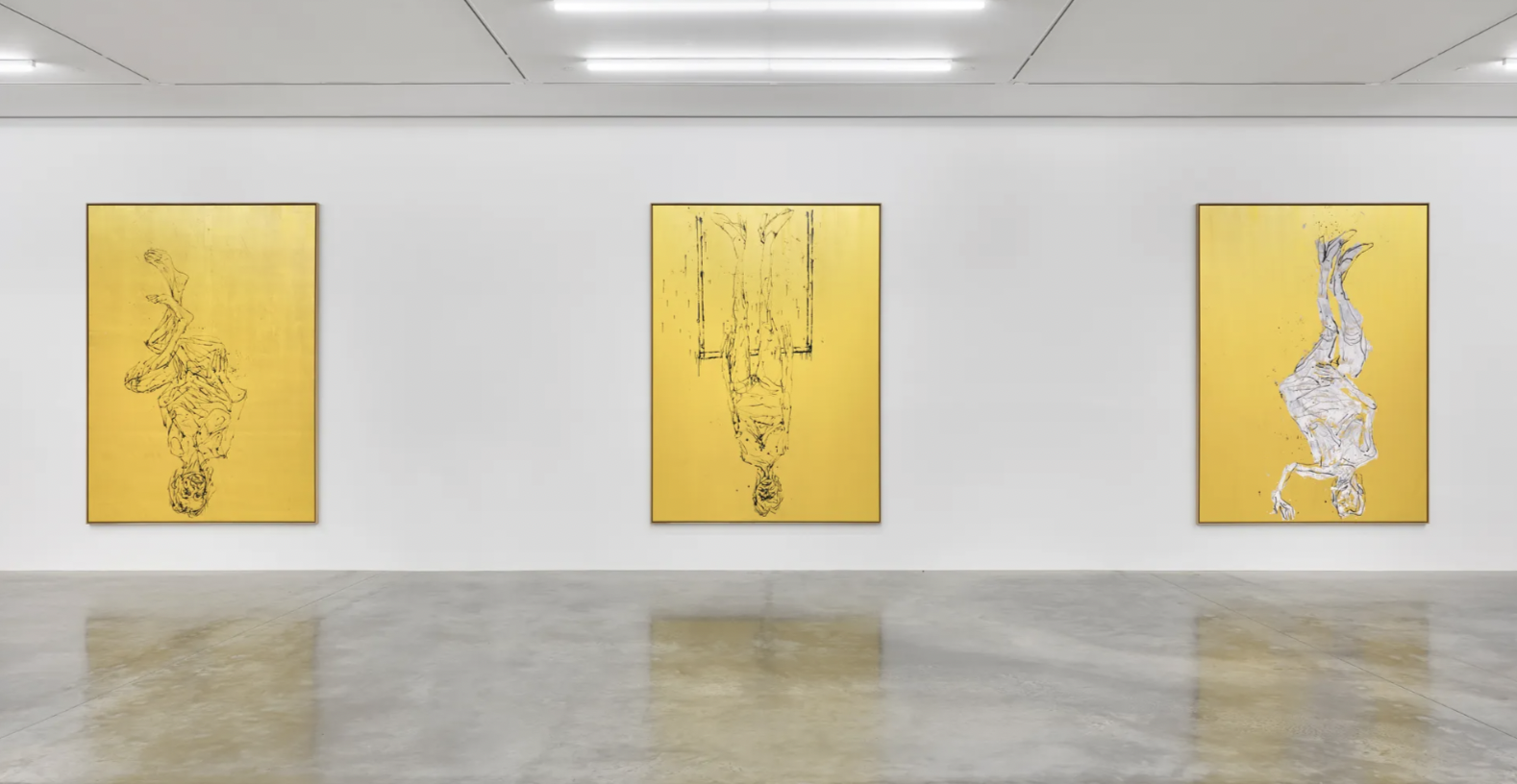
The first thing that happened when I walked into Back Again, Georg Baselitz's final exhibition at White Cube following his death in April, was a man asking me to photograph him doing a handstand in front of Es war hot (2025). This was one of the larger paintings in the first room, featuring an upside-down figure namesake of Baselitz's pictorial invention, caught rushing mid-fall but still paused within the confinements of the frame. It was such a peaceful image. Or, it could have been, if this man's legs hadn't aimed for an alignment with the centre of the painted figure, so that the two inversions would meet. I'm unsure why I obliged to take this photograph and perhaps it was because, though I'm not entirely sure whether what surprised me more was the request itself, or that it seemed, somehow, like a reasonable one. It seemed there that one of the remaining lasting effects of Baselitz's work could have on any of us was to invite such a physical response, as though all one can do before a Baselitz anymore is simply to invert oneself in return.
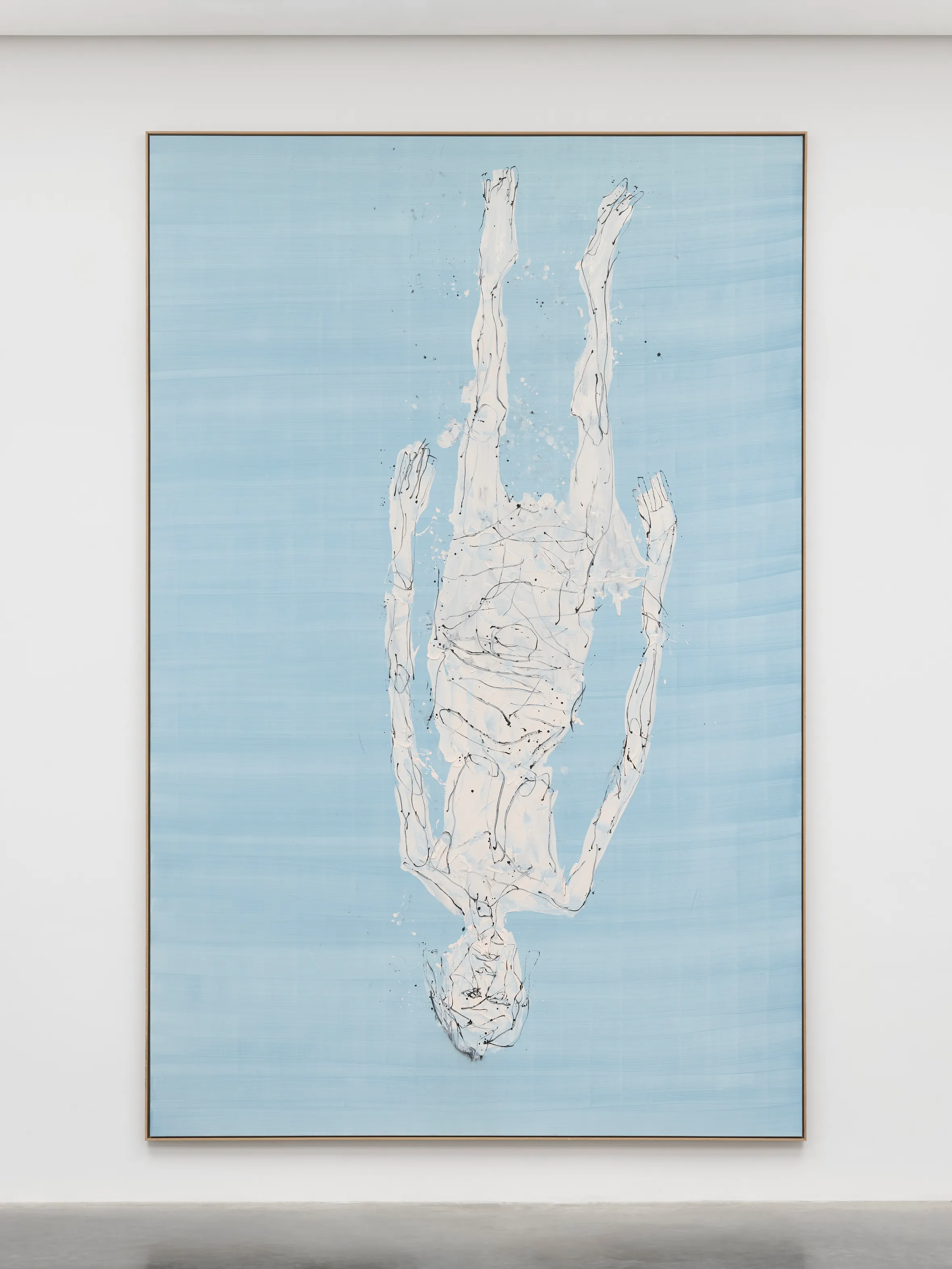
Back Again feels animated by an impulse toward inversion that is no longer an act of provocation against the social realism of East Berlin, but one of retrospection, as the artist turns his world upside down one final time in order to look back upon it. In an interview recorded during his exhibition at the Fondazione Giorgio Cini in Venice, Baselitz remarked: "Now that I'm more or less at the end of my painting activity, I thought I should draw some kind of conclusion." Yet conclusions are strange things; they usually have an inevitable habit of resembling beginnings.
The exhibition is inevitably haunted by Igor Stravinsky's two-part theatrical work, L'Histoire du Soldat, whose characters Baselitz reimagined for the Salzburg Marionette Theatre in July 2025 and is the first time the artist had designed puppets, though his paintings may have often been described as gravity-defying marionettes stretched across vast canvases with nowhere to go but remain in stillness. In the accompanying essay to the exhibition, Matthew Holman writes that Baselitz was moved to tears on encountering the finished production. An artist weeping at his own puppets is also an artist watching himself from the outside, which is another kind of inversion entirely.
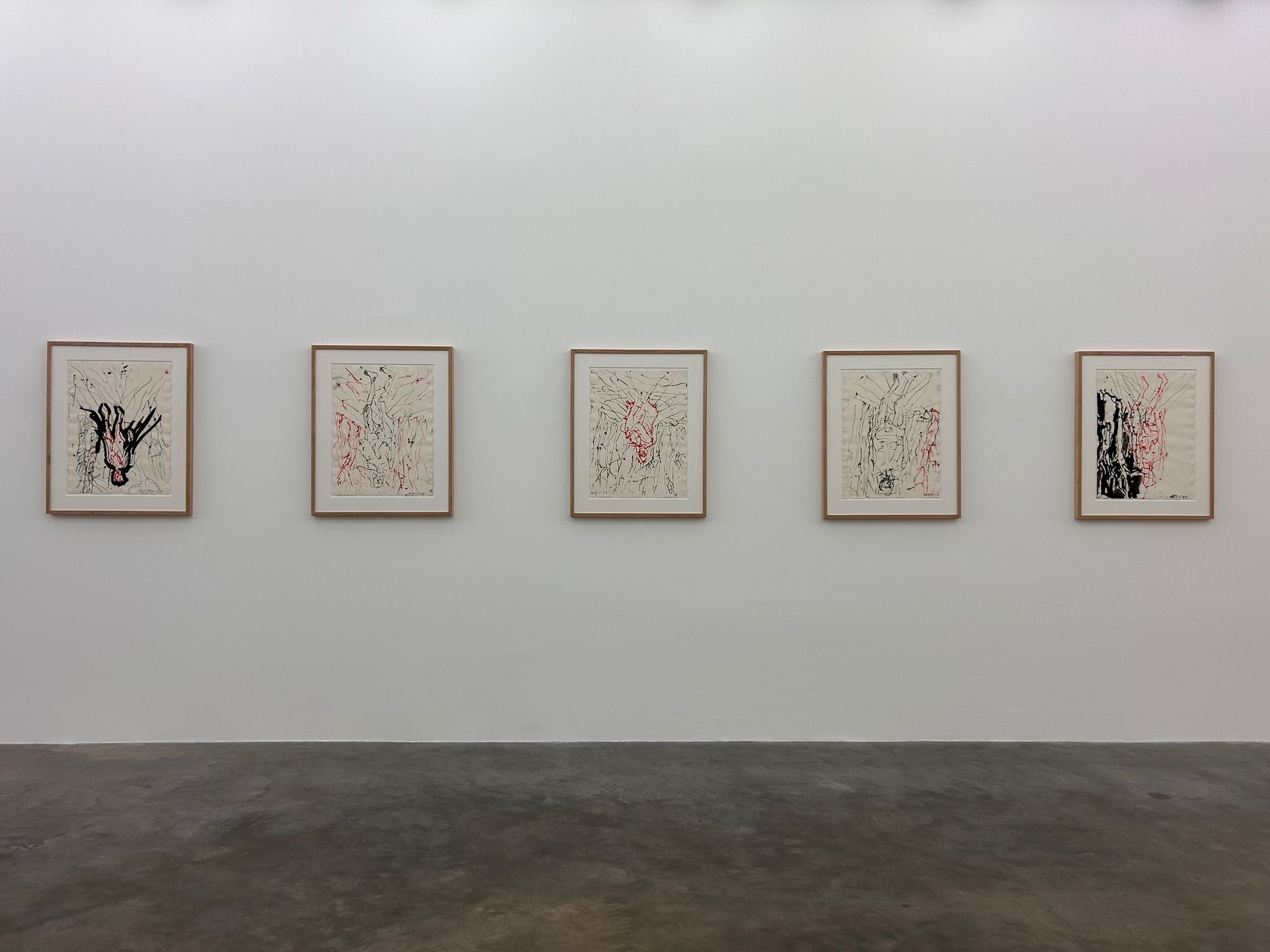
In Stravinsky’s tale, the soldier returns from the war to find that what he traded his violin for has cost him the very ground he stood on and he can no longer trace the path back to who he was. In Baselitz's drawings, something similar seems to happen in reverse as everything around the figure begins to dissolve, until only the accumulation of something that assimilates a face or simply the residue of having once seen. The body itself disappears, dissolving into alienated strokes which, like the giant inverted figures in the paintings, seem to disperse across the white of the page, as though gravity had finally loosened its hold. But unlike Holman, I don't think Baselitz is the soldier of the fable. The tragedy of Stravinsky's soldier is that he cannot retrace his steps. Baselitz's final act, by contrast, is precisely to retrace them– from the doubleness in the eagle, Elke, inverted bodies, the landscape that he carries in his name, the gold – and call it a conclusion. If anything, this exhibition is the evidence that he could trace the steps back, when the soldier's whole tragedy is that he couldn't.One spends a lifetime travelling from one place to another only to arrive back to one's obsessions.
I had not seen Baselitz's drawings before, but I found myself lingering over them compelled by the contour of a face dissolving into a thousand red and black lines, stretched across the white page, close enough to fall outside the canvas. This delineated background marks a return to Baselitz's known devotion to Munch, whose own fascination with the multiplying lines pushed him toward something beyond Munch’s notorious piece,The Scream (1893).
Through the walls of the White Cube, one confronts thirty paintings made during Baselitz's final months, an awareness of our own decay trailing behind us, leaving its own ash-like line against the gallery's relentless white. Every painting holds a trace of ageing filtering through the gold, creaking black lines settling into his and Elke's bodies what they once were, now laid out, patient, waiting for an end that arrives, as endings usually do. Still Baselitz had enough time to gather all the images that had crawled from behind his mind and onto the canvas one last time.
Perhaps this is the last inversion Baselitz had left to perform. For sixty years he turned bodies upside down so that we might stop looking for a subject and fade away inside the paint. In Back Again, the inversion turns on him as the man who has ultimately disappeared, perhaps it is there that he most resembles the Soldier and what remains the right way up, standing where he no longer can, is the work itself. In the end the artist trades places with the work, deliberately, at the very end not as a disappearance but a simple exchange, the last and most complete of all his inversions.


You may be
interested
...