Exhibitions
Hammershøi or the painter who made silence a way of listening
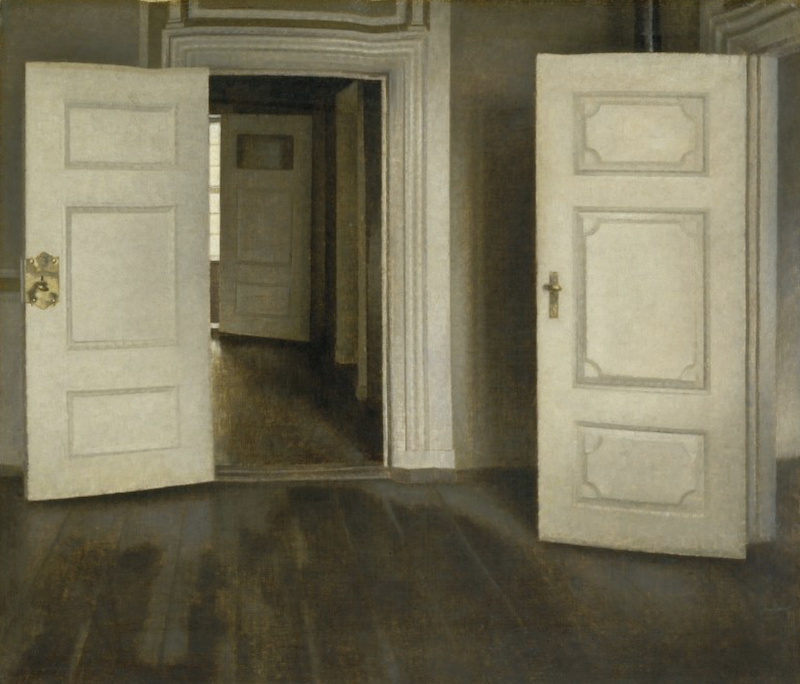
The Thyssen-Bornemisza National Museum is dedicating a highly anticipated retrospective to Vilhelm Hammershøi, the first ever held in Spain on the great Danish master, curated by Clara Marcellán. Known for his enigmatic interiors and refined palette of grays, the artist arrives in Madrid at a time of renewed international interest in his work, whose influence and magnetism have continued to grow in recent decades.
More than a century after his death, Hammershøi continues to fascinate with the radical intimacy of his pictorial language: silent rooms, figures with their backs turned, half-open doors, and a light that seems to suspend time. The exhibition's subtitle, The Listening Eye , alludes precisely to this sensory dimension of his painting, where silence becomes matter and the gaze acquires an almost musical quality. The reference is not accidental: the cadence, rhythm, and tonal variations of his compositions resonate with his profound interest in music, revealing a body of work that is not only contemplated but also—metaphorically—listened to.
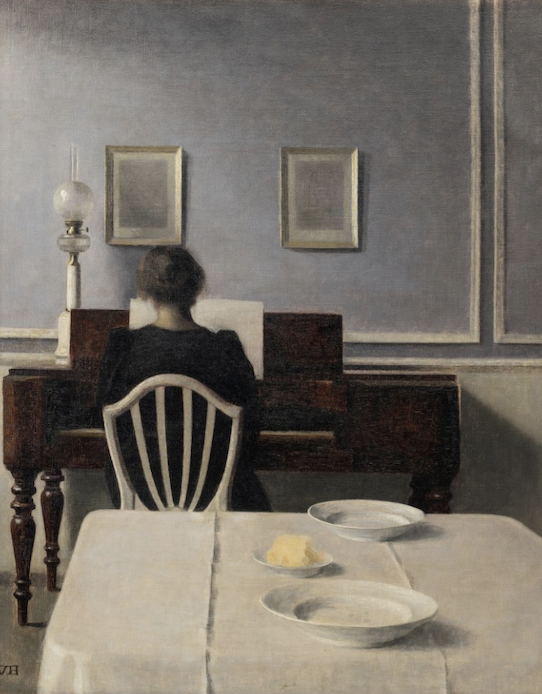
Vilhelm Hammershøi , Interior with woman at the piano, Strandgade 30 , 1901 , Private collection, Photo: ©Bruno Lopes.
The paintings of the Danish artist, celebrated for their silent interiors and almost mineral-like coldness, continue to exert a powerful fascination on contemporary viewers. Far from being exhausted by a single interpretation, the ambiguity that permeates his compositions—figures with their backs turned, bare rooms, half-open doors—unfolds a range of interpretations that has expanded in recent decades thanks to the study of his affinities with other European artists and a renewed contextualization within the Danish art scene of his time.
The exhibition also addresses key aspects of his career, such as the fundamental role of his wife, Ida Ilsted, in his creative universe; the progressive formal refinement of domestic interiors and their resonances with the treatment of architecture and landscapes; and the construction of his own image as a painter in the final years of his life, when self-representation becomes a silent reflection on the craft and artistic identity.
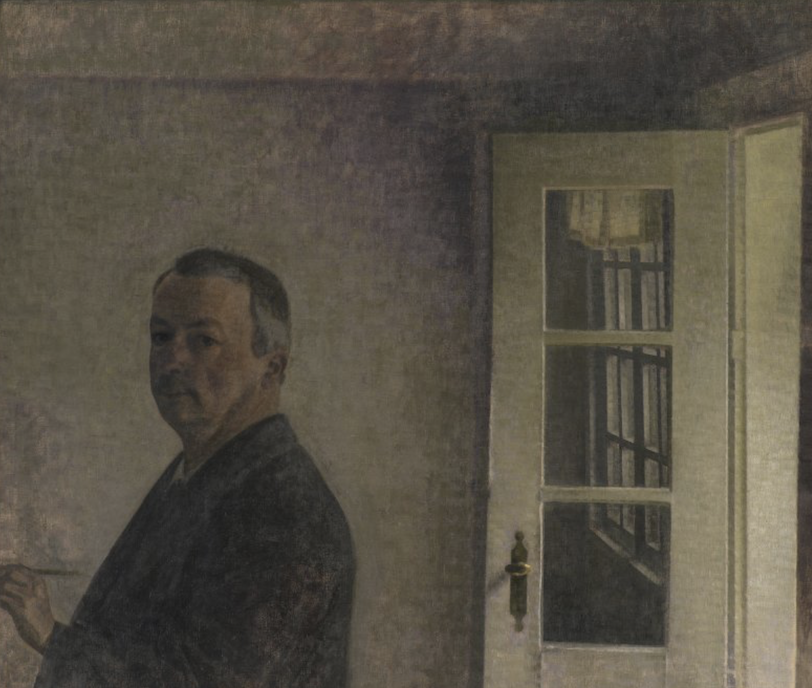
Vilhelm Hammershøi , Self-portrait. The Spurveskjul country house in Sorgenfri, north of Copenhagen , 1911 , SMK, National Gallery of Denmark, Copenhagen Statens Museum for Kunst.
Those who knew Vilhelm Hammershøi describe him as a reserved and introspective man, a personality that seemed to extend into the restrained atmosphere of his canvases. However, this discretion did not prevent him from having staunch supporters of his work. He maintained close ties with Danish artists such as Jens Ferdinand Willumsen and Carl Holsøe, as well as with musicians like cellist Alfred Bramsen and pianist Leonard Borwick, two of his most consistent advocates.
As Clara Marcellán points out, in his paintings, the stark spaces, the introspective figures, and the apparent suspension of action intensify a sense of silence that is reinforced by the chromatic economy and the subtle gray glazes that unify the painted surface. In this austere palette, white acquires a decisive role: a color that, in the words of Wassily Kandinsky, embodies a silence full of possibilities. Like a pause in a musical score, the white in Hammershøi is not emptiness, but expectation; not absence, but the very condition for the eye—and almost the ear—to enter a state of listening.
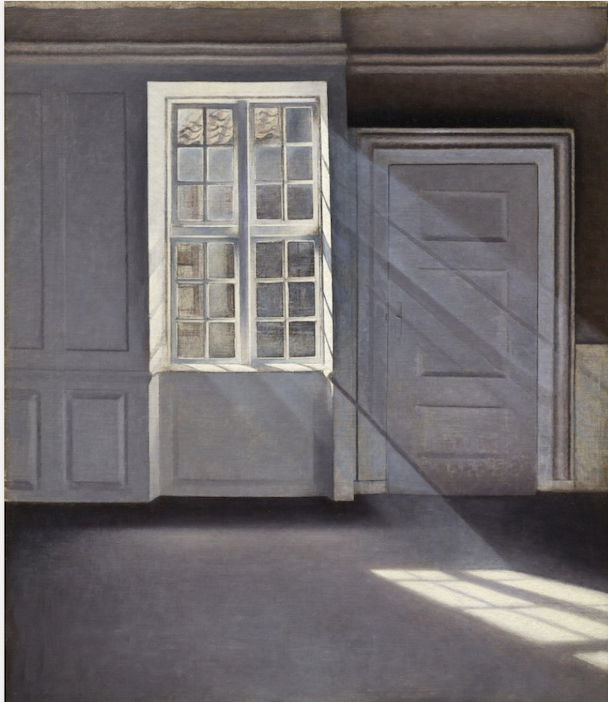
Vilhelm Hammershøi , Sunbeams or Sun. Dust motes dancing in the sun's rays. Strandgade 30 , 1900 , Ordrupgaard, Copenhagen Ordrupgaard, Copenhagen © Photo: Anders Sune Berg.
The Centre for Contemporary Culture of Barcelona (CCCB) already explored this evocative cinematic dimension in 2007 by fostering a fruitful dialogue between Vilhelm Hammershøi and filmmaker Carl Theodor Dreyer in the exhibition Hammershøi and Dreyer . That face-to-face encounter highlighted the aesthetic affinities between the two creators: formal austerity, the intensity of silence, and an almost spiritual conception of the image.

You may be
interested
...