News
Juan Carlos Distéfano, the Argentine artist who transformed pain and memory into sculpture, has died.
The art world bids farewell to one of the fundamental figures of contemporary Argentine creation, a creator who knew how to capture violence, the human condition and the horrors of history through a work of enormous expressive power.
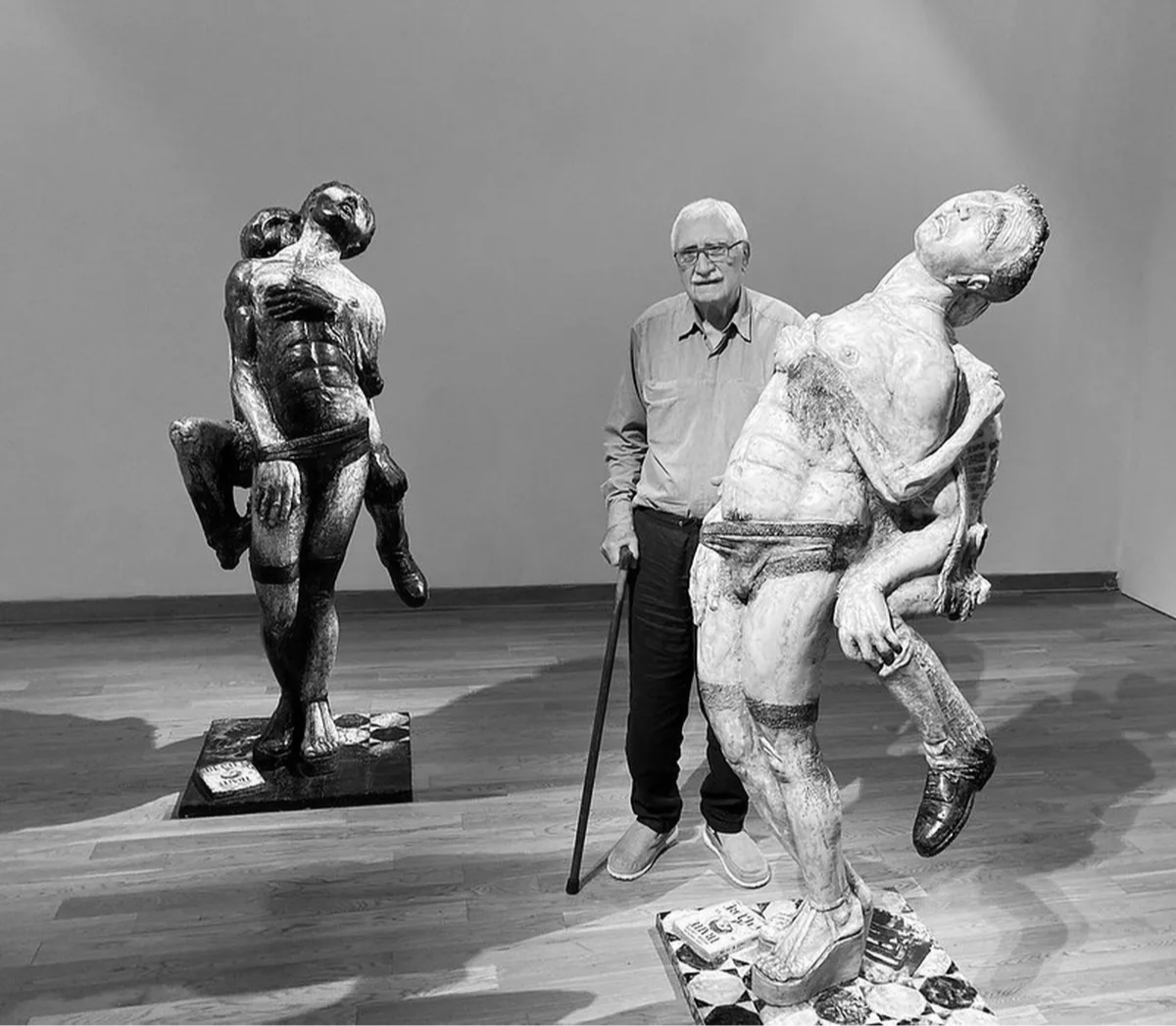
"I'm not interested in virtuosity in the slightest. Virtuosity is merely a demonstration of skill, and skill, in relation to art, is reduced to the category of a circus act."
The Argentine art world mourns the loss of Juan Carlos Distéfano, a sculptor and painter considered one of the most important voices in contemporary Latin American art, who died this Saturday at the age of 92. His career was marked by a profound reflection on humanity, violence, memory, and collective wounds, transforming sculpture into a space for resistance and thought.
Artists, curators, and institutions have highlighted the unique nature of a body of work that, for more than six decades, explored art's capacity to confront the most painful episodes in history. "He had the ability to capture horrors," a phrase that summarizes one of the essential characteristics of his production: the representation of bodies marked by suffering, but also by dignity and resilience.
The director of the National Museum of Fine Arts in Buenos Aires, Andrés Duprat, remembered the artist as “exceptional,” highlighting his “original and unique” contribution to the history of Argentine art, as well as his approachable, generous, and committed nature. The institution also recalled its relationship with Distéfano in recent years, especially with the exhibition *La memoria residual * (Residual Memory), presented in 2022 and curated by María Teresa Constantin, considered his last major exhibition.
Born in Argentina, Distéfano began his training at the National School of Graphic Arts No. 9 and continued his studies at the Manuel Belgrano School of Fine Arts. After a trip to Italy to deepen his knowledge of the masters of the Trecento and Quattrocento, he returned to the country and became a key figure in the Argentine artistic renewal.
In 1960, he played a fundamental role in the creation and organization of the Graphic Design Department at the Di Tella Institute, one of the major centers of cultural experimentation in Latin America during the second half of the 20th century. Some of his works from that period are now part of the collection of the Museum of Modern Art (MoMA) in New York.
During the 1960s, he consolidated his artistic language within the neo-figurative movement. His first solo exhibition took place in 1964 at the Riobóo Nova Gallery, and a few years later, his participation in the 9th São Paulo Biennial in 1967 caused a strong stir due to the intensity of his images and his break with traditional forms of representation.
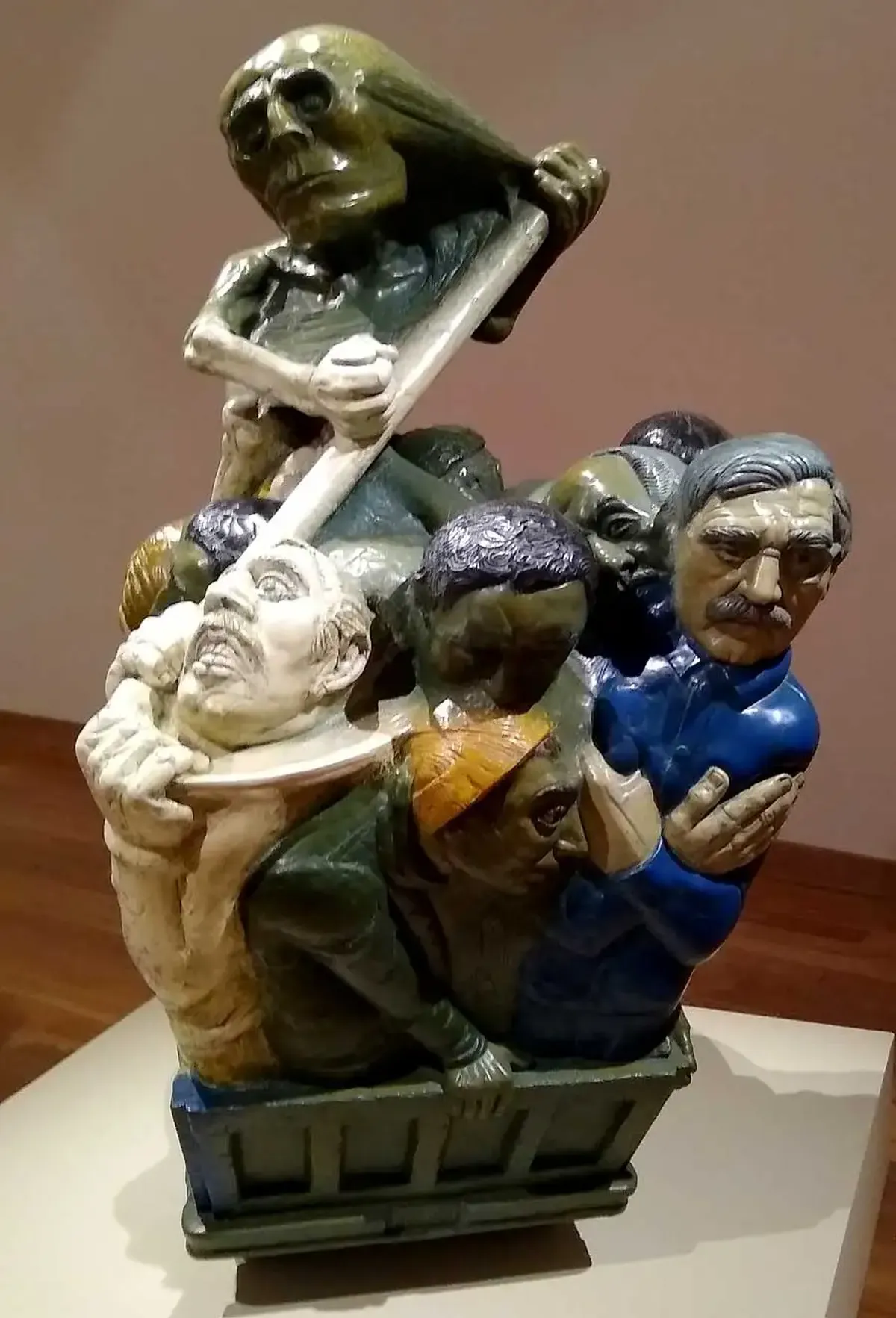
Distéfano found a territory for experimentation in materials like fiberglass and polyester resin. Although he described polyester as an 'unpleasant' material to work with, he valued its potential for constructing volumes and forms impossible to achieve with more conventional sculptural techniques. This technical choice became one of the hallmarks of his work.
His life was closely linked to the writer Griselda Gambaro, with whom he shared more than seven decades of personal history. In 1977, during the last Argentine military dictatorship, they were both forced into exile in Barcelona. They returned to Argentina in 1980, at which point Distéfano resumed his artistic production and delved deeper into some of the central themes of his work: repression, authoritarianism, torture, and the marks that violence leaves on bodies and collective memory.
Throughout her career, she received numerous awards. In 2015, she represented Argentina at the Venice Biennale with the exhibition "The Rebellion of Form ," a project focused on the human condition and art's capacity to question reality. In 2018, she received the National Lifetime Achievement Award, granted by the then Ministry of Culture of Argentina.
His last major exhibition, Residual Memory , brought together nineteen sculptures created between 1973 and the present at the National Museum of Fine Arts in 2022. The exhibition reaffirmed the enduring relevance of an artist who never ceased to question the past and who transformed memory into a sculptural material capable of speaking to the present.

You may be
interested
...