Exhibitions
Looking In: Nan Goldin's The Ballad of Sexual Dependancy
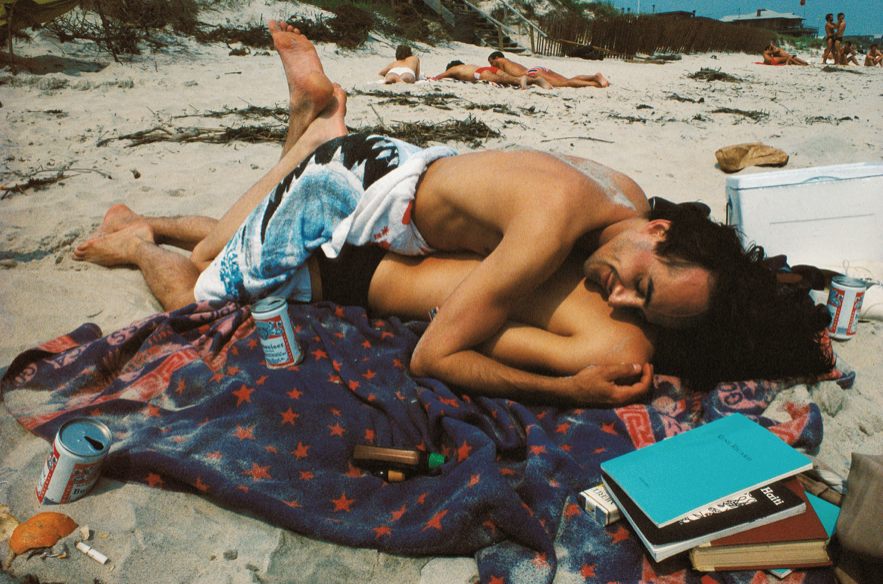
Suburban life, on the outskirts of major North American cities, is an aesthetized death, one beautiful lie that Nan Goldin pulls apart in what she calls her visual public diary. The Ballad of Sexual Dependency, in her words, “expands from its subjective base with the input of other people… an invitation into her world,” a world in which every emotion is felt simultaneously. To mark the 40th anniversary of its publication, this body of work is being presented for the first time in the UK as a complete series. It will be on view from January 14 to March 21, 2026, at Gagosian, 17–19 Davies Street, London.
The slideshow originally featured up to 800 images over 45 minutes in a darkened room, accompanied by a changing soundtrack that included the voices of Maria Callas, Petula Clark, Dionne Warwick, and Dean Martin. Now, the exhibition includes 126 framed photographic prints from the series, arranged in four rows and covering three black walls of the space, to be contemplated without the constraints of time.
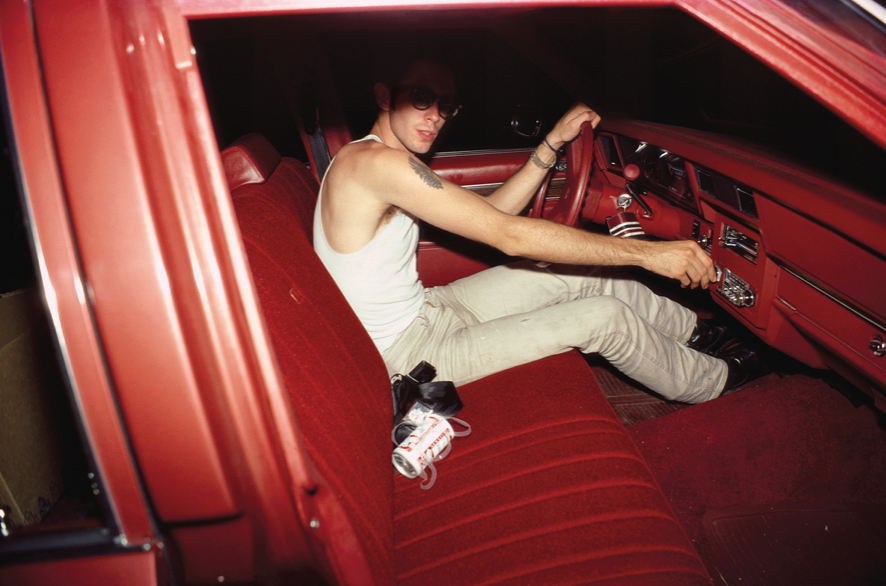
Nan Goldin, Mark in the red car, Lexington, Mass, 1979. © Nan Goldin.
The Ballad of Sexual Dependency constantly challenges Nan Goldin's mother's refrain, "Don't let the neighbors find out." And yet, here we are, invited into a place where secrecy is the first thing that must be unlearned. Between the flashbacks in each scene we observe, we revisit memories of a life lived by Goldin and the stories she invites us to remember with her, of what she liked to call "her tribe." This Tuesday, during the London opening, the room was for a moment populated by strangers who doubted each other's presence, but as we lingered and looked longer, a strange familiarity emerged. We became neighbours, all of us, looking in together. A place where there was no longer a veil to conceal the truth: everything was exposed, and there was nowhere left to hide.
Nan has said that she does not choose whom she photographs, and therefore, the images do not observe life from the outside; they emerge from within it. They are inseparable from the relationships that made them possible. Naked bodies slumped on a bed, mascara collapsed beneath one eye; a lover’s hand resting on a thigh without ceremony; a kitchen table littered with the residue of the night before; eroded faces with demanding eyes; self-portraits in bathroom mirrors and lovers in the dispute of understanding. These were instances of pure happiness, all against the aftermath. These photographs do not announce themselves as moments worth remembering, but rather as moments that continue to exist in the aftermath, the afterlife, after violence, after tenderness, after happiness, where life continues without performance.
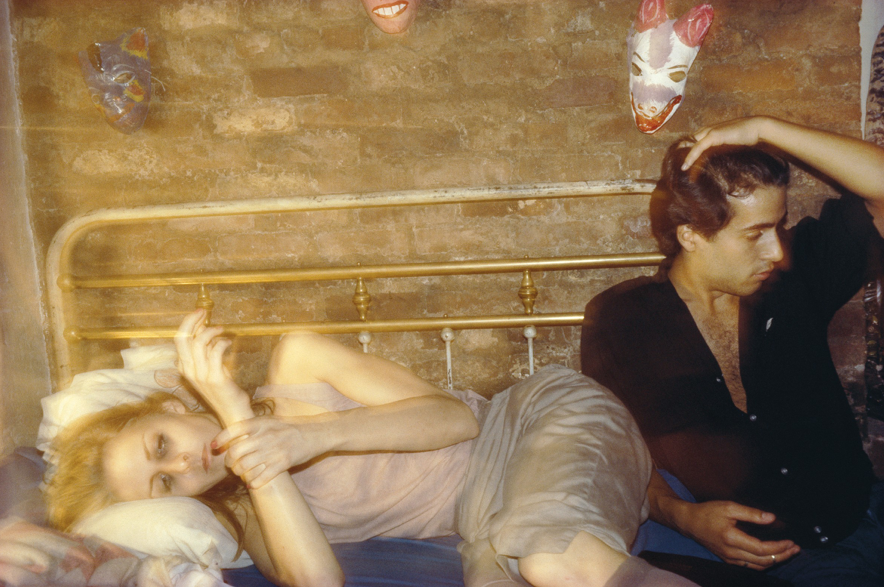
Nan Goldin, Greer and Robert on the bed, New York City, 1982. © Nan Goldin.
Goldin's childhood unfolded in post-Vietnam War America, during the early Reagan years, a period defined by "family values," privatization, and moral conservatism. It was also a society shaped by the domestic ideology of late capitalism, in which convenience progressively replaced meaning and appearance displaced truth. Ironically, or perhaps inevitably, this is a condition that contemporary society knows well, intensified by technology, social media, and the incessant circulation of keywords for living, such as the word of the year 2025: performative . The way we have now learned to act and to be the great imitators of our own lives is a condition that the artist dismantles in her work. This exhibition arrives at a moment that feels quietly pivotal, compelling us to look back and to stand courageously for our truth.
The acclaimed 2022 documentary *All the Beauty and the Bloodshed* , based on the life of Nan Goldin and her commitment, through her organization PAIN, to fighting the opioid crisis, addresses the Sackler family's distribution of OxyContin through Purdue Pharma LP. But we also learn of Goldin's close relationship with and early admiration for her non-normative older sister, Barbara, who later committed suicide in her struggle to defend her identity. *The Ballad of Sexual Dependency* is dedicated to Barbara, and it's impossible not to recall a voice we've never heard in every photograph that portrays a life, or even a moment, in which Barbara might have appeared. Within those three walls, the question of the role of art resonates in Nan Goldin's commitment to fighting for a truth larger than the one we're sold, using her memory as her sole vehicle. Through her expression, which accumulates in the tenderness of the square windows, her memories can be released and enshrined within the space. Light filters through each dancing body, affirming that these are real people who once lived here and they lived a beautiful life filled with evidence of what it means to have truly lived, but mostly, exceptionally real. They are something you can touch.
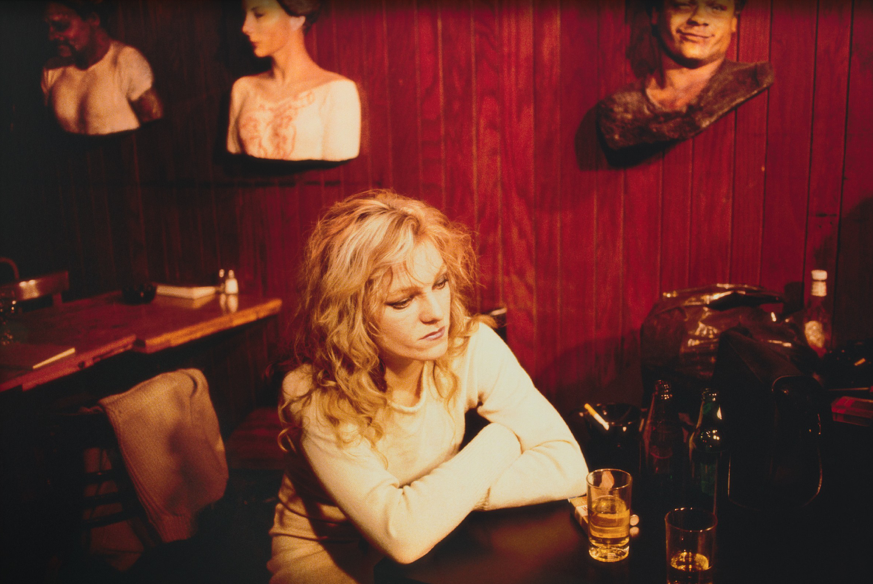
Nan Goldin, Cookie at Tin Pan Alley, New York City, 1983, © Nan Goldin.
There is so much to say about Nan Goldin's work that it almost seems redundant to say it again. And yet, in this case, repetition is not only inevitable but necessary. Her work speaks of a generation that has not been forgotten; she has refused to let us forget her, and for that, we are grateful. Thinking of American Beauty (1999), Sam Mendes's portrait of the collapse of post-1960s America, there is a moment in the film's final scene where Ricky Fitts, played by Wes Bentley, delivers a monologue: “It’s hard to stay mad when there’s so much beauty in the world. Sometimes I feel like I see it all at once and it’s too much, my heart fills up like a balloon about to burst… And then I remember to relax and stop trying to hold on to it, and it flows through me like rain, and I can’t feel anything but gratitude for every moment of my stupid little life… You have no idea what I’m saying, I’m sure. But don’t worry… someday you will.” That feeling comes over and over again when we encounter Nan Goldin's visual diary, The Ballad of Sexual Dependency.

You may be
interested
...