
interviews
Imma Prieto: “The Tàpies Museum must be an institution that thinks about the present”
The director of the Tàpies Museum advocates for research, openness to other disciplines, and the critical review of the artist’s legacy as drivers of a new institutional stage. In conversation with Ricard Planas Camps, she reflects on the role of museums in contemporary society, new audiences, the political dimension of art, and the need to reread Antoni Tàpies from the concerns of our time.
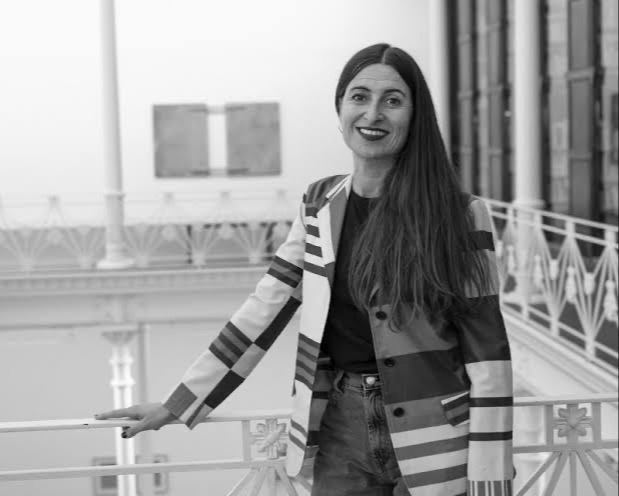
Reviewing established narratives and formulating new questions are two essential tools for understanding the current direction of the Tàpies Museum. Under the direction of Imma Prieto, the institution works to expand the reading of the artist's legacy beyond the visual dimension, integrating research, the study of his texts, interdisciplinary dialogue, and openness to new audiences. The goal is to position Tàpies in a living conversation with the present, reaffirming that the weight of a museum is measured, above all, by its ability to activate contemporary thought and not just by the exhibitions it shows.
In this interview with Ricard Planas Camps, Prieto explains the conceptual and structural transformations she is promoting at the museum, including strengthening research, creating a new editorial line, and the autonomy of the Education and Public Programs departments. She also addresses the need to rethink the museum institution, recover a more organic and community-oriented dimension, and question the barriers that still hinder citizens' access to cultural spaces.
The conversation also delves into a contemporary reading of Tàpies, from his symbols and relationship with urban culture to the possible connection between some works from the late 1980s and early 1990s and the context of the AIDS crisis. A perspective that claims the autonomy of the artwork in relation to the intentions of its creator and invites discovering meanings that may not yet have been sufficiently explored.
Rethinking the Museum from Research
Ricard Planas. If you had to make a first assessment of your period at the Tàpies Museum, which aspects would you particularly highlight?
Imma Prieto. One of the elements I consider most differentiating compared to previous stages is the emphasis and reinforcement of research. Research that we approach from different perspectives: on Tàpies, on the collection, and on the questions we can pose in front of a finite archive. The images are what they are, and I cannot change them. What I can transform are the questions we address to them.
That is why we have reflected a lot on the institution's objectives and on how to address different audiences. I am interested in opening new readings and narratives around the stories constructed about Tàpies and his imaginaries. I also want to highlight the importance of his written legacy, which has often been relegated to a second plane compared to his visual production.
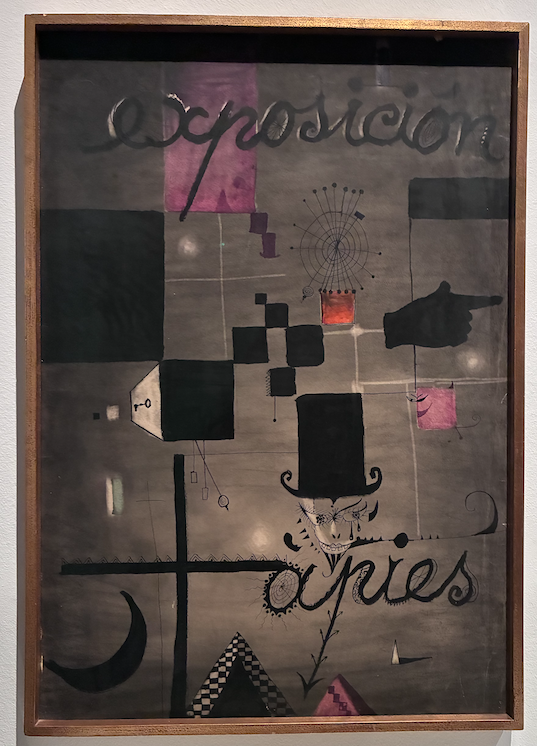
In this sense, one of the priorities is to strengthen the identity of the Tàpies Museum as an author's museum. The change in denomination, from foundation to museum, responds to three reasons. The first is practical: the word museum facilitates communication with the public. Everyone knows what a museum is, while a foundation can have very diverse purposes.
The reality is that Tàpies does not yet have the same degree of popular recognition as Picasso or Miró. His name has become blurred, and I have found myself in a situation where an important part of young people do not know who he was. If this happens here, it is even more difficult to reach international audiences. Therefore, we need clearer communication and a more defined institutional identity.
The second reason is that we are, indeed, a museum: we have a collection, organize exhibitions, carry out research, and develop educational and public programs. A foundation can have very different objectives. Additionally, there is a certain association between foundations and economic potential that does not correspond to our reality. We are an institution with limited resources and significant dependence on public funding.
The third reason is more conceptual. There is often talk about the crisis of the museum, especially of the accumulative and contemplative model inherited from the Enlightenment. But I am not worried that the museum is in crisis. On the contrary, I think crisis gives us the opportunity to question ourselves, review our practices, and imagine other ways of operating.
Can this idea of crisis also be understood as an opportunity to recover a more lively and organic dimension of the museum?
Absolutely. If we understand that the museum is at the service of society, we must assume that this society is a living organism, in constant transformation. Whether we talk about a large city or a smaller town, the community changes and the institution must have the capacity to listen to these changes.
There is also a historical issue that particularly interests me. When we talk about the concept of the museum, we usually refer to the European Enlightenment model, but this is a partial reading. The origin of the museum as we know it can be related to the Mouseion of Alexandria, in North Africa. The library of Alexandria was only a part of it. That space was also a place where philosophers and poets lived, where people ate, talked, shared knowledge, and sought advice.
I am interested in recovering this broader and more organic dimension of the institution. It is not simply about making a museum where people can sleep or live, but breaking the strictness of an excessively contemplative model. The museum must recover its full potential as a space for thought, exchange, and knowledge production.
Audiences and the Right to Culture
One of the great questions of contemporary museology is the distance that still exists between museums and part of the public. What do you think has failed? Is it a problem of discourse, language, or the very conception of the museum space?
I believe that during the 20th century very important transformations have occurred in how free time and cultural practices are understood. At a certain point, certain social classes were given more time to devote to culture and visiting museums. But progressively, the ways of occupying leisure time have changed.
I would like us to ask a question when someone says they don't have time to go to a museum: how many hours do they spend on social media? Perhaps if part of that time were dedicated to visiting an exhibition with their children, the relationship with culture would be different. Obviously, we cannot analyze contemporary practices without some temporal distance, but it is an issue we should address.
I also believe we need to talk about economic access. When we travel, we often accept paying an entrance fee of twelve or fourteen euros to visit a museum without questioning it. But we must not forget that the local public has a different relationship with the institutions in their territory. I defend that citizens' access should be practically free because we are talking about public institutions that, in some way, have already been paid for by citizens through their taxes.
It is a matter of public responsibility. We must guarantee that museums are accessible spaces and are not perceived as places reserved for certain social sectors.
Does the location of the Tàpies Museum also condition this relationship with the public?
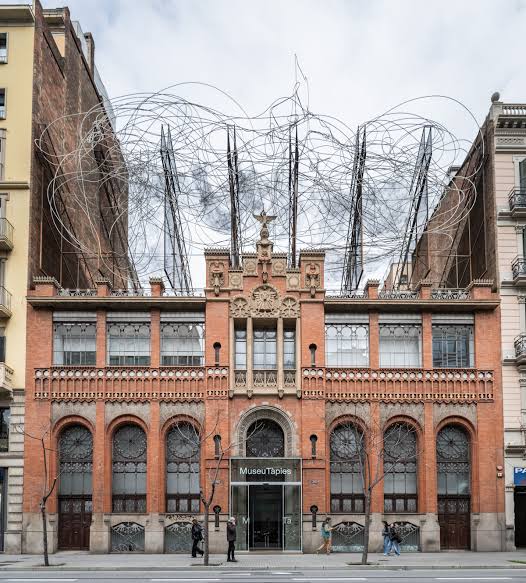
Undoubtedly. Our urban situation is complex. We are very well located, but Aragó street is a busy road with a lot of traffic, noise, and constant movement. We do not have a square in front or a public space that facilitates spontaneous approach, as other museum institutions in Barcelona do.
This conditions the activities we can develop. We cannot easily propose a performance that begins in the street or an intervention that needs to occupy the sidewalk. The relationship with public space is very different from what other museums may have.
We also need to better analyze our audiences. Since I arrived, we have greatly strengthened activities aimed at the local public, especially from the Departments of Education and Public Programs, and we have noticed a significant increase in this audience. The tourist visitor usually arrives through exhibitions, while someone who lives here can participate in a three-day seminar, a lecture, or a continuous activity.
However, we need a deeper analysis to understand what is happening with museums and visiting habits. It is a topic I have also discussed with other directors, such as Valentín Roma of the MACBA, because I believe we should work together on this transformation.
In this context, economic resources are also decisive. The rising costs of transport, insurance, and exhibition production are greatly affecting the sector.
Yes, transport costs are enormous. There are also difficulties with tenders and the companies that must provide these services. Sometimes a tender remains unawarded, which forces an increase in amounts. The geopolitical reality also has direct consequences on exhibition logistics.
We ourselves face this situation in international projects. On November 30th, we inaugurate a Tàpies exhibition in India, within the framework of the Spain-India Dual Year. It is a project that aims to explore the influence of Zen thought on the artist's work, establishing a conceptual route between India, China, and Japan. We are interested both in the philosophical dimension and in the possibility of constructing a tour that makes sense territorially and culturally.
But obviously, current circumstances complicate transport and international routes. Geopolitics also ends up entering into museum programming.
TÀPIES, A GAZE THAT TRANSCENDS ART HISTORY
One interesting aspect of the new stage is the desire to have Tàpies engage in dialogue with thinkers from other disciplines. How is this openness structured?
We have wanted to create a working structure in which each department has autonomy and can develop its own programs. This means that both Education and Public Programs do not depend exclusively on the exhibitions we have at any given moment. There are stable lines of work.
Regarding research, we are interested in Tàpies being read from perspectives that are not necessarily those of art history. We have counted on Carmen Pablo from the University of Girona, Valentín Roma, and Josep Ramoneda, among other voices. The first invited guest was anthropologist Rita Segato. Afterwards, we wanted to incorporate a perspective closer to the thought of the image, with Georges Didi-Huberman, who was invited to Barcelona in residence.
The idea is that thinkers from various disciplines can rethink Tàpies from their own fields of knowledge. We also plan to invite someone from physics or quantum physics. We are interested in these contemporary perspectives that reach Tàpies from unexpected places.
This is less an invitation to write about an artist and more a proposal for different thinkers to confront his universe and relate it to the issues of our time.
This desire to generate new readings also translates to publishing. You have created a new editorial line with three collections.
Yes. We have created a new editorial line structured into three collections. The first is dedicated to recovering and republishing Tàpies's essays. There are six of them, and some had been out of print for over fifty years. This situation explains to what extent his written thought had been out of circulation. The Practice of Art, for example, had not been published since the 1970s.
The second collection is linked to the International Prize, while the third gathers works and reflections arising from our seminars, conferences, and congresses, with authors from different disciplines.
We have opted for small and inexpensive formats, which are also accessible to students. Art catalogs tend to be more expensive, and that can become a barrier. We want these publications to be a tool for thinking, reading, and reapproaching Tàpies from different perspectives.
There is also a performative and sound dimension in the public programs, with proposals such as Following the Sun and Tàpies's Chairs.
Exactly. These are programs that allow us to work on different aspects of Tàpies's universe through word, sound, performance, and the body. We are interested that his symbols and forms are not locked within painting but can activate other languages.
Tàpies's symbols have a very contemporary dimension. They are timeless because they continue to acquire meanings over the years. They also have a very urban nature. Their typography, the way the signs are constructed, and the relationship with the surface make some of these elements look perfectly like a current graffiti.
To me, a symbol is universal precisely because it does not exhaust its meaning. It continues generating new readings without losing the previous ones.
ARTWORK BEYOND THE ARTIST'S INTENTION
If you had to raise an issue you still consider pending in the international projection of Tàpies, what would it be?
I think we need to update the discourse and position his work in relation to the major events and concerns of his time. There is a matter that particularly interests me: what was happening in the world when Tàpies made certain works in the late 1980s and early 1990s?
I have always thought that a work of art goes beyond the explicit will of the artist. If it were otherwise, we would probably be talking about craft but not necessarily about a work of art. A creation responds to a specific historical space and time. Sometimes, it even incorporates issues the artist is not aware of expressing.
We all carry within us an amount of information that conditions how we respond to the world. Very often that information is implicit, not explicit. When I look at certain works by Tàpies from the late 1980s and early 1990s, with varnishes, materials, and representations of the body, I cannot help but think of the AIDS crisis.
It is a connection that interests me to investigate. There is an abject dimension, in the sense developed by Julia Kristeva, that appears in these works. Disease, the body, vulnerability, and the social transformations of that moment can offer a new perspective for reading that imaginary.
It is not about affirming that Tàpies was directly representing AIDS but about investigating to what extent the historical and social context may have been incorporated into his work. It is a line I would like to develop in a future museum exhibition, from our contemporary perspective.
In this sense, Tàpies's figure is also difficult to classify within the traditional categories of art history. His relationship with informalism, abstraction, and figuration is much more complex than often explained.
Yes, and I think it is important not to speak of informalism in a too generic way. It is a movement that appears after World War II and is deeply connected to the social and moral breakdown left by the conflict. Here, it is interesting to recover Adorno's reflection on the impossibility of continuing to make poetry after Auschwitz.
The underlying question is how we can trust humans and reason again after having seen what we are capable of in the name of that very reason. There is a need to return to a primitive or infantile point but in a fully conscious way. And, as these forms are worked on, horror also emerges.
We can think of artists like Millares, Saura, or Tàpies, who belong to a generation very aware of the social breakdown of their time. Informalism is not simply a formal matter or an investigation of material: it is also a response to a historical experience.
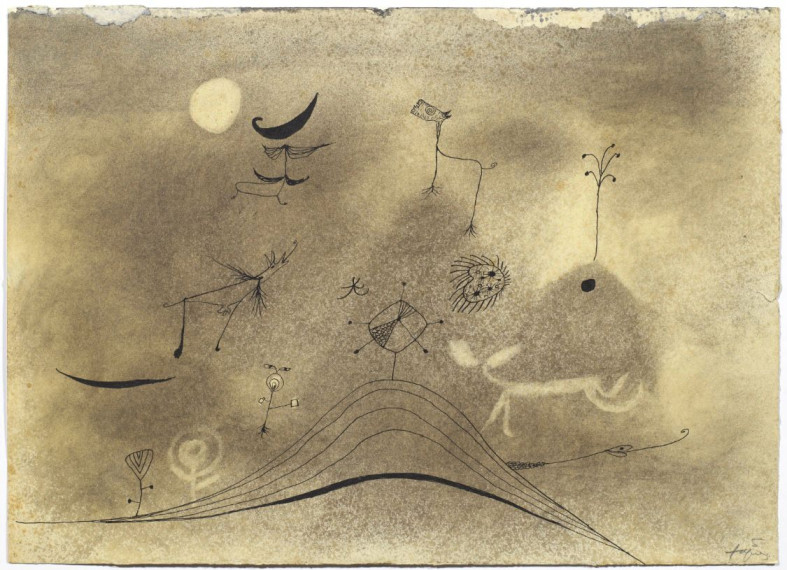
But this break with academicism and representation also coexisted with other artistic discourses with more political and figurative character. In some contexts, abstraction was defended as a form of rupture, while in others it served to displace discourses of a more social or realist character.
Yes, and here we must take political contexts into account. At certain times, dictatorships used certain artistic forms to the detriment of others. There were also movements that defended a more direct and committed representation, such as Estampa Popular.
But in Tàpies's case, I think it is especially difficult to establish a rigid division between figuration and abstraction. He participates in both dimensions and uses them very freely. He explained this many times throughout his life. His work incorporates signs, bodily references, materials, and elements that can have a figurative reading but at the same time builds a language that overflows any classification.
It is also worth remembering that the very concept of informalism has been questioned. We cannot reduce that entire generation to a single label. There was a diversity of practices and positions, as well as a very fruitful dialogue between Europe and South America, especially with countries like Colombia and Brazil.
In short, Tàpies is a figure very difficult to box because his language incorporates different codes and relates them. This is also one of the reasons why returning to him remains so productive: his work is not locked into a definitive interpretation.
An Institution That Speaks from the Present
In this new stage, it seems your goal is not only to reclaim Tàpies but to use his legacy to think about issues that affect us today.
Tàpies is our starting point and our sign of identity, but what really interests me is the present. I want the museum to be an institution capable of opening questions, incorporating other disciplines, and generating knowledge from its collection and legacy.
We cannot limit ourselves to explaining over and over who Tàpies was or repeating known discourses. We have to put his work into circulation, make it dialogue with other thoughts, and understand what it can tell us today.
That is why we have reinforced research, created new editorial tools, and given autonomy to the different departments. We want the museum to be a space for work, debate, and relation with society. Tàpies's legacy is not a closed reality: it is a possibility that continues to open up to new interpretations.

You may be
interested
...