Exhibitions
De Chirico and Metaphysics turn Rome into a timeless setting
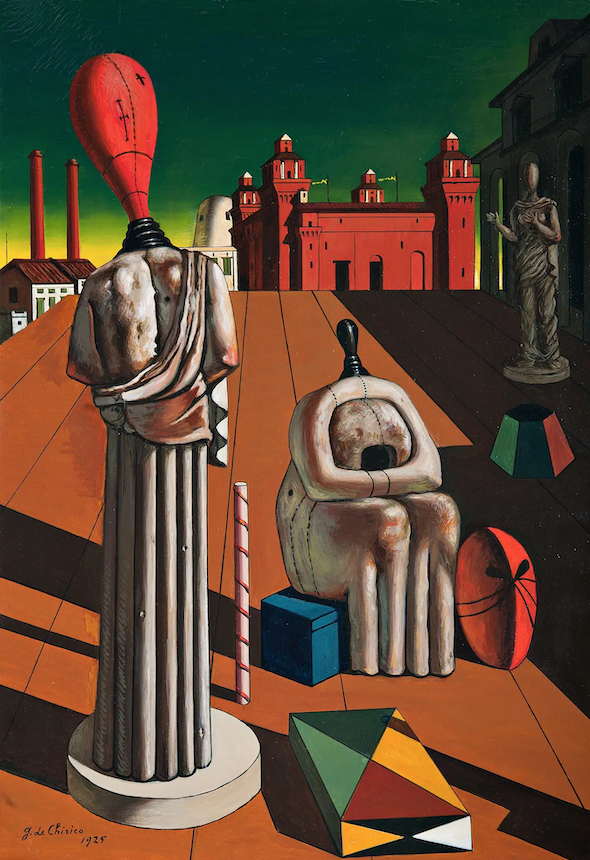
The Galleria Nazionale d’Arte Moderna e Contemporanea (GNAMC) in Rome dedicates an exhibition to Giorgio de Chirico and the relationship of his artistic universe with the eternal city. Under the title De Chirico e la Metafisica, the exhibition, which can be visited from October 20, 2026 to March 21, 2027, offers an approach to one of the most unique and influential movements of 20th-century art, situating Rome as one of the essential settings for understanding the construction of the metaphysical imaginary. Curated by Renata Cristina Mazzantini, director of the institution, the exhibition establishes a dialogue between ten important works from external loans and the museum’s permanent collection, also incorporating architectural documentation, drawings, and period photographs.
The project proposes a new reading of the metaphysical holdings of the GNAMC itself, highlighting the quality and diversity of an artistic body that serves as a reference for approaching this current of the Italian avant-garde. To this core are added works from the Museo del Novecento, the Grande Brera and Casa Boschi Di Stefano in Milan, the Museo Bilotti in Rome, and various private collections. The route also includes selected photographs from the archives of MAXXI and the Archivio Storico dell’Ente EUR, which expand the view towards the architectural and urban dimension of metaphysical culture.
At the center of the exhibition is Giorgio de Chirico (1888-1978), a fundamental figure in European painting and the main promoter of metaphysical painting. His artistic career was marked by a search for the enigmatic and the invisible, which found some of its most recognizable motifs in urban spaces, architectural perspectives, and everyday objects. Deserted squares, arcades, towers, statues, mannequins, and elongated shadows configure a visual universe in which reality seems to detach from its usual meaning to acquire a mysterious and suspended dimension.
Born in Volos, Greece, into an Italian family, De Chirico developed a training and sensibility deeply linked to European classical culture. His stay in Munich, where he came into contact with Nietzsche’s philosophy and Arnold Böcklin’s painting, was decisive in shaping his artistic language. Later, in Paris, he established contact with the avant-garde and found recognition in the artistic circles of the time. His painting, however, took its own path, away from the formal experimentation of other modern movements and oriented towards a disturbing representation of reality.
Alongside Carlo Carrà, Giorgio Morandi, and Alberto Savinio, among others, De Chirico contributed to defining the horizon of metaphysical painting, an artistic experience that proposed looking beyond the immediate appearance of things. His compositions, constructed through impossible perspectives, unexpected associations, and silent atmospheres, anticipated some of the concerns that would later resonate in surrealism. His influence extended through various generations of artists, consolidating one of the most personal contributions to pictorial modernity.

You may be
interested
...