News
A digital lantern to recover the silenced voices of history
UPF promotes Resurrection. A hymn to freedom of conscience, an interdisciplinary project that combines augmented reality, interactive art, and music to reconstruct the memory of dissident figures repressed in late 19th century Catalonia.
Historical memory finds in new technologies a way to recover narratives that have been left out of official history. With this aim, Resurrection. A song to the freedom of conscience is born, a project led by Pompeu Fabra University (UPF) that proposes an artistic and immersive experience to reclaim the legacy of figures linked to republican, spiritualist, theosophical, and Masonic movements of the late 19th century.
The initiative focuses on two unique trajectories: that of the Catalan military doctor Francesc Parés Llansó and that of the Cuban medium María Macías Pons. Their lives, linked to heterodox circles of thought in Barcelona, Mahón, and Figueres, allow a deeper understanding of the forms of cultural and intellectual dissent in an era marked by the repression of freedoms of conscience. Their memory is also marked by excommunication and, in the case of subsequent persecution during Francoism, by the actions of the Special Tribunal for the Repression of Freemasonry and Communism (TERMC). The project also includes a specific perspective on the role of women in the cultural heterodoxies of the period.
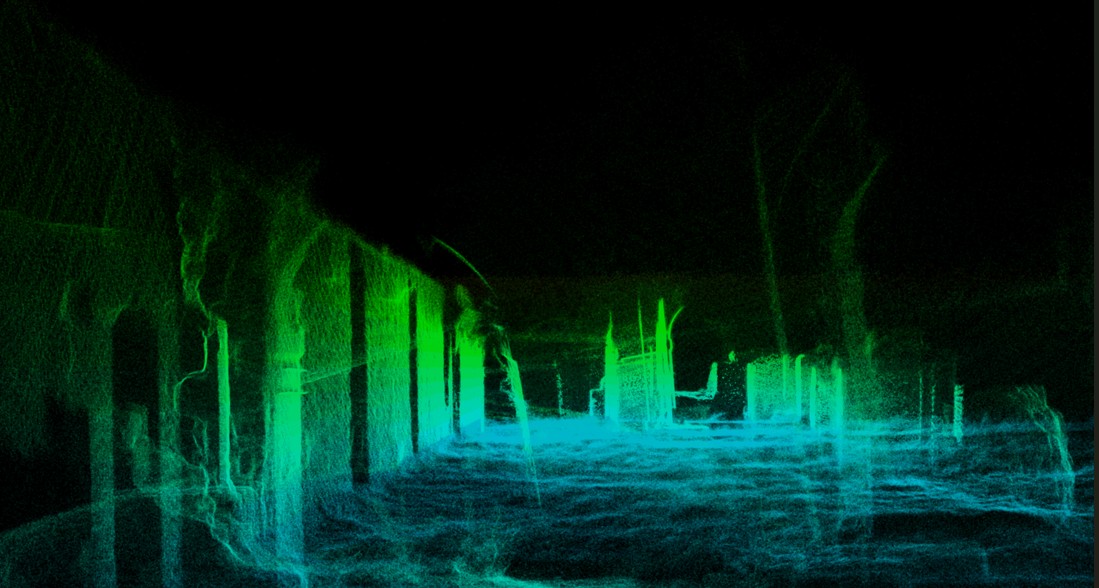
The proposal combines documentary and archival research with digital creation, augmented reality, interactive art, and musical composition. Far from proposing a hyperrealistic historical reconstruction, those responsible have developed their own audiovisual language that works with presence and absence. Through motion capture technologies and heritage space reproductions, the images transform into audioreactive point clouds that respond to the music and evoke, from a poetic dimension, the traces of a silenced past.
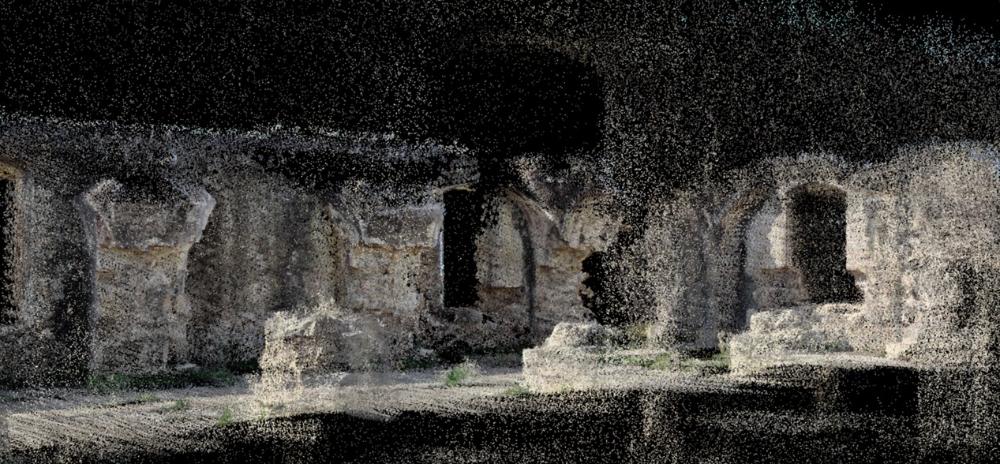
Capture of three-dimensional point clouds of the ruins of the hospital of the Castle of Sant Ferran (Roc Parés, 2026).
The music, composed by Laura Farré Rozada, pianist and mathematician, with the support of the Phonos Foundation, does not function as a mere sound accompaniment, but constitutes a structural part of the experience. The relationship between image and sound is bidirectional: the composition modifies in real time the density, color, and arrangement of the geometric points, while visual perception also conditions the musical interpretation. In this way, technology serves a narrative that seeks to activate new ways of perceiving and interpreting memory.
One of the central elements is the so-called Augmented Reality Magic Lantern (AR Magic Lantern), a system developed by the Full-Body Interaction Lab (FuBIntLab) group, from the UPF Department of Engineering. These devices allow projecting digital content directly onto the physical and architectural environment, which becomes an active part of the narration. The result is an interactive and mobile mapping experience that adapts to the characteristics of each heritage space and has an approximate duration of thirty minutes.
The project began last April and is currently in a ten-month development phase. After the first pilot tests, dissemination and public exhibition are planned through a traveling route across different heritage spaces. The first presentations are expected during 2027 at the ruins of the former hospital of the Castle of Sant Ferran in Figueres, with the collaboration of the Empordà Museum.
Artistic direction and main research are led by Roc Parés Burguès, a pioneering artist in interactive art and virtual reality in Catalonia and researcher of the DigiDoc group of the UPF Department of Communication. Technological direction is the responsibility of Narcís Parés Burguès, director of FuBIntLab, while technical development falls to Francisco Macía Varela, XR technologies specialist from the same laboratory. Musical composition and sound production are the work of Laura Farré Rozada.

You may be
interested
...