Exhibitions
María Villa returns to the spotlight
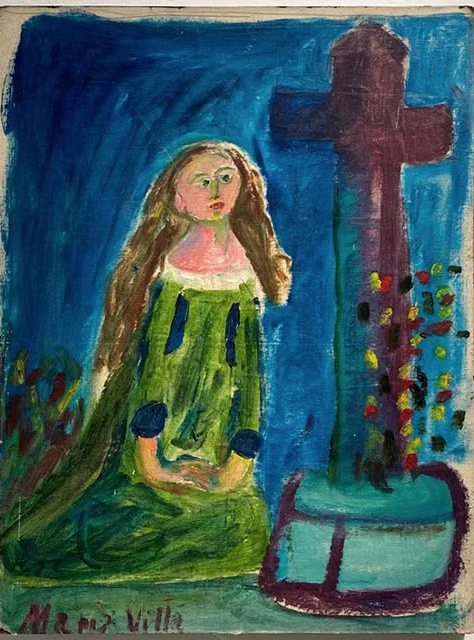
The Carlos Orozco Gallery presents "Returning to María Villa ," an exhibition featuring around one hundred works that revisits the career of a self-taught painter whose work has been largely reduced to the label of "primitivist" for many years. The exhibition is curated by Raúl Zuleta, a researcher of her work, along with Carlos Uribe and Camila Téllez, and will be on view from August 27 to October 31.
María Villa was born on November 16, 1909, in Guarne, Antioquia. Far removed from academic training and conventional art circles, she developed a profoundly personal style of painting, built upon observation, memory, and a unique way of representing the world around her. Her self-taught nature was for a long time one of the main elements used to define her, although it also contributed to placing her in a marginal position within Colombian art history.
His work has typically been included in the sections dedicated to primitivist art, a classification that proves insufficient to explain the richness of his paintings. Contrary to the idea of a naive or almost childlike production traditionally associated with this category, Villa's works reveal a much more conscious construction of space, figures, and the relationships established between them. Their apparent simplicity conceals a vision capable of condensing scenes, characters, and situations charged with tension and meaning onto small surfaces.
Small formats are also an integral part of his artistic identity. Recently, some twenty of his works were presented by the gallery at the Un-Fair art fair in Bogotá, all of them small in size. In Medellín, the exhibition considerably expands this range with a hundred pieces that allow viewers to observe the continuity and evolution of his artistic language.
Raúl Zuleta points out that one of the reasons for this small format is related to the very material circumstances in which the artist worked. Villa used to paint on the leftover canvas scraps from the paintings used by her partner, Federico Vargas. What might have seemed like a limitation ended up becoming a distinctive characteristic of her work. Her small surfaces concentrate a highly intense painting, in which each figure and each element acquires a particularly significant presence.
Revisiting María Villa raises the question of the need to look at her works beyond the categories that have been attached to them. The exhibition not only aims to bring back to light a little-known artist, but also to question the way in which certain self-taught creators have been incorporated into the history of art. In Villa's case, the label of primitivist has allowed her to be placed within a tradition, but at the same time has obscured much of the uniqueness of her artistic language.
His painting moves between the everyday and the symbolic, between recognizable representation and a construction of the world that responds solely to its own rules. There is a desire for synthesis in his compositions that stems not from a lack of resources, but from a particular way of seeing. The figures, spaces, and scenes appear subject to their own logic, far removed from both academic canons and the dominant trends of his time.
The rediscovery of María Villa thus takes on a dimension that goes beyond the exhibition. It means restoring visibility to an artist who developed her work from a peripheral position and who, precisely for that reason, constructed a language difficult to fit into conventional categories. Her painting compels us to reconsider the boundaries between academic and self-taught art, between naiveté and formal awareness, between tradition and freedom.

You may be
interested
...