Exhibitions
Jenny Holzer against silence
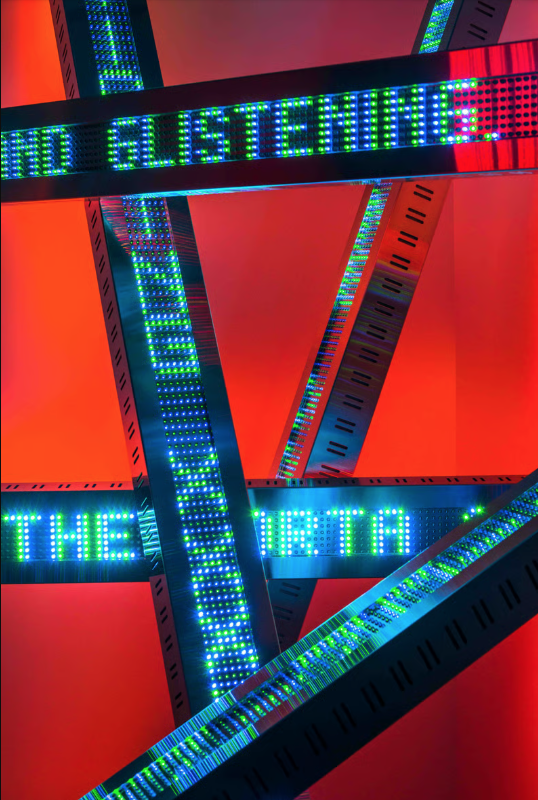
Much of Jenny Holzer's (1950) career has been built precisely around a tension: the capacity of language to reveal what remains hidden, but also to exert forms of violence, manipulation, and censorship. For more than four decades, the American artist has placed the text at the center of her practice, displacing it from traditional art spaces and introducing it into the streets, buildings, advertising media, and public communication channels.
The Serralves Museum and Library presents Wrong Answers , Holzer's first solo exhibition in Portugal, a show that traces the evolution of one of the artists who has most radically explored the relationship between word, image, and public space. The exhibition, open until January 3, 2027, brings together different moments in a career that began with the celebrated Truisms and Inflammatory Essays , works in which short, forceful, and deliberately ambiguous phrases questioned the ideological and social certainties of her time.
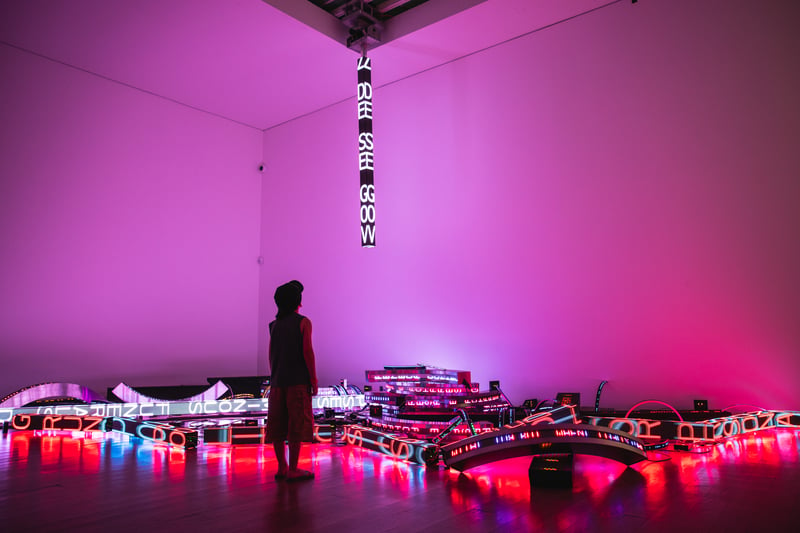
Holzer's capital letters have become one of the most recognizable images in contemporary art. His phrases have appeared projected onto facades and monuments, scrolling across electronic panels and occupying urban spaces worldwide. Rather than confining himself to institutional art circuits, Holzer has used the same channels employed by advertising, propaganda, and official communication to introduce messages capable of altering their meaning and provoking critical reading.
Her work thus moves between visibility and concealment. Over the years, the text has evolved from posters and urban interventions to stone, paint, sculptural installations, and electronic media. In Wrong Answers , this expansion of media allows us to observe how the same concern runs through different stages of her production: who controls the words, who decides what can be made public, and what mechanisms come into play when information is silenced.
One of the central themes of the exhibition lies precisely in the forms of censorship and erasure. Holzer appropriates government documents subjected to classification and redaction processes, transferring to painting what was originally conceived to conceal information. The black areas that prevent the reading of certain fragments cease to be merely an absence and acquire their own visual presence. The censored document is thus transformed into an image of the impossibility of accessing a part of the truth.
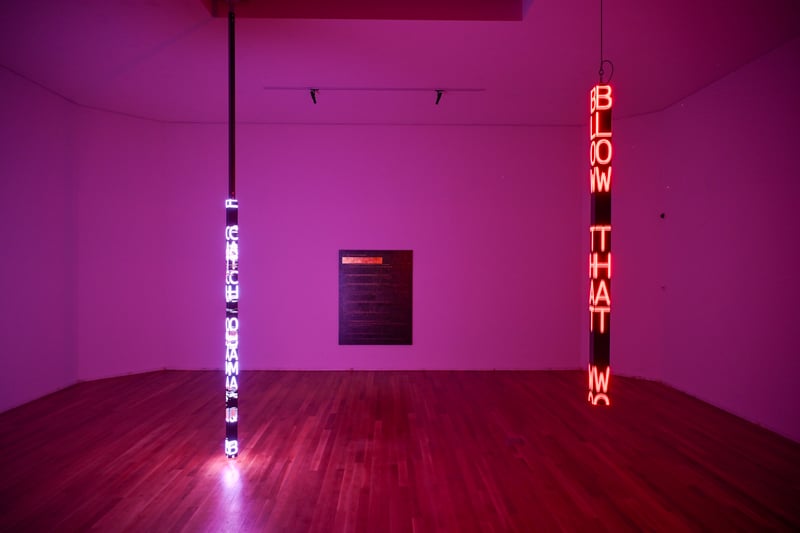
This tension between word and disappearance also appears in the artist's own sculptures. Stone benches and sarcophagi, elements that evoke permanence and memory, coexist with fragmented and piled-up works, while LED panels introduce the changing and almost immaterial dimension of contemporary communication. Even the use of human bones reinforces the relationship between language, memory, violence, and death.
The exhibition's title, Wrong Answers , introduces a significant paradox. Wrong answers don't simply refer to error, but also to a context in which the proliferation of messages can ultimately neutralize their meaning. The saturation of images, headlines, slogans, and content in contemporary media generates a constant flow of information in which words can acquire an extraordinary capacity for impact and, simultaneously, lose their ability to communicate.
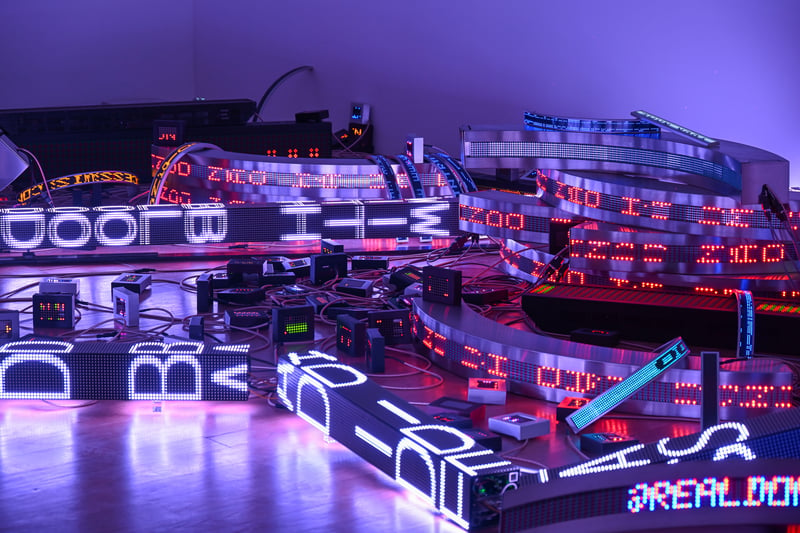
Holzer works from this contradiction. Her texts can appear as a resounding statement, but also as an open question. They can denounce violence and, at the same time, show how institutional language can conceal it. They can occupy a public space to make themselves visible and resort to erasure to point out what cannot or will not be seen.
The exhibition thus presents a journey through an artistic practice that has never understood language as a neutral element. For Holzer, words have a body, occupy a space, and produce consequences. They can transform a facade into a site of political confrontation, turn an official document into an image of censorship, or make a seemingly simple phrase acquire a poetic and unsettling dimension.

You may be
interested
...