News
Viterbo lights its 'walking bell tower' in honor of Saint Rose
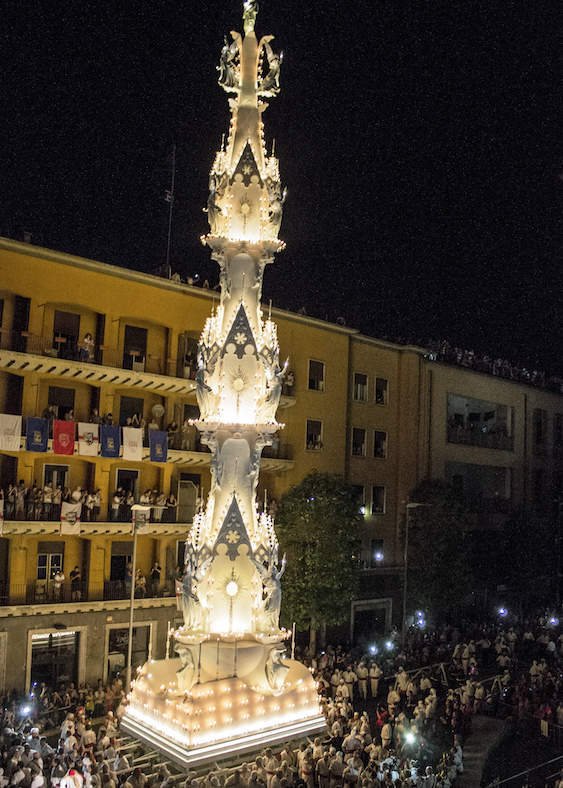
Every September 3rd, as night falls on the town of Viterbo, the Italian city transforms into the stage for one of Europe's most unique celebrations. From the vicinity of Porta Romana to the Sanctuary of Santa Rosa, a monumental illuminated tower slowly makes its way through the streets of the historic center, carried on the shoulders of a hundred men. This is the Macchina di Santa Rosa, a tradition that combines religious devotion, collective memory, craftsmanship, physical exertion, and spectacle, and which, since 2013, has been part of UNESCO's Intangible Cultural Heritage of Humanity.
The ceremony takes place on the eve of the feast of Saint Rose, patron saint of Viterbo. Its origin dates back to an ancient tradition linked to the transfer of the saint's remains from the church of Santa Maria del Poggio to the church of San Damiano, where the sanctuary dedicated to her is now located. The first documented reference to the celebration of the Macchina dates from the 17th century, and over time, this religious event grew to increasingly monumental proportions.
The centerpiece is an ephemeral structure conceived as a gigantic bell tower, although it is not actually a conventional tower. A competition is held periodically to design a new Macchina, and for decades the model has been renewed approximately every five years. The current version, Dies Natalis, was designed by architect Raffaele Ascenzi and began its transport cycle in 2024. Standing 33 meters tall, it represents the birth and life of Saint Rose through a vertical composition of figures and symbols.
Its construction is also a demonstration of engineering and contemporary craftsmanship. Lighter and stronger materials were used for Dies Natalis, allowing for extraordinary dimensions to be maintained within the strict safety limits established for transport. In 2026, the structure underwent the traditional weighing test before its departure and registered 5,071 kilograms.
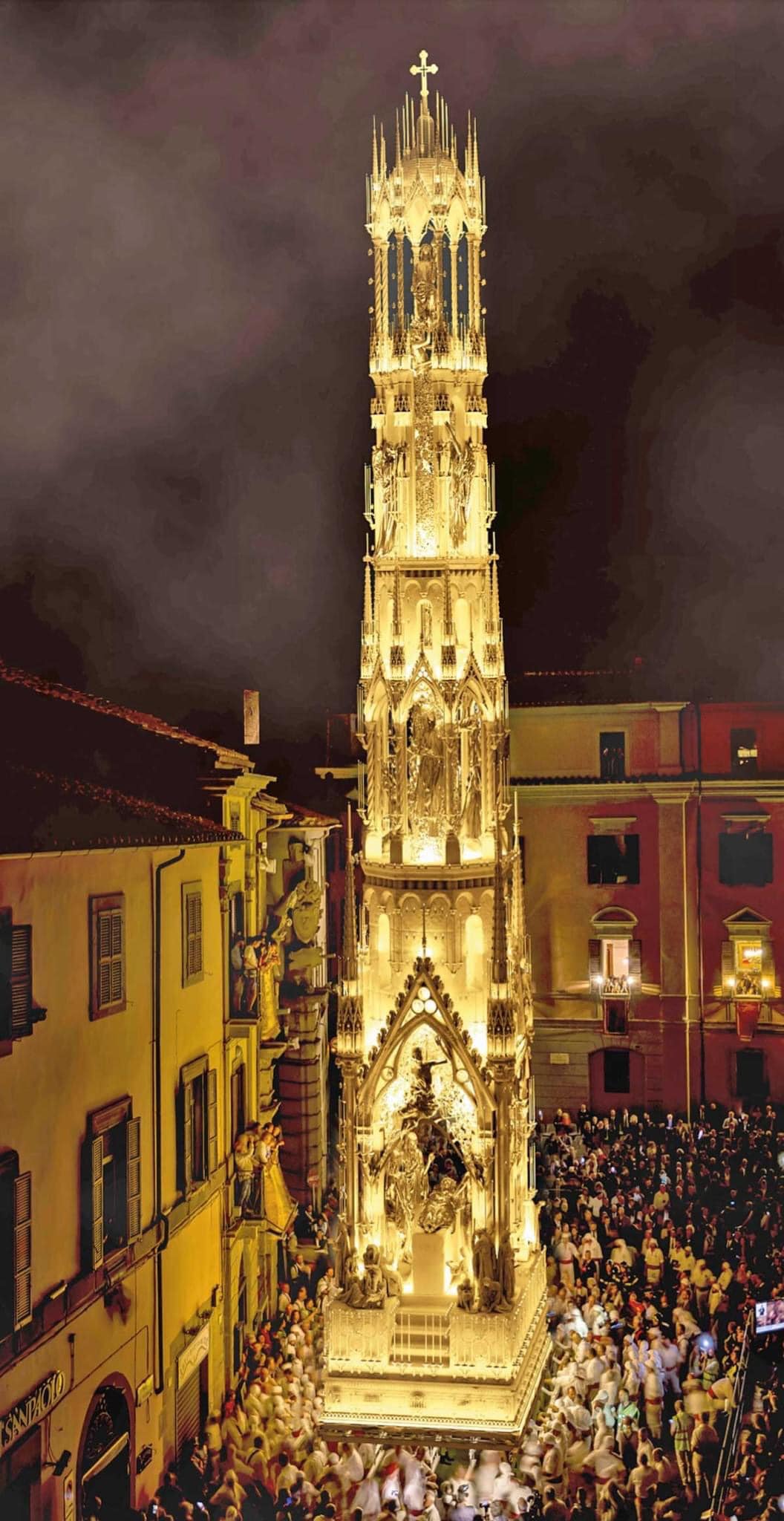
But the true strength of the celebration lies in the facchini di Santa Rosa, the men responsible for supporting and advancing the structure. Dressed in white, they form a community closely linked to tradition and ritual. Beneath their shoulders rests a tower that can exceed thirty meters in height, its weight concentrated on a human formation that must coordinate every movement with absolute precision. The capofacchino's command, "Sollevate e fermi!" —"Lift up and stay still!"— marks one of the essential moments of the ceremony.
The procession begins in Piazza San Sisto, next to Porta Romana, where the Macchina is assembled before the celebration. Starting at nine o'clock in the evening, the structure begins a journey of just over a kilometer through the streets of the historic center until it reaches the Sanctuary of Santa Rosa. The route includes several stops at emblematic points of the city, including Piazza Fontana Grande, Piazza del Plebiscito, Piazza delle Erbe, Corso Italia, and Piazza Verdi. The pauses allow the falchini (carriers) to rest and regain their strength, but they are also part of the ceremonial language of the event.
During the procession, the streets remain almost entirely dark, and the illumination of the Macchina itself takes center stage. Thousands of tiny lights transform the structure into a luminous apparition that seems to move above the crowd. This is why the people of Viterbo also call it the "campanile che cammina," the walking bell tower. The darkness is not merely a theatrical device: it allows the tower to become the absolute focus of attention and accentuates the almost supernatural character of the procession.
The climactic moment arrives in the final meters. After traversing the city center streets, the pallbearers face the final stretch to the sanctuary, where the Macchina arrives at the tomb of Saint Rose. There, a journey that demands an extraordinary combination of strength, balance, discipline, and coordination comes to an end. What may appear to the spectator as a spontaneous marvel is, in reality, the result of a complex collective organization and knowledge passed down from generation to generation.
It is precisely this communal dimension that explains its international recognition. In 2013, UNESCO included the celebrations of the large processional floats carried on the shoulders of men in Italy, which bring together the traditions of Viterbo, Nola, Palmi, and Sassari. In the case of Viterbo, the organization highlights not only the spectacular nature of the Macchina, but also the cooperation among the participants, the transmission of knowledge and techniques, and the sense of shared identity that the celebration generates.



You may be
interested
...