Exhibitions
Fifty years against time
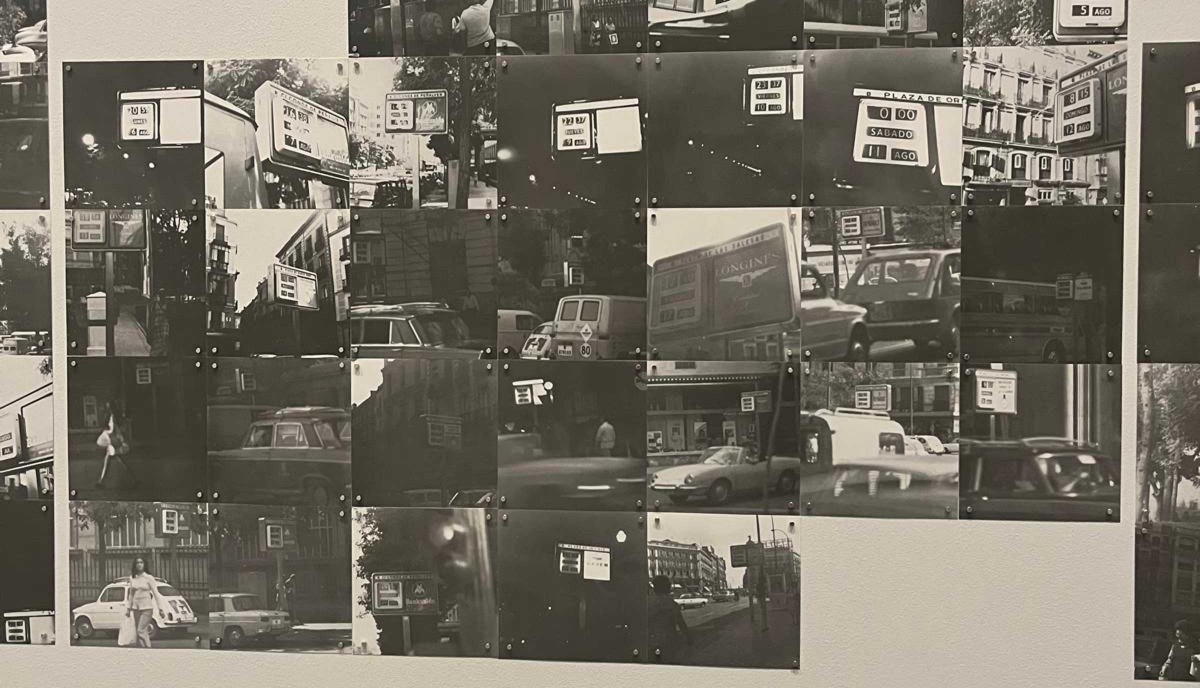
Fifty years can be a measure, a memory, or an artistic subject. For Isidoro Valcárcel Medina, they are also a starting point. The artist from Murcia, one of the essential figures of Spanish conceptual art, returns to Buenos Aires in 2026, exactly half a century after his first exhibition in the city, to present El transcurrir (The Passage ), a project conceived specifically for this return.
The exhibition occupies Room 13 of the Recoleta Cultural Center and comprises 50 panels, accompanied by an introductory sheet, that symbolically trace each of the years since that first visit to Argentina to the present day. The number serves not only as a chronological reference but also as the structure of a work that invites us to reflect on what is normally invisible: the very passage of time.
Curated by Ferran Barenblit, "The Passage" was organized by the Cultural and Scientific Office of the Embassy of Spain in Argentina, the Spanish Cultural Center in Buenos Aires, and the Recoleta Cultural Center. The project deliberately departs from the logic of retrospectives or commemorations to present a new work, constructed from the distance between two historical moments.
The starting point is July 1976. At that time, Valcárcel Medina presented Personal Practices of Artistic Performance in Buenos Aires, an exhibition organized at the Center for Art and Communication (CAYC) at the invitation of Jorge Glusberg. The artist arrived in the city a few months after the coup d'état that had ushered in the Argentine civic-military dictatorship. From there, he continued his tour through Asunción, Montevideo, and São Paulo.
That first experience was marked by a central concern in her career: questioning the relationship between reality and the forms we use to represent it. Fifty years later, that question reappears from a different perspective. The time elapsed between that exhibition and the current one is not presented as a mere interval, but as a territory charged with events, transformations, and new ways of seeing.
The passage of time thus establishes a dialogue between 1976 and 2026 without attempting to reconstruct the past. The work also incorporates the original dossier prepared by the artist after that trip, which serves as a documentary record in relation to the new creation. The encounter between these two materials allows us to observe not only what has changed, but also what remains the same.
Time thus becomes the subject matter of the work. The pieces gathered in the exhibition do not merely seek to record events, but to make their duration and the transformations they produce perceptible. In Valcárcel Medina's practice, the artistic gesture appears linked to everyday experience, to critical observation, and to the capacity to alter our perception of what we take for granted.
The choice of 2026 takes on a particularly significant dimension because of its exact coincidence with the half-century mark. The 50 years are not merely an anniversary: they physically organize the exhibition and function as a tool for questioning the present from a distance. Each panel represents one of those years and, at the same time, raises a question about what it means to make art when the past continues to influence our understanding of the present.
Valcárcel Medina's return to Buenos Aires is not, therefore, a repetition of that 1976 experience. It is rather a conversation between two times separated by half a century. A conversation in which memory does not appear as something closed, but as a still-active material.

You may be
interested
...