Exhibitions
Matisse and Yves Saint Laurent, a dialogue between color, matter and beauty
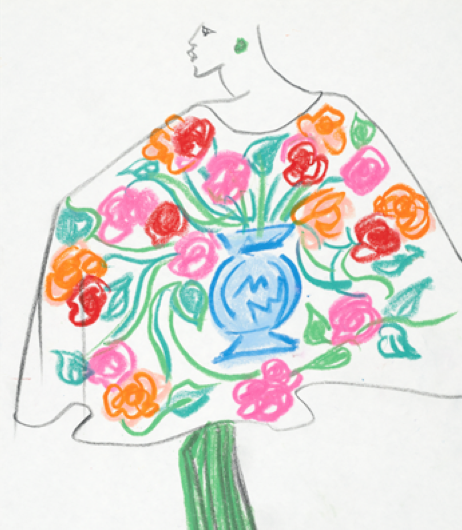
The boundary between fine arts and applied arts has been, for decades, a territory of debate and experimentation. Few creators have contributed as much to blurring that separation as Henri Matisse and Yves Saint Laurent, two essential figures of the 20th century who, from seemingly different artistic languages, shared the same obsession: to transform color, form, and matter into instruments capable of transforming the perception of reality.
The Musée Matisse in Nice will host the exhibition Henri Matisse – Yves Saint Laurent: Beauty, Fashion, and Happiness from June 17 to September 28, 2026. Organized in collaboration with the Musée Yves Saint Laurent Paris, the exhibition proposes a unique dialogue between the work of the Fauvist master and the creations of the designer who revolutionized French haute couture. Curated by Serena Bucalo-Mussely and Aymeric Jeudy, director of the Musée Matisse in Nice, the exhibition brings together approximately 160 pieces from the collections of both institutions, in addition to significant national and international loans.
The proposal does not seek to establish a simple relationship of direct influence—Matisse and Saint Laurent never met—but rather to reveal an aesthetic and conceptual affinity that runs through their respective careers. Both understood creation as a space of freedom where traditional categories lose their meaning and where painting can become fabric, and fashion a form of art in motion.
For Matisse, decorative motifs, fabrics, and prints were not secondary elements, but fundamental tools for constructing a pictorial universe where space seemed to extend beyond the canvas. His interest in the decorative arts, everyday objects, and non-Western visual cultures allowed him to develop a style of painting based on the harmony between lines, surfaces, and colors.
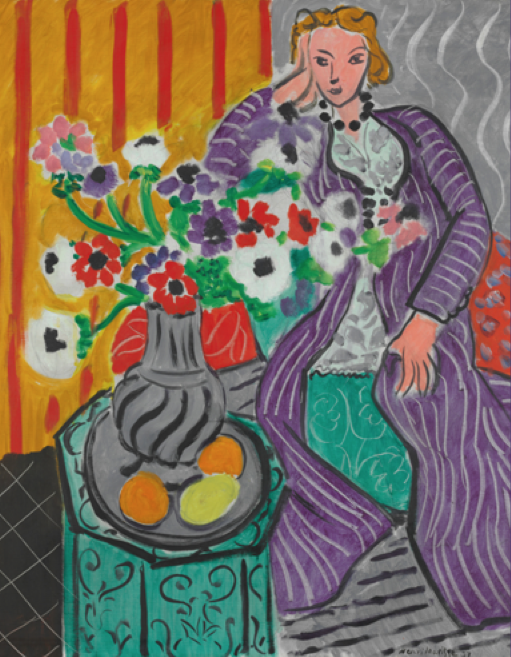
Henri Matisse, Purple Robe and Anemones, 1937 - Baltimore Museum of Art, The Cone Collection, established by Dr. Claribel Cone and Ms. Etta Cone of Baltimore, Maryland - Photo © Mitro Hood.
At Yves Saint Laurent, that same quest found a three-dimensional expression. The designer conceived of the garment as a mobile architecture, a body that occupies space and engages in dialogue with the wearer. Painting was always a constant source of inspiration: from his homages to artists like Mondrian, Picasso, and Van Gogh to the way he used color as a structural element in his collections.
The exhibition highlights that both creators shared the same visual grammar: the importance of drawing as a research tool, the exploration of the body, the relationship between volume and surface, and a conception of color not as mere decoration, but as an emotional and constructive force.
The exhibition brings together haute couture pieces, traditional costumes, paintings, drawings, textiles, accessories, and archival documents, creating an exchange between two mutually enriching creative universes. The silhouettes designed by Saint Laurent engage in a dialogue with Matisse's compositions, revealing how both artists sought a beauty far removed from academic rigidity, based on sensuality, movement, and sensory experience.
More than a comparative exhibition, Henri Matisse – Yves Saint Laurent: Beauty, Fashion, and Happiness prompts reflection on the continuity between art and life. In both cases, creation stems from the same desire: to transform the everyday through a fresh perspective. Matisse took painting into realms where decoration acquired a poetic dimension; Saint Laurent transformed fashion into a cultural language capable of engaging with the history of art.
To coincide with the exhibition, the Musée Matisse will also present a special installation dedicated to the models and figures that inspired the artist, reinforcing a central idea of the exhibition: that behind each work by Matisse and each creation by Saint Laurent there is a deep investigation into beauty, understood not as a superficial appearance, but as a form of knowledge and happiness.
You may be
interested
...