Exhibitions
Archive of a gesture and memory compressed into matter
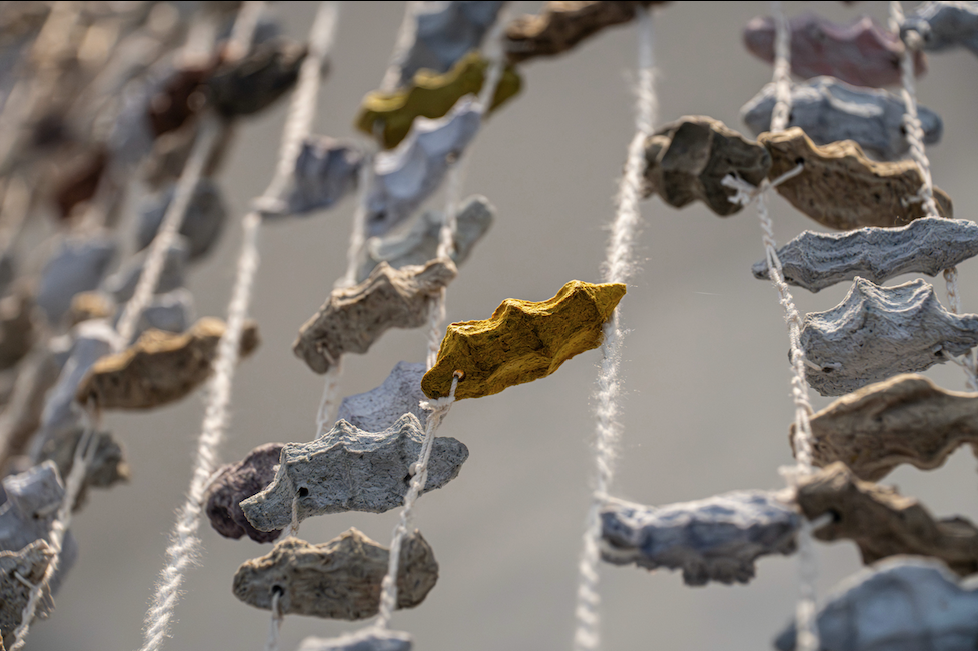
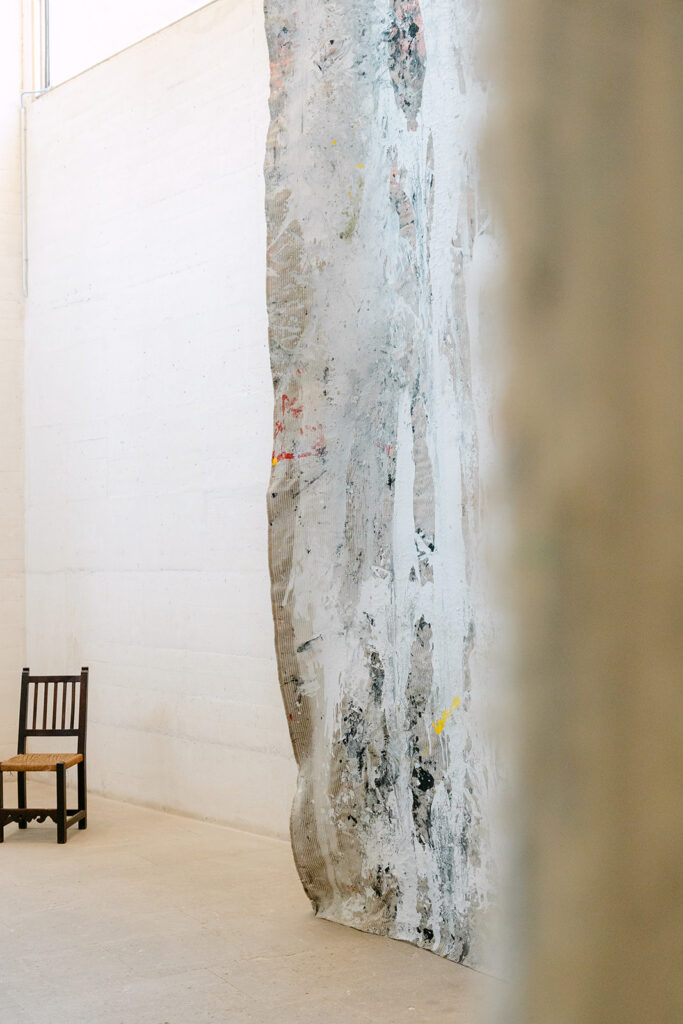
At La Nave in Quito's Contemporary Art Center, artist Pamela Suasti presents Archive of a Gesture , an installation that, from the apparent modesty of a minimal action, unfolds a complex reflection on memory, mechanisms of control, and the political power of the everyday. The gesture that activates the work—pressing a sheet of paper in the hand—might seem elementary, even domestic. However, in Suasti's universe, that pressure becomes a language: a form of inscription where the body leaves a trace and matter becomes a witness.
The piece begins with a simple yet profoundly resonant operation. Each sheet, compressed by hand, retains a unique imprint, a kind of sculptural trace that records the contact between body and surface. It is not merely a physical mark, but a vestige of presence: a sign of time, of strength, of persistence. The artist thus shifts the manual gesture from the realm of the intimate to a collective dimension, constructing an archive where each fragment is singular and, at the same time, part of a larger accumulation.
One of the most significant aspects of the work lies in the choice of material. Suasti works with recycled paper from public offices, a medium previously permeated by administrative logic: documents, forms, files, and procedures that once belonged to the world of bureaucracy. This origin is not anecdotal. On the contrary, it is the conceptual core of the installation. Where rules, control, and the mechanical repetition of the system once operated, the artist introduces a bodily gesture that interrupts this logic and redefines it. The paper ceases to be a mere vehicle for institutional management and becomes a surface of memory, a vulnerable body, a residue transformed by human action.
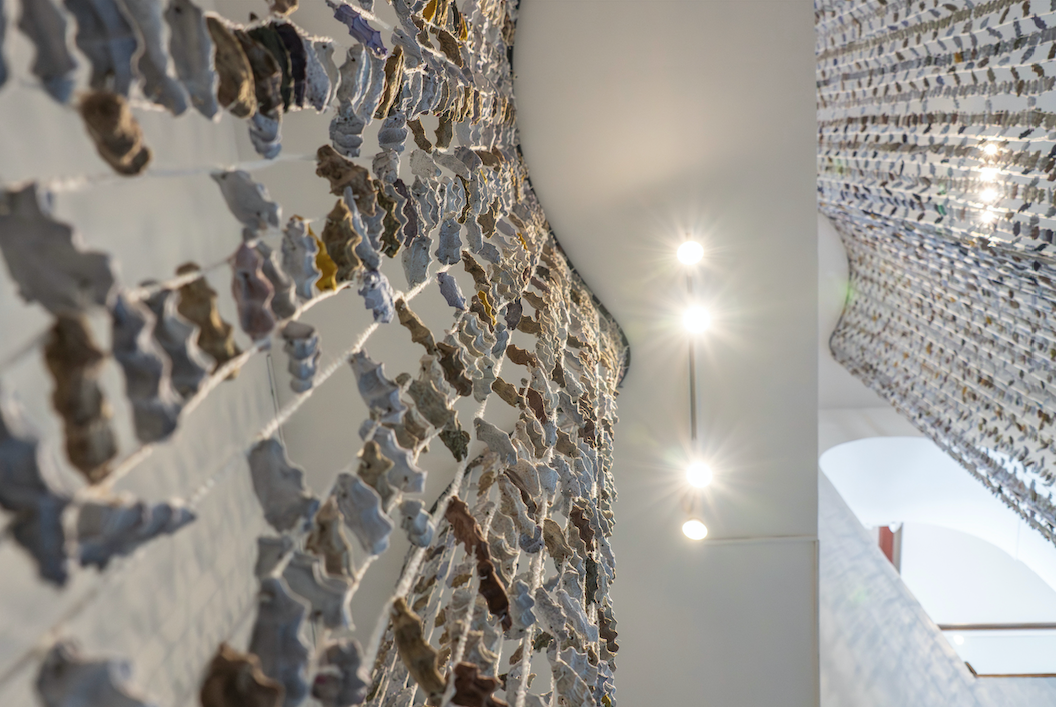
In Archive of a Gesture , repetition does not appear as an empty mechanism, but as a poetic and critical strategy. The accumulation of pressed papers constructs a constellation of traces that alludes both to the modern archive and to ancestral forms of organizing memory. In this sense, the installation evokes Andean quipus, not through a literal quotation, but through a structural affinity: each mark, like each knot, acquires meaning within a broader network, where information is not organized linearly, but relationally. The work thus proposes a reading of memory as an entanglement, as a fabric of scattered signs that only reveal their density within the whole.
This relationship between archive and embodiment is one of the most powerful findings of the project. Suasti doesn't construct an archive to fix or classify, but rather to show how all memory is permeated by fragility, wear, and persistence. Instead of striving for the pristine condition of the document, the artist works with deformation, pressure, and accumulation. What emerges is not an orderly inventory, but a topography of the friction between the individual and the structures that contain them. Each fold and each compression seems to speak of the experience of inhabiting administrative systems that organize social life, but also crush, slow, and homogenize it.
From a critical perspective, the work can be read as a meditation on the silent violence of bureaucracy. Not a spectacular violence, but a more subtle one: the violence of endless procedures, of institutional repetition, of documents that regulate existence until it becomes mere paperwork. In response, Archivo de un gesto (Archive of a Gesture) proposes a low-intensity but highly symbolic response. The hand that grips the paper does not destroy the document: it transforms it. The power of the work lies in this shift. Where the system produces papers as instruments of administration, Suasti returns them to the realm of the senses, reinscribing them as evidence of a human presence that refuses to be entirely absorbed by the logic of the official archive.
The installation also prompts a reflection on scale. The smallest element—a gesture, a leaf, a touch of pressure—multiplies to form a larger, almost organic structure. The work grows through repetition, but it doesn't become mechanized; it expands without losing the singularity of each trace. In this balance between the serial and the unrepeatable, Suasti constructs a poetics of persistence: a way of insisting on matter until matter speaks. The result is a space where the viewer not only observes a collection of pieces, but also confronts a field of forces where institutional memory, manual labor, material wear, and symbolic resistance intersect.


You may be
interested
...