Exhibitions
Sitges Museums. New Stories
An exhibition that unearths hidden memories and opens new perspectives on an artistic heritage marked by diversity, dissidence and freedom of expression.
Pere Parramon, subdelegate of the Government of Spain in Girona, doctor in Art History, critic and writer, university professor, has curated the exhibition New Acquisitions for New Stories 2025.2 , which opened on Friday 5 June in the Rocamora room on the third floor of the Maricel Museum in Sitges. Parramon, together with Laura Cornejo, are the curators of the booklet Queer Aesthetics and Dissent in the Museums of XMAC (2023), a diverse approach with an alternative look at the collections of our local museums.
Now, with the celebration of LGTBIQ+ Pride, the Sitges Museums present an exhibition that highlights new narratives within the artistic and documentary heritage preserved by the Sitges Heritage Consortium. These are works acquired in 2025 and incorporated into the Sitges Museums' collections or deposits from the Art Fund of the Generalitat de Catalunya.
Ocaña's self-portraits are paired with drawings by Nazario Luque, an underground comic artist and painter from the Barcelona of the transition, who was present at the inauguration accompanied by friends and Sitges authorities. Nazario, through the Colors Sitges Link association, was recognized in 2023 with the Pepito Zamora award. You can see The Erotic Cavalcade , the contemporary Saint Sebastian, drawn under the arches of the Plaça Reial, and many other drawings and notes from his celebrated comics, as well as documents from the time that provide social and political context.
The comic Salamandra by artist Roser Oduber is on display, which was part of the exhibition at the Reina Sofia Museum in Madrid ¡Mujercitas del mundo entero, uníos! Autoras del cómic adulto . A revelation and a discovery for the public from Garraf. Roser Oduber is the director of the CACiS in Calders (Moianès), El Forn de Calç Contemporary Art and Sustainability Center, and president of the AAVCC (Association of Contemporary Visual Artists of Catalonia).
The bronze portrait of Vidal Ventosa, by Ismael Smith, opens the itinerary, where there are also drawings of this extravagant dandy, gentleman, who was about to buy the Palau Maricel. The current director of the Sitges Museums, Txema Romero, is a great scholar and specialist in the work of this Smith, revealed by historical research works and cultural studies of art under the prism and new eyes of gender and dissident sexualities.
Special mention deserves the drawing of a sailor by Jean Cocteau, laconically dedicated "To Serrano", Josep Miquel Serrano i Serra, a friend of Picasso, who ended his life in Sitges, where he died on September 21, 1982. El Cable, a successful tapas and wine bar, was his retreat, and where some of his drawings can still be seen. In fact, from Serranos to Sitges there is one in every house, or at least that is the claim and legend of the holy drinker, companion of Ciscu Bernat van de Veure.
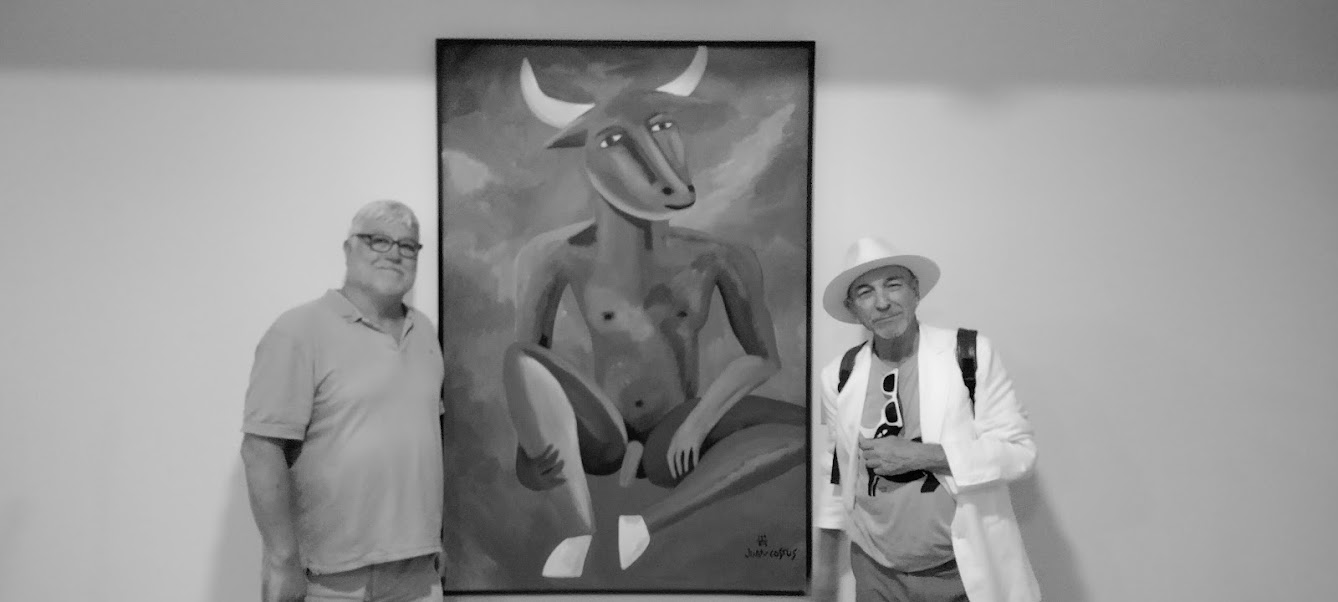
The photographs by Lluís Ripoll i Querol referring to Sitges are paired with the triptych Atlant by Paco y Manolo, where the rocks of the caves and the ruins of the Atlàntida nightclub appear. The fluorine minotaur by Enrique Naya is impressive, one of the Costus, painters of the Madrid movida who went to Sitges in 1992, encountering serious problems of discrimination but facing them with the support of the FAGC (Front d'Alliberament Gai de Catalunya) and gaining, after his death, jurisprudence around the stigma of the disease. The story of AIDS begins to be written from this and other cases. The sexual pandemic emerges and flourishes through a monster that is half-bull, half-human.
One of the rarest flowers in this exhibition is the photographic poster of the discotheque Trailer, the poster that was hung on the wall of the bar as a posthumous tribute to one of the souls of the night, Turmix-Roger, a performer and artist also from the Sitges scene of the eighties. The work belongs to the series of photographs that Toni Ruiz shot in 1991 to create the poster for Carnival, the party of parties that defines the essence of gay, dissident and transgressive Sitges.
Sitges LGTBIQ+ is slowly emerging and will soon have a new story about why, who and how it became the gay capital of the Mediterranean; despite the opinion of the people of Sitges who, until recently, defended that the flowery town and the town of carnations was the preferred destination for family tourism. May Santa Turmix preserve our sight. And of course, there are many and diverse types of families.
On the occasion of this exhibition, a series of activities have been programmed that promise to keep the spirit alert and the eyes wide open to the reality of a village of fishermen and winegrowers, gardeners and sailors who suddenly went from espadrilles to shoes, and from Malvasia wine to Pernod and JB.
Sitges is a LGTBIQ+ reference beyond itself. The imaginary has been forged like one of the chandeliers of Cau Ferrat, with fire and hammer blows. Rusiñol revealed its power, but there is still a lot of history to reveal and artists to discover, creatives who made it their Arcadia, Mecca where the barriers of the level crossings were raised to enjoy to the fullest.
An opportunity to expand, with honesty and responsibility, the set of shared meanings that we call culture, as Pere Parramon proclaims in the introductory text. An exhibition that aligns with the essential foundations of a democratic society, where the importance of the individual emerges and the need for a community based on human rights arises.
Santiago Rusiñol loved iron and glass, models of strength and fragility; spirit and metaphor of shared dignity and shared care, delicacy and strength together and well understood.


You may be
interested
...