Exhibitions
Concha Ibáñez. Homage to the landscape
On the occasion of the centenary of the birth of the artist Concha Ibáñez (Canet de Mar, 1926- Barcelona, 2022), the Museu d'Art de Girona has organized an exhibition as a tribute to an exceptional author, but who has not had the institutional recognition she deserved. In fact, for many years now I have been claiming that a retrospective should be held for her, but so far this has not happened, at least in Barcelona. For this reason, we must thank the will and interest of the historian and art critic Elina Norandi, as well as the artist's niece, also a painter Cristina Fonollosa, who have made it possible for her work to be seen in Girona. In fact, the current director of the museum, Carme Clusellas, has long been committed to vindicating women artists, who are often forgotten, despite their creative qualities.
The exhibition is curated by Elina Norandi herself, who two years ago also curated another of the artist from Maresme at the Fundación Cristino de Vera-Espacio Cultural Cajacanarias in San Cristóbal de La Laguna, Tenerife, which was, in fact, the first solo exhibition after her death. According to Norandi, it is not an anthology, but it is larger than the previous one, both in terms of the number of pieces and the fact that it follows most of her career, making it ideal for the public who visits it to realize her value and uniqueness.
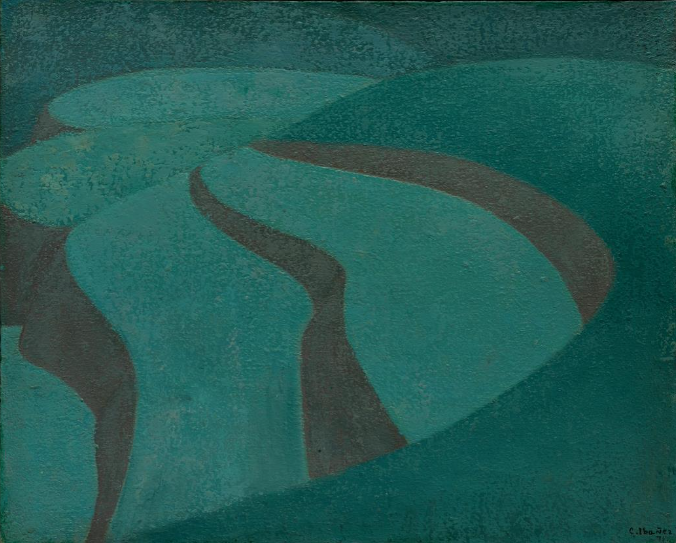
The title The evocation of the landscape perfectly expresses the artist's character, as he has always moved around the landscape. A landscape that is only found in his imagination, creating a style of his own that has served him to create a work that is visible at first glance and that, in addition, is very different from any current trend. The human figure does not appear in these landscapes, although it is present in some way, since someone cultivates the fields or has built a mill or a house. The work process is very simple, since starting from drawing or making sketches of what his eyes see due to the trips he has made to different continents, when he arrives at the studio he transfers it to canvases and papers. He is equally fond of oil painting and watercolor, as well as drawing and engraving. In all these disciplines he has always felt very free, giving each one the same importance. The landscapes cover a very diverse geographical space.
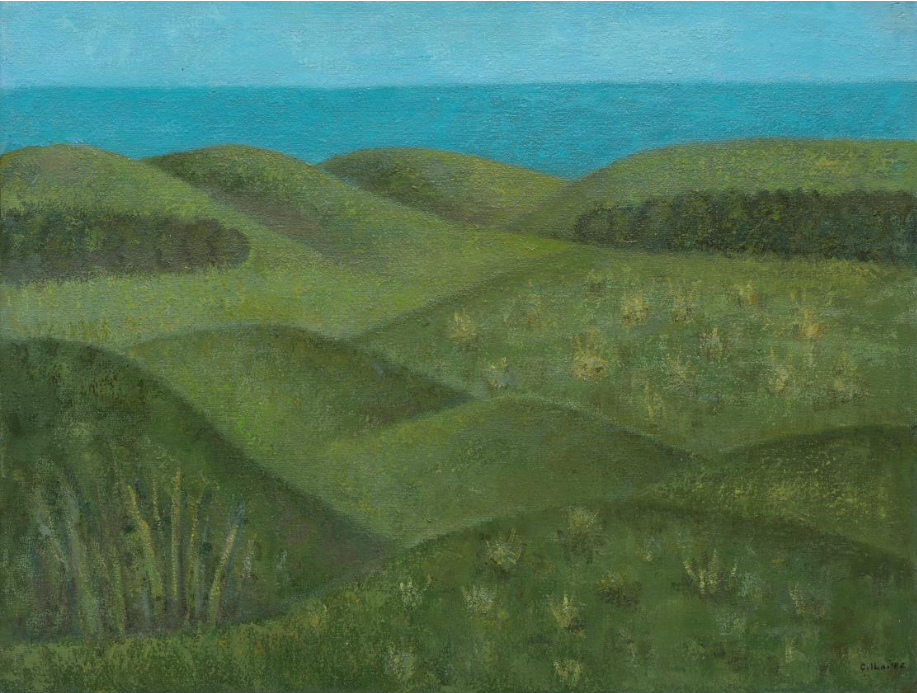
Concha Ibáñez, El Garraf, 2002.
We find the wheat fields of Castile, the olive groves of Jaén, the coasts of Menorca, Costa Brava, Garraf, Maresme, the barren and rugged landscapes of Monegres, the plantations of Lanzarote, but also places in Morocco, Cuba, Venice and New York. In all of them, no movement is perceived, but, on the contrary, we notice the existence of life, color and light, giving the viewer a feeling of calm, placidity and tranquility.
She has been one of the few female artists who, from the beginning, has been able to fully dedicate herself to what she liked most, which is the world of art, a circumstance that is not very common, and even more so being a woman. She studied at the Sant Jordi School of Fine Arts and the Llotja School. She had several teachers of recognized prestige, such as Francesc Labarta, as well as Josep Oriol Baqué. She has combined her artistic practice with teaching, giving painting and drawing classes in her own studio, but has also done so outside of it, such as in Hospitalet, the FAD (Foment d'Arts Decoratives) and the Cuban city of Holguín. Her first individual exhibition took place at the Sala Jaimes in Barcelona, in 1960. Her work has been shown in many European countries, as well as in the United States, Cuba and Thailand, in addition to a large number of Catalan and Spanish cities.
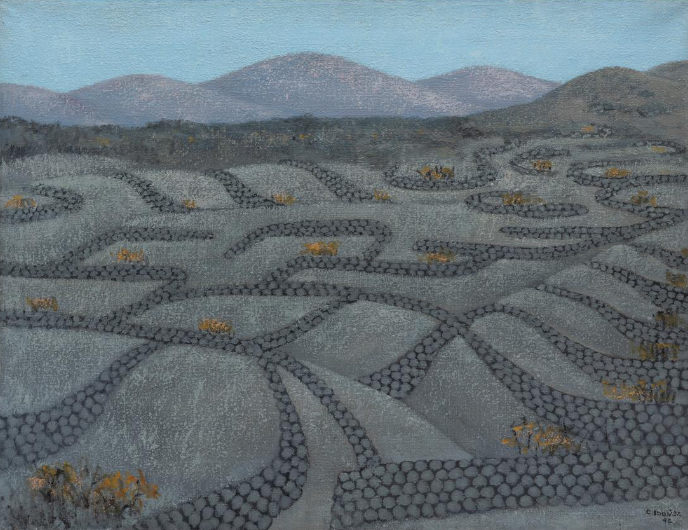
Concha Ibáñez, Lanzarote, 1992.

You may be
interested
...