Opinion
After the whistle, art remains.
The 2026 World Cup has already begun to unfold in stadiums across Mexico, Canada, and the United States. For over a month, 104 matches will transform North America into the grand stage of world football, a territory where sporting passion, collective emotions, and those unexpected moments that become part of the shared memory of several generations will intertwine. However, beyond the pitch and the competition, this major football event has also resonated within the broader cultural sphere.
Aware that an event of this magnitude transcends mere sport, numerous museums in the three host countries have designed temporary exhibitions and tours that explore the relationship between football, society, and artistic creation. From photography and design to painting and contemporary installations, these offerings seek to capture what the ninety minutes of a match cannot always convey: the identity of nations, the rituals of the fans, the celebration, the defeat, and the symbolic dimension of a sport capable of stopping the world.
Meanwhile, artists from various disciplines have seized upon the World Cup as a source of inspiration, creating works that engage with the aesthetics of the ball, the architecture of the stadiums, the energy of the stands, and the human stories that unfold around the tournament. Because, ultimately, each World Cup leaves behind not only goals and champions: it also leaves behind images, narratives, and creations that endure long after the final whistle has blown.
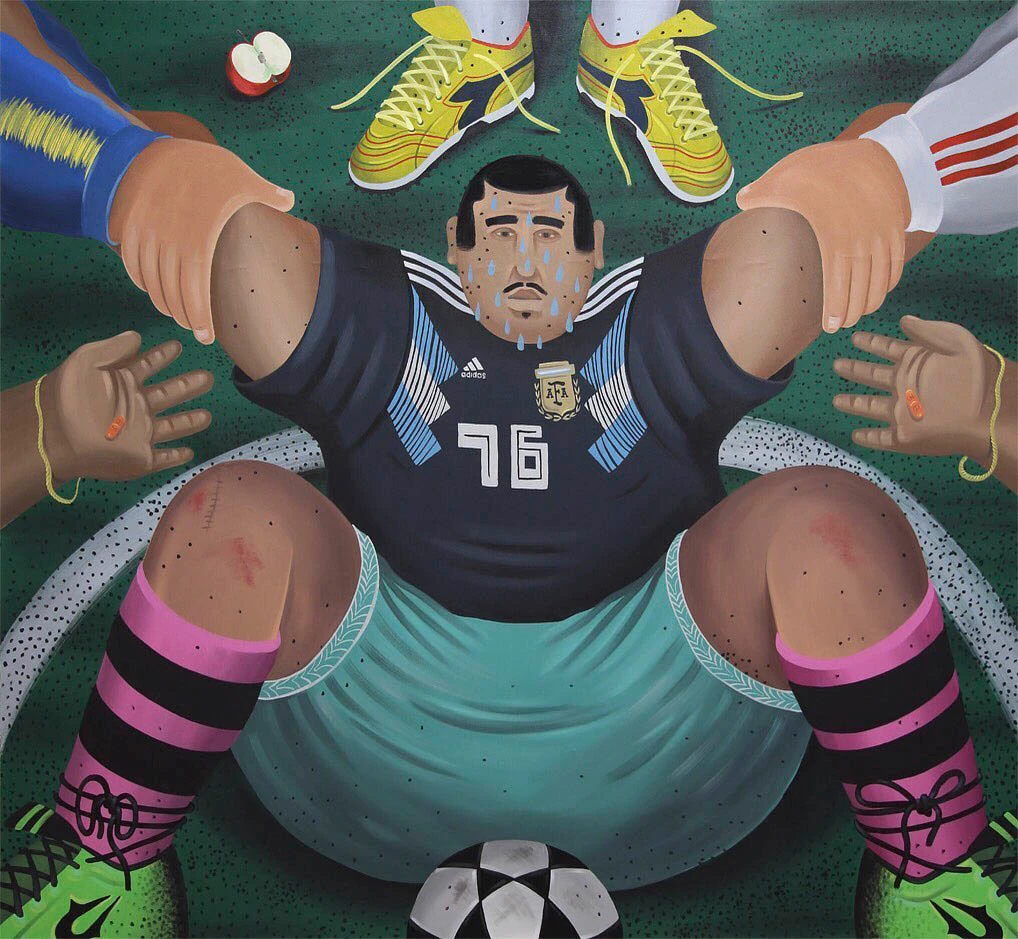
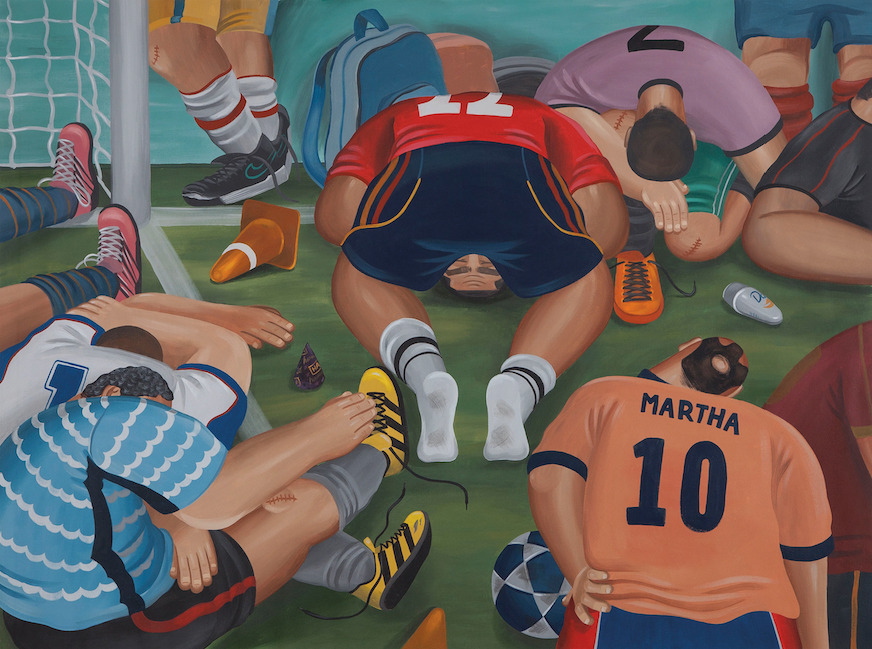
The first artistic journey takes us to the work of Martín Kazanietz, an artist who moves away from the spectacular football of the big stadiums, the epic of the impossible goal or the massive celebration, to focus on its more human and everyday dimension. That is real football: the football of friendship, of the third half, of the leisurely conversation after the match, and of bodies that still retain the weariness and joy of what they experienced on the pitch.
His paintings feature rounded figures, almost as if they were an extension of the ball itself, wrapped in sports jerseys and situated in those moments of pause that are part of the football ritual. These are not the moments of maximum competitive tension, but rather that sweet emotional afterglow that comes after the euphoria of the game, when victory or defeat gives way to meeting, conversation, and companionship.
Kazanietz's imagery ultimately portrays the social essence of football: a shared language that transcends the scoreboard and results. His serene and relatable characters remind us that this sport is not only played on the pitch, but also in the stands, in the streets, and in those small moments of shared experience that make football a universal cultural phenomenon.
While Martín Kazanietz's work situates us in the world of football characterized by pauses and camaraderie, Simon Prades's visual universe returns us to the intensity of the daily narrative that accompanies a World Cup. For Brazil 2014, the artist and illustrator undertook an almost journalistic exercise: creating a single image each day capable of condensing the emotion, tension, and most significant events of each matchday.
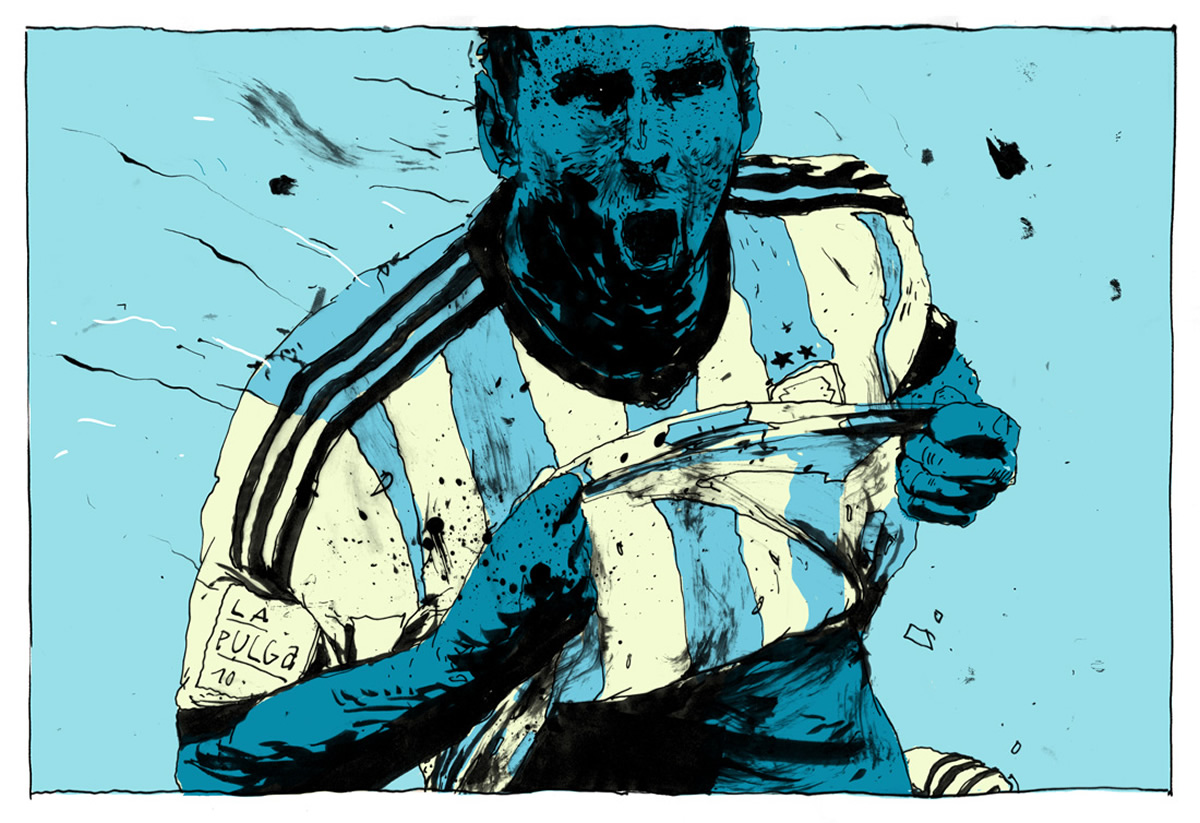
His illustrations weren't limited to the sporting outcome. Prades understood the World Cup as a grand stage for human and social stories, where the joy of the goal coexisted with the controversy and the reality surrounding the event. Thus, his works evolved from contrasting the brilliance of the opening ceremony with the protests that swept through the Brazilian streets, to immortalizing the moments of glory of figures like Messi or Cristiano Ronaldo in their dramatic, last-minute goals.
With an aesthetic that blends the precision of editorial illustration with a strong narrative drive, Simon Prades constructs scenes of great symbolic power. His compositions, characterized by clean lines and a carefully chosen color palette, transform ephemeral events into images that endure beyond the immediate present. In his hands, football becomes a visual chronicle: a space where sport, politics, collective emotion, and individual gestures converge in a single instant frozen on paper.
The journey continues with Adrian Mangel, an artist who approaches football through the mythology of its greatest protagonists. Trained in illustration at Parsons School of Design and with a career spanning from journalism to fashion design and the world of sports, Mangel uses portraiture as a tool to explore the identity and almost legendary status of footballers.
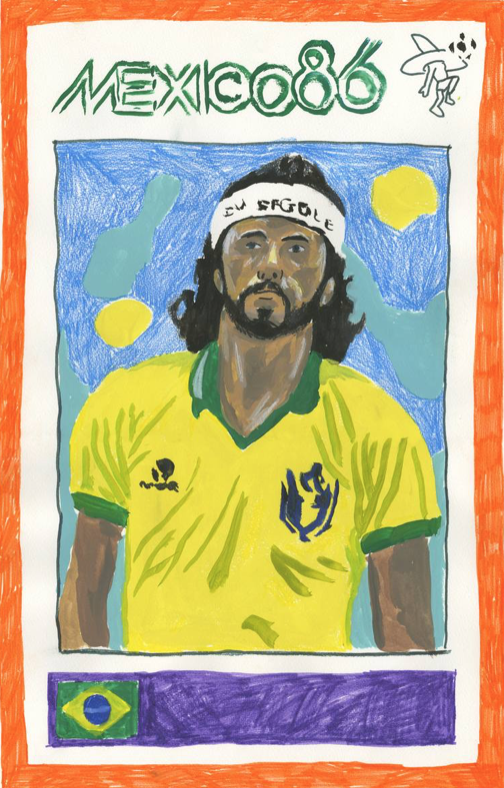
His works depart from photorealism, constructing figures brimming with personality through expressive strokes, flat colors, and an aesthetic that draws from both editorial illustration and folk art. In his portraits, legendary players are transformed into contemporary icons: recognizable faces that, beyond fame, speak of an era, a way of understanding the game, and the emotional connection that millions of fans maintain with them. His series dedicated to some of the greatest stars in world football was recognized for its unique way of reinterpreting these figures from a personal and graphic perspective.
An example of this vision is Fenómeno , his depiction of Brazilian Ronaldo during his time at PSV Eindhoven. Created with watercolor, gouache, and marker on paper, the piece doesn't aim to reproduce a photograph of the striker, but rather to capture the energy and aura of a footballer who defined a generation. In Mangel's work, football appears as a realm of modern heroes where collective memory and artistic expression converge.
The memory of football is also built from specific moments. A shot, a technical skill, or a split second of inspiration can be forever etched in the collective history of millions of fans. Italian illustrator Emiliano Bonazzi explores this idea in his series Twenty Images to Illustrate All the Editions of the World Cup (1930-2014) , a project that condenses more than eight decades of World Cup history into twenty essential images.
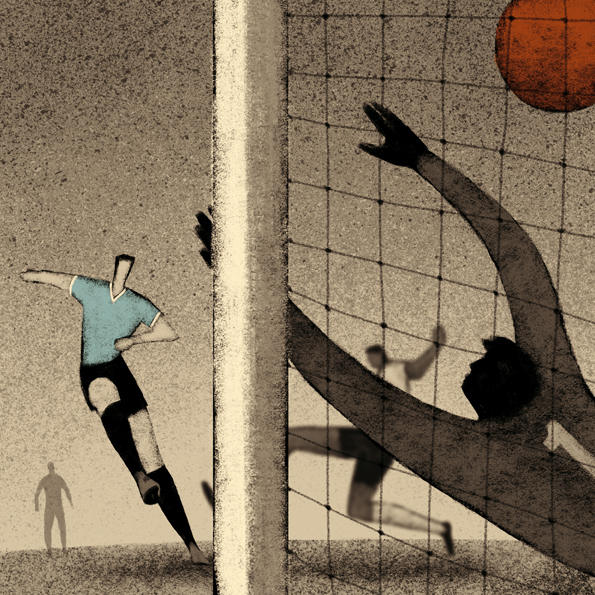
Each illustration represents a decisive goal in the World Cup finals, from the first tournaments held in the 1930s to the 2014 edition in Brazil. Bonazzi does not intend to reconstruct the play with photographic accuracy, but rather to reinterpret those moments from his own visual language, where graphic synthesis, geometric shapes and careful composition transform fleeting actions into almost timeless images.
His work transforms sporting memories into pieces of art and design. The goal ceases to be merely a statistical event, becoming a symbol capable of representing an era, a country, or a generation of fans. His illustrations blend nostalgia, epic moments, and the beauty of those seconds when a World Cup changed hands forever.
Bonazzi's series demonstrates that the history of football can be told in many ways: through chronicles, photographs or audiovisual archives, but also through images capable of distilling the essence of the great moments that have shaped the legend of the tournament.


You may be
interested
...