News
Conchita Comamala and Antoni Tàpies: the return of an intimate legacy to the Tàpies Museum
The Barcelona City Council is lending a set of works that delve into Tàpies' first creative stage and his relationship with Conchita Comamala.
The Tàpies Museum is incorporating into its collection an exceptional set from the legacy of Conchita Comamala, lent by the Barcelona City Council through the Barcelona Institute of Culture. The incorporation strengthens the museum's collection and opens up new avenues of study on Antoni Tàpies' early artistic stage, as well as on the personal ties that marked his training.
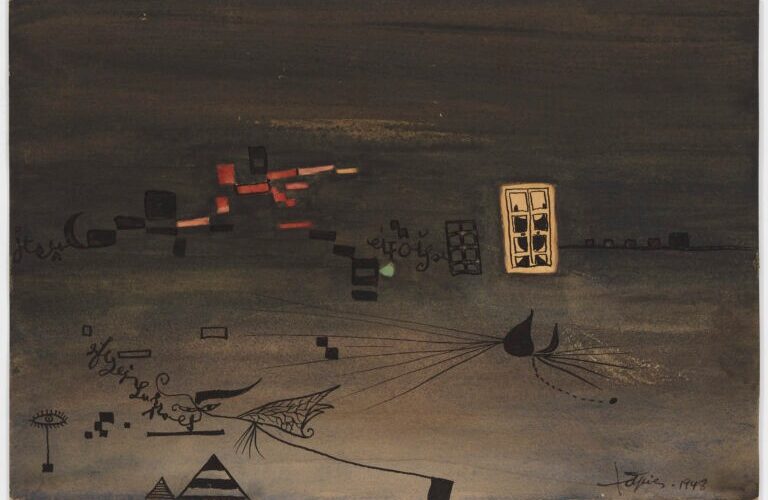
The set consists of three original works of great historical and documentary value: two portraits of Conchita Comamala made by Tàpies —a pencil drawing from 1943 and an oil on canvas from 1952— and an abstract composition from 1948 linked to his initial period of artistic research. To these pieces is added a complete copy of the series Letters to Teresa (1974), as well as more than sixty books on the artist's work kept by Comamala at his home.
The works will be restored by the museum and one of them, Drawing (1948) , will be integrated into the exhibition Antoni Tàpies. The perpetual movement of the wall , in the section dedicated to the artist's first solo exhibition. This incorporation allows for a better contextualization of Tàpies' beginnings, before the development of his material stage in the late 1950s.
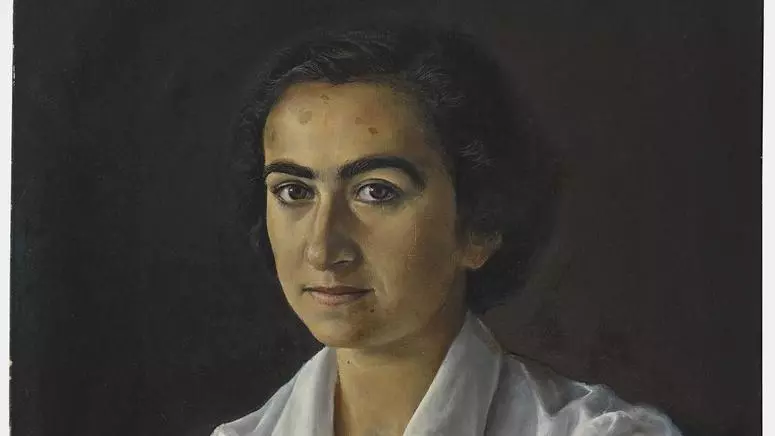
The first of the portraits, made in 1943, shows a work that is still academic but already interested in the psychological introspection of the face. The second, from 1952, evolves towards a more consolidated composition, where the body and the background dialogue with the pictorial solidity typical of the moment.
The abstract piece from 1948 falls within the artist's surrealist or "magicist" period, with influences from creators such as Paul Klee, Joan Miró and Max Ernst. During this stage, Tàpies explores a painting of floating and symbolic images, where matter becomes language and evocation.
The legacy is completed with Cartes per a la Teresa (1974), a graphic series in which Tàpies plays with the duality of the concept of “letter”: as intimate correspondence and as a symbolic or playful object linked to the world of chance and representation. This set reinforces the personal and poetic dimension of the relationship between artist and recipient.


You may be
interested
...