Opinion
Venice Biennale: To speak of art is to speak of politics
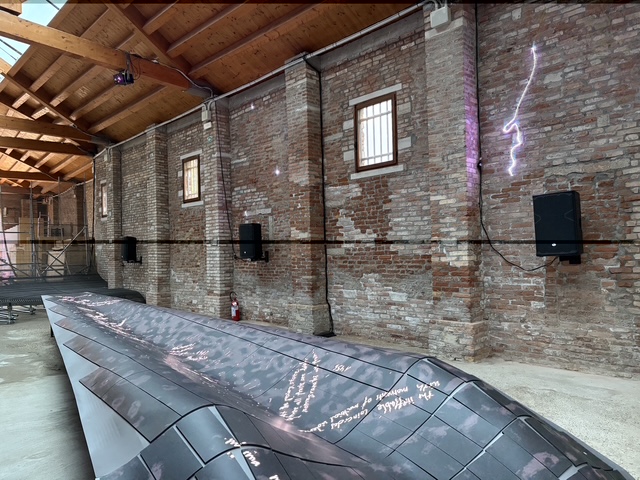
"Art is more powerful than any arrogance," declared Pierangelo Buttafuoco, president of the Venice Biennale, on the first day of the renowned art fair, which until Saturday will open its doors to professionals only by strict invitation. After that, the controversial exhibition will be open to everyone. The United States Pavilion hasn't even garnered criticism; it's so detached from any interest that the queues of previous editions have been replaced by the indifference of empty halls and people hurrying past it to other destinations. For example, to the Russian Pavilion, mysterious and contested by the Italian right, starting with Culture Minister Giuli, who announced his absence from the official opening, as well as the jury, who resigned en masse. Such are the perversions of our society: people from different sides acting in the same way. The Russian Pavilion , curated by Anastasia Karneeva, will host a multitude of performances during the opening week, which will be recorded and later projected on giant screens until November 22, the closing day, while the pavilion remains completely closed. Just opposite, Chus Martínez, curator of the Danish Pavilion, presents a video work by Maja Malou Lyse telling a story about sperm donors and banks. It's a shame that, as usual, the nude bodies are exclusively female… something that's becoming tiresome. Is it possible that even in a place like the Venice Biennale, the old taboo surrounding the male body persists? So much talk about sperm as if it were falling from the sky… well… I don't want to quote that antiquated yet still relevant saying.
Female nudes are used as if there were no tomorrow in the Austrian pavilion as well, but it is less annoying than the Danish one, because Florentina Holzinger, whom we will soon see in Barcelona at the Grec Festival, is more raw, more authentic and also more capable of capturing the viewer's gaze with her oriental performers who stage the dichotomy between purity and dirt, cleanliness and pollution.
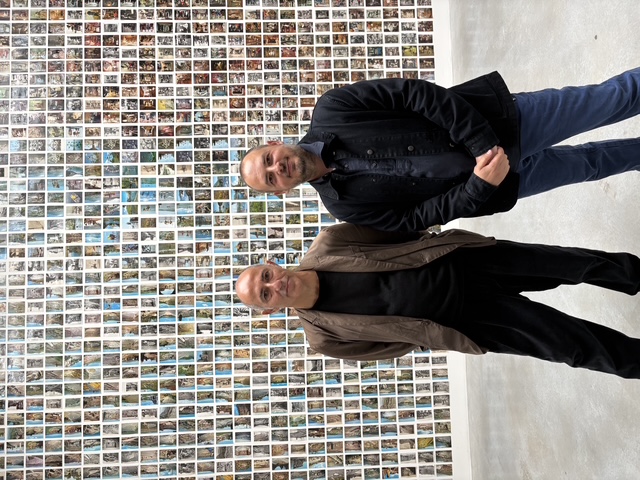
Carles Guerra and Oriol Vilanova at the Spanish Pavilion. Photo: @arte.edad.silicio
Oriol Vilanova (Manresa, 1980), whose exhibition "Los restos" (The Remains) is curated by Carles Guerra in the Spanish Pavilion, offers no controversy, only a very interesting visual impact. Although both the artist and curator are Catalan, Vilanova, represented by the Àngels Barcelona gallery, which also features Claudia Pagès, the protagonist of the Catalan Pavilion, has been collecting postcards for two decades. However, he doesn't do so with the almost manic care of a collector searching for a rare and precious piece; he buys them in bulk, revealing more of a desire for accumulation. This accumulation unfolds in the rooms of the Spanish Pavilion with 50,000 copies, many of them duplicates. Nothing new; it's his practice, what he always does, but this doesn't diminish the visual impact I mentioned earlier. On the other hand, political and social reflections struggle to surface if you don't have, like journalists, an artist or curator to explain them. A relic of the past, postcards remain a fixture in churches and museums; people buy them, but rarely send them. In Venice, a single postcard will be the star of the performance "The Phantom of Liberty ," in which an actor will silently display it to passersby at unannounced and unpredictable times and locations. All the postcards covering the pavilion walls, however, are part of a publication designed by Zak Group.
The Catalonia Pavilion offers a far more cryptic experience. Claudia Pagès 's * Paper Tears* takes its starting point from an archive of watermarks, preserved in Capellades, as the handbill states. The space is occupied by a projection in three parts, in which five people activate an archive of 15th-century watermarks through vocal interventions and two tiers of seating that, if you don't fall, allow you to view the projection uncomfortably from above. It's another work that, unless explained to you, you'll rarely understand what the artist wants to convey.
Spain's presence in Venice is further enhanced by I Baschi alla Biennale 1976/2026 , with which the Basque Country returns to the lagoon 50 years after its historic participation in the 1976 Venice Biennale. In 1976, amidst an atmosphere of uncertainty and struggle for freedoms during Spain's democratic transition, a group of Basque artists raised their voices at the Venice Biennale, using art as a means of expression, freedom, and collective affirmation. Today, the Basque Country returns to Venice with a different perspective, with renewed artistic tools and languages, but with the same conviction: that culture is a way of relating to the world. Through a multidisciplinary approach, I Baschi alla Biennale 1976/2026 presents itself as a critical and project-oriented platform, capable of engaging with the present.
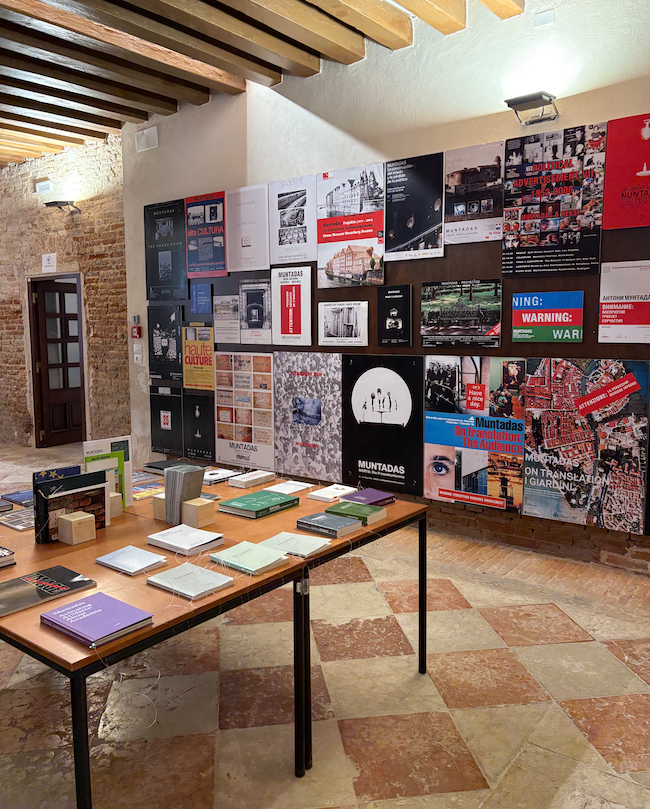
Exhibition by Antoni Muntadas at the IUAV's Terese campus. Photo: @arte.edad.silicio
Also important to remember is Antoni Muntadas, the subject of a tribute for his 20 years of teaching at the University of Venice (IUAV). An entire day was dedicated to the Catalan artist, beginning with a conversation between him, art critic and historian Angela Vettese, and curator Ute Meta Bauer. Art professionals, students, alumni, and others joined the discussion, sharing their experiences of Muntadas in Italy and Venice. The event extended well beyond the initially planned three hours and concluded with the opening of the exhibition dedicated to Muntadas's 20 years of teaching. The exhibition is titled "Muntadas." Information and Documentation: A Selection , which can be visited until May 29 in the Giardino Classroom of the Terese campus of the IUAV and which is curated by Andrea Nacach, Muntadas' assistant for many years, presents a small selection of works from the large exhibition that was presented in 2025 at the Universitat Politècnica de València on the occasion of the awarding of the honorary doctorate to the artist.

You may be
interested
...