Exhibitions
Without a head or a centenary: The Antitête of Tristan Tzara and Joan Miró
Between word and image, the experimental dialogue of Tristan Tzara and Joan Miró unfolds in a radical avant-garde that transforms meaning through the fragment, the gesture and chance.
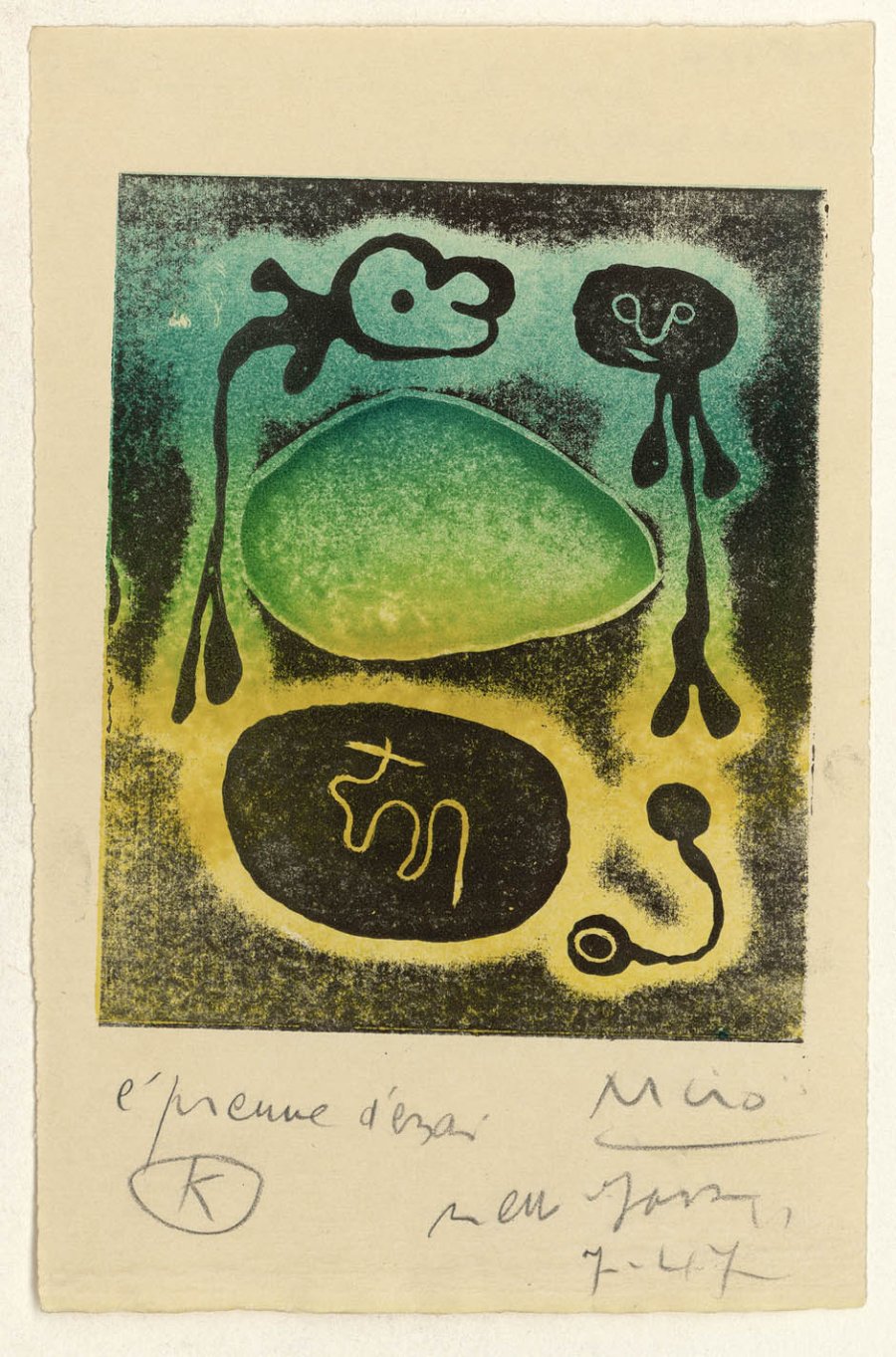
The Fundació Joan Miró revisits the collaboration between Tristan Tzara and Joan Miró through the archive of Le Désespéranto , a piece that acts as a catalyst for the radical spirit of avant-garde poetry of the early 20th century. It is an anthology that is configured as a statement against ordered rationality and bourgeois logic: a set of texts that reject any norm, from syntax to narrative coherence, playing with nonsense, fragmentation and chance.
Open Archive 07. L'Antitête , a temporary exhibition open until May 24 and located in the Institution's Archive, is curated by Elena Escolar, Francesca López and Teresa Montaner. The project, born from an insurgent and deeply creative impulse, proposes an immersion in the dialogue between poetry, engraving and artistic experimentation based on the universe of Tristan Tzara and his connection with Joan Miró.
The exhibition delves into a dissonant territory where word and image cease to be separate languages and converge into a single symbolic vehicle in motion. The book thus becomes a meeting space, a living body in constant transformation, where meaning is not fixed but emerges from the process. Through correspondence, evidence and archival materials, the exhibition reveals the shared work as a dialogue made of decisions, doubts and discoveries.
It is worth highlighting the eight plates engraved by Miró at Atelier 17 in New York, a key experimental environment in the development of his visual language, which brought him closer to a freer and more intuitive writing of the image. Le Désespéranto, which combines despair and hope, condenses the tension of an era and a collaboration: the desire to transform creation into an open space, where meaning is born from the fragment, the gesture and chance.

You may be
interested
...