Exhibitions
Philadelphia Museum of Art: the final stop in Noah Davis’s retrospective
The first question that felt honest before beginning this review was: why now? Why do we so often resuscitate artists only once their breath and labour can no longer be sustained by recognition? Why does institutional care arrive after vitality has already been converted into legacy?
The international retrospective of Noah Davis, now making its final stop at the Philadelphia Museum of Art, does not arrive in isolation. It belongs to a broader moment in which museums have begun to reckon—belatedly—with the artists they failed to support at scale while those artists were still alive. Black artists and women artists, in particular, have often been granted retrospectives only once absence can be corrected without altering lived conditions. Vitality hardens into legacy; recognition becomes safe.
As Maura Reilly argues in Curatorial Activism, museums’ claims of neutrality have historically masked structural exclusion. The delay surrounding Davis’s retrospective reflects not a slow maturation of artistic value, but an institutional reluctance to intervene earlier in the careers of Black artists to act without consensus, to privilege safety over advocacy. That this recognition arrives posthumously underscores precisely the curatorial failure Reilly identifies: correction without consequence. The exhibition organized with DAS MINSK in Potsdam and previously shown at the Barbican in London and the Hammer Museum in Los Angeles is expansive, careful, and overdue. It is also inseparable from the structural conditions that delayed it.
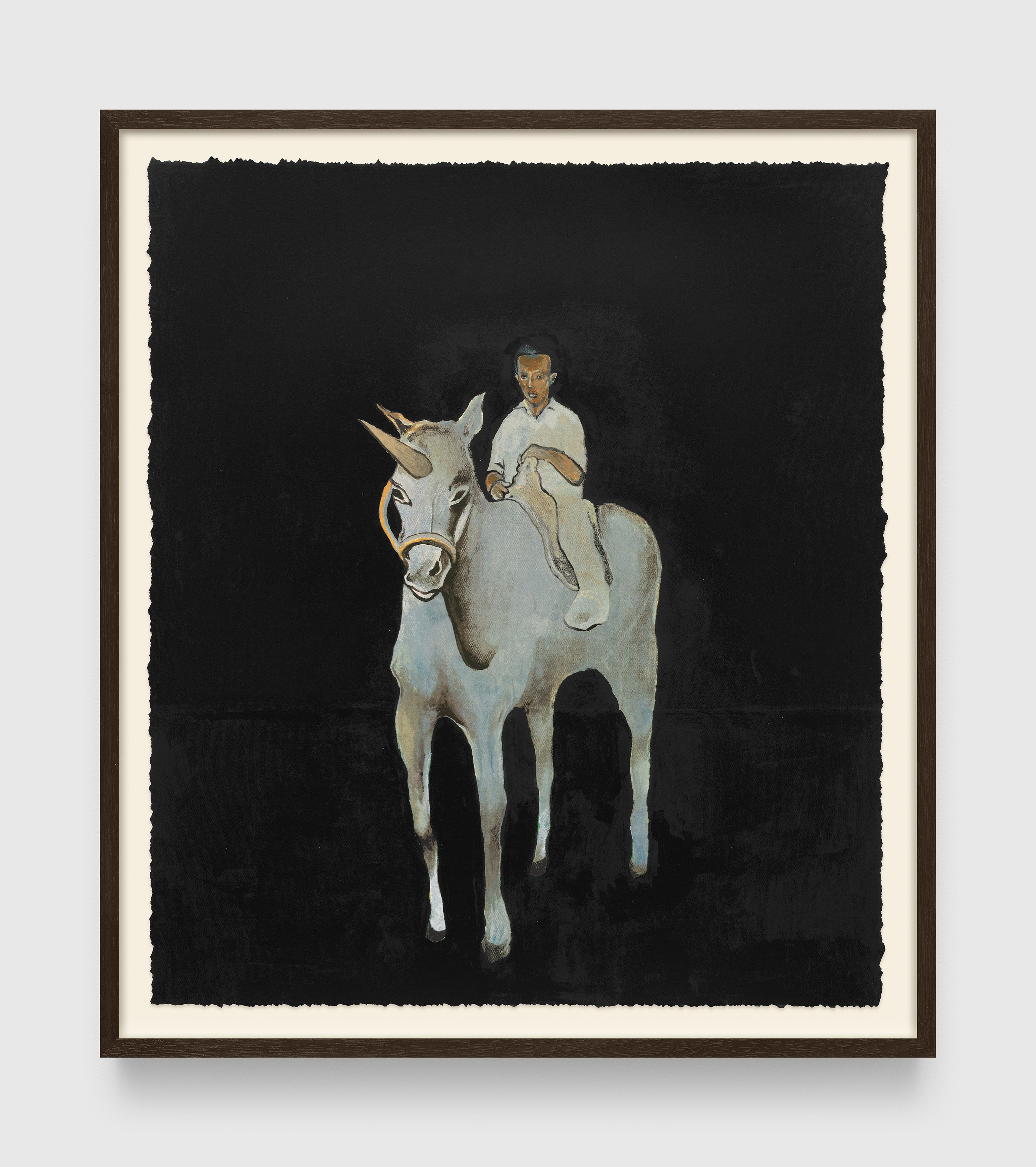
One of the first works viewers inevitably search for is 40 Acres and a Unicorn (2007). On paper, its allegory announces itself clearly enough: a revision of Reconstruction’s failed promise, history rendered surreal. Yet the painting resists allegory’s clarity. The figure’s face is uneasy, almost overworked, as if Davis were testing how much symbolic weight a body can bear before collapsing under meaning. The unicorn appears as an impossible companion a promised ideal perhaps only realizable in dreams—but its presence does not redeem the scene so much as destabilize it. What lingers is not reference but hesitation. The painting pauses mid-thought, unsure whether it wants to be read at all. The darkness does not threaten; it absorbs.
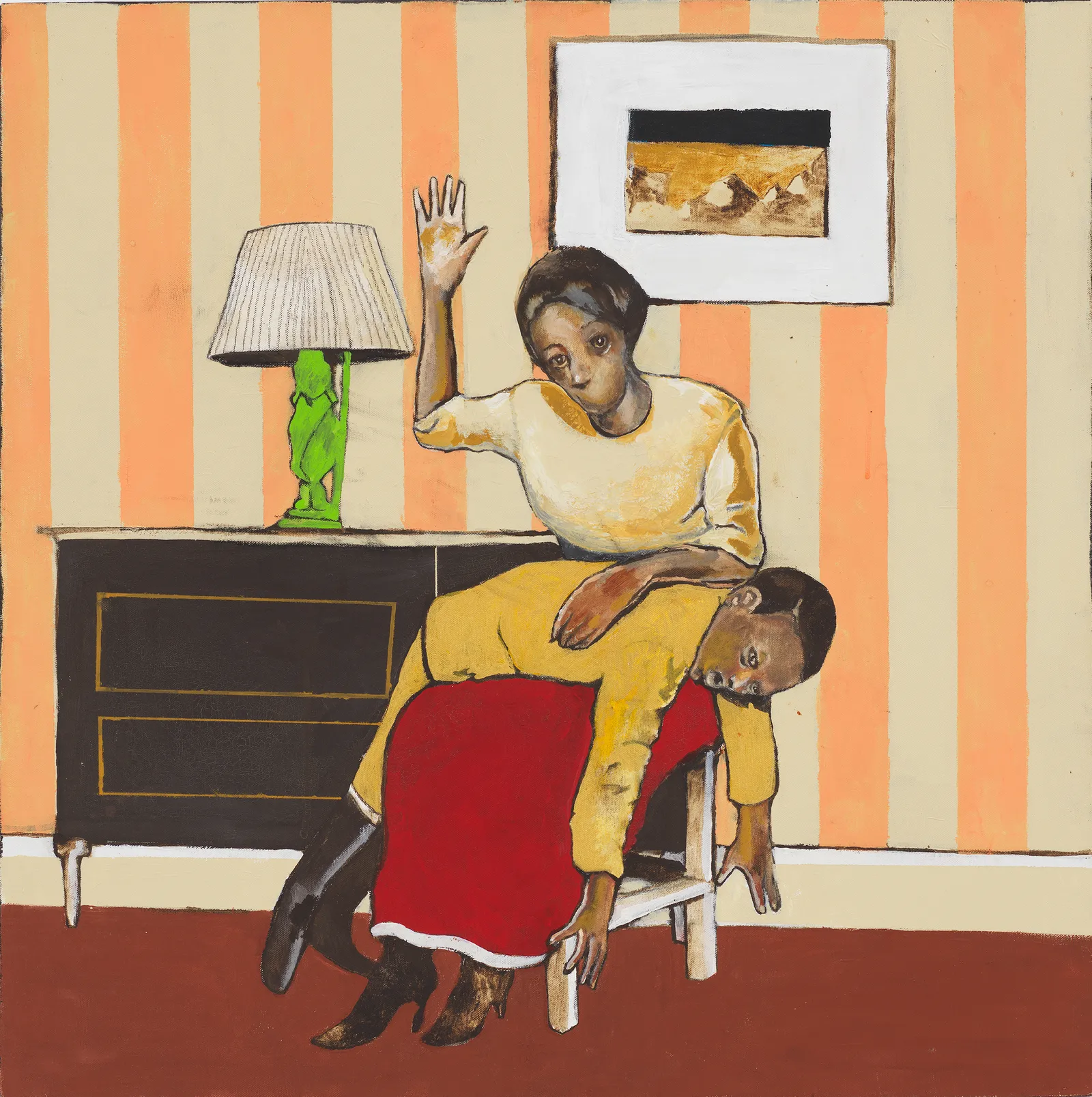
This hesitation appears again in Bad Boy for Life (2007), one of the exhibition’s early thunderclaps. A woman raises her arm to strike a child seated on her lap; her mouth is absent, erased entirely. The scene teeters between violence and absurdity, its moral gravity destabilised by stylisation. The figures are loosely handled, nearly dissolving, while the candy-striped wallpaper behind them remains crisp, insistently decorative. Davis often stages this imbalance blurred bodies against declarative grounds so that people appear both of this world and already halfway out of it. What might read as narrative instead becomes atmosphere: not an event, but a condition.
This is where Davis’s surfaces do their quiet work. Paint drips, thins, pools, and runs, not as expressionistic flourish but as a way of loosening the permanence of things. Figures are never fully secured; they hover, waver, recede. Even in moments of apparent clarity, the painting seems to be preparing an exit. Meaning is not withheld so much as gently refused, allowed to disperse.
Across the exhibition, Davis paints figures who are present but not declared, environments that feel rehearsed rather than observed. Even in busier compositions, there is a sense that the painting has already decided not to explain itself. This may be why the work travels so strangely through time why it feels at once finished and unresolved, intimate and distant.
Davis was never only a painter. Through the Underground Museum in Los Angeles, which he co-founded, he challenged the very mechanisms of cultural access bypassing elite gatekeeping and compelling institutions to collaborate on his terms. This gesture was visionary, but it also made him difficult to absorb into traditional museum structures while he was alive. The Underground Museum was not merely radical; it was uncomfortable.
There is a generosity in this refusal. Davis does not ask to be rescued by history, nor does he plead for recognition. His figures wait, his colours have settled, and his surfaces continue to work long after the subject has dispersed beyond the frame. Standing before these paintings now, one feels not closure, but a quiet unease, the sense that something essential arrived too late, and yet still insists on being seen.

You may be
interested
...