Duty Free Art in Santa Mónica Airport for Frieze Los Ángeles 2026
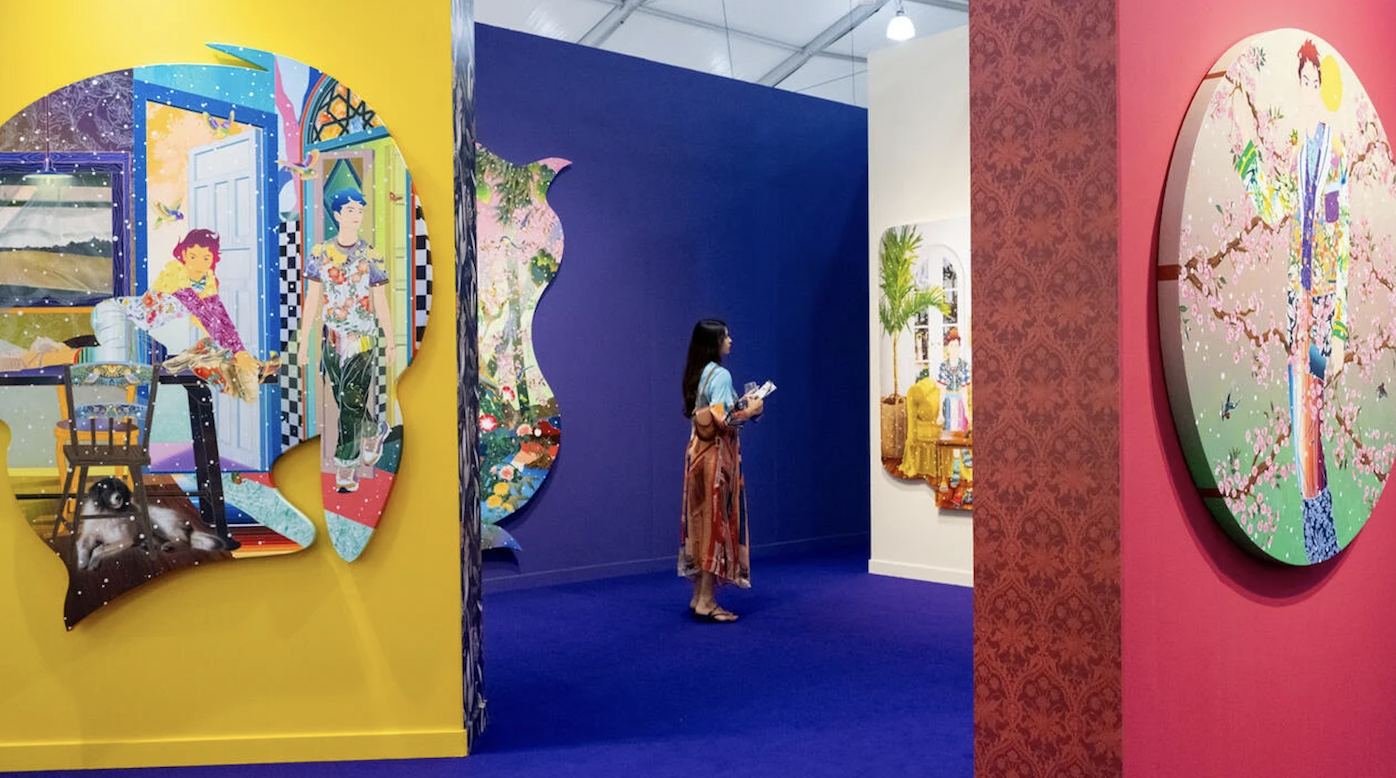
Fairs, right? You either love them or you hate them, but what you certainly cannot do is avoid them. They arrive, they take over, they make you walk more than you planned. You bump into people who can spend ten million on an Egyptian reliquary, an abundance of black glasses, and assistants trailing buyers on FaceTime. In Seven Days in the Art World, Sarah Thornton famously described Art Basel as “the Olympics of the art world,” while also calling fairs its “hub,” places where reputations are made visible, allegiances tested, and success becomes briefly legible. Through this ethnographic eye she captures a system powered by proximity and speed, where looking, networking, and buying collapse into a single gesture. Art fairs, as Paco Barragán notes in The Art Fair Story, have long outgrown their role as simple marketplaces. They have become cultural infrastructures, temporary cities that compress the art world’s hierarchies into a dense and unavoidable form of retail.
Frieze itself began as an extension of Frieze magazine, founded by Amanda Sharp and Matthew Slotover, who transformed Regent’s Park in 2003 into a temporary argument for why fairs mattered at all. Over time, the project expanded into Frieze Masters, New York, Los Angeles, and Seoul, before absorbing other fairs such as The Armory Show and EXPO Chicago. Today, Frieze feels less like a single event than a year round system, a constellation in which art endlessly orbits its own occasions.When Frieze first arrived in Los Angeles in 2019, it did so with the air of a belated confirmation, as if the fair had finally caught up with a truth the city had been quietly rehearsing. Los Angeles, often dismissed as too dispersed, too “Hollywood,” too distracted, was already a major center for contemporary art. Frieze’s arrival simply made it official. As often happens, the fair quickly exceeded its own frame, expanding into a week-long condition ruled by openings, dinners, detours, and exhibitions unfolding across a city that resists being crossed without digression. You plan to go somewhere and end up somewhere else, very unequivocally Los Angeles.
This year Frieze Los Angeles introduces a number of first time participants, including El Apartamento, Bradley Ertaskiran, Cardi Gallery, Fort Gansevoort, Josh Lilley, Lomex, and Nicodim. They are joined by galleries returning after a year’s absence, among them Gallery Hyundai, Sprüth Magers, Craig Starr Gallery, and Various Small Fires. Extending the fair’s global reach, a strong cohort of international galleries will arrive from across Asia, the Middle East, Latin America, North America, and Africa, including Bank, Dastan, Taka Ishii Gallery, Johyun Gallery, Kaikai Kiki Gallery, Tina Kim Gallery, Kukje Gallery, Mendes Wood DM, Proyectos Monclova, Nara Roesler, and Southern Guild, among others. Alongside this, Frieze LA continues to foreground emerging practices through Focus, its section dedicated to new and experimental voices. Curated for the third consecutive year by Essence Harden, recently appointed curator of EXPO Chicago, Focus will feature bold solo presentations from an expanded group of 15 US based galleries that have been operating for 12 years or less.
Whilst the first edition of Frieze LA took place at Paramount Pictures Studios, a location that felt less like a venue than a knowing aside, where art staged itself on a historic set. In 2023, the fair migrated west to Santa Monica, where it has since become the anchor of Los Angeles’s unofficial art week. This February, Frieze returns for its seventh edition, running from 26 February to 1 March 2026. What makes this year’s edition particularly compelling is its setting. This time around, Frieze LA lands at the Santa Monica Airport, a location suspended between departure and arrival, situated in between what Marc Augé describes as a contemporary “non place.” The choice feels uncannily suitable. As Augé writes, airports are paradigmatic non places, spaces defined by transit, anonymity, and contractual encounters, to stage an art fair here feels less like a provocation than a quiet logic mirroring the fair and the site itself as places of accelerated circulation where objects, people, and conversations are perpetually en route.
Within this logic we could argue the airport’s duty free zone becomes a useful metaphor. In Duty Free Art, Hito Steyerl examines how contemporary art increasingly mirrors the conditions of duty free commerce, untethered from national frameworks and circulating through fairs, freeports, and tax exempt zones where value is abstracted, deferred, and endlessly portable. Art, like luxury goods in transit, exists in a state of suspension, owned but unseen, bought but not yet arrived. Frieze LA’s airport setting does not merely host the fair, it stages the conditions that sustain it. This year for Frieze Los Angeles the art world briefly lands on its favourite runway, rehearses its familiar choreography, checks its documents, and prepares for the next destination.


You may be
interested
...