News
Spain is betting on Oriol Vilanova's residual memory and will take "The Remains" to the Venice Biennale 2026
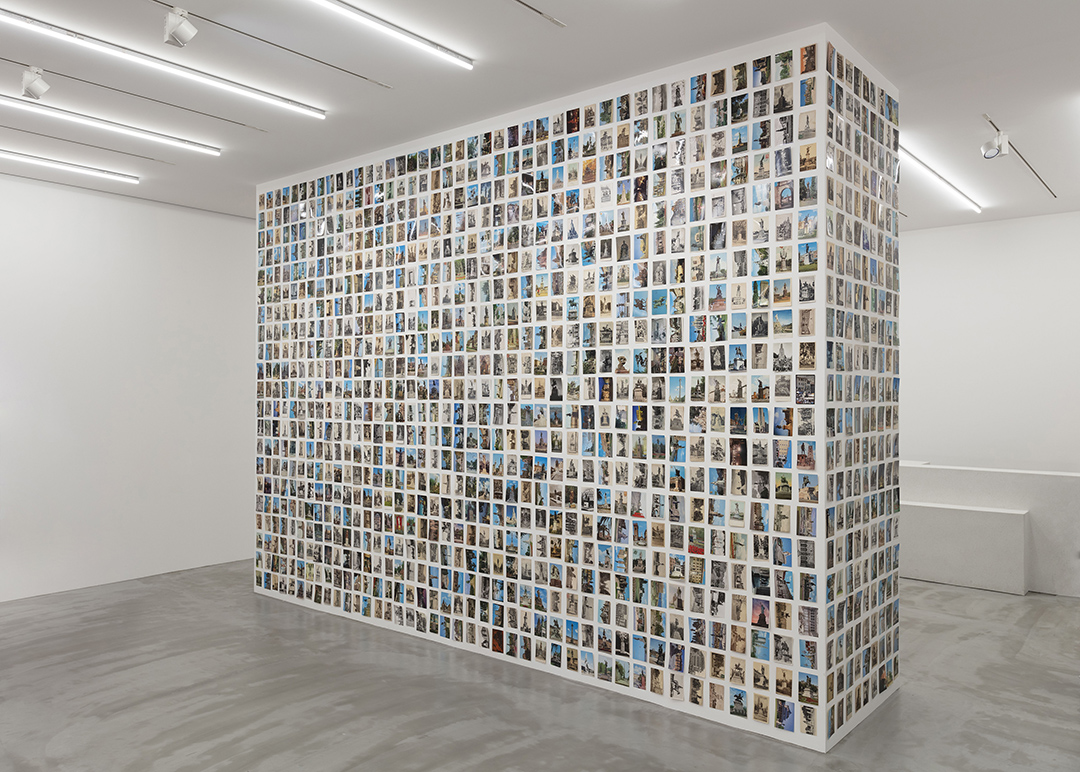
The artist Oriol Vilanova will represent Spain at the 61st Venice Biennale with his project "The Remains ," an exhibition that will be on view from May 9 to November 22, 2026, in the Spanish Pavilion and curated by Carles Guerra. Vilanova's selection places at the heart of the pavilion an artistic practice that is sustained over time, rigorous in its conceptual approach, and deeply attentive to the political implications of the image.
The exhibition is structured around a collection of postcards that the artist has gathered over more than twenty years in flea markets and secondhand shops. What might seem like an almost anecdotal gesture—rescuing fragments of everyday correspondence, repeated images of monuments, landscapes, and tourist sites—becomes the core of an investigation into memory and its mechanisms of construction. These postcards, conceived as vestiges of private experiences and as remnants of a mass visual economy, acquire a new dimension: they are contemporary ruins, material remains of a shared imaginary.
In Vilanova's hands, accumulation ceases to be mere sum and becomes a method. The insistent repetition of iconography reveals how the tourist image not only documents a place but also symbolically produces it. Each postcard speaks as much about what it represents as about the system that generated it: circuits of consumption, logics of standardization, promises of experience. The archive thus becomes a critical tool that questions the naturalization of certain visual narratives and exposes the mechanisms of global image circulation.
The Spanish Pavilion in Venice will be conceived as an “anti-museum” in constant flux. In contrast to traditional museography—based on classification, hierarchy, and the stability of the narrative—the proposal opts for an open and dynamic arrangement, where the persistent act of collecting is asserted as an aesthetic and political practice. Far from monumentalizing the objects, the installation activates them as points of friction, capable of generating new associations and interpretations.
In this international context, the Biennale becomes a privileged stage for amplifying a reflection that transcends the local sphere. “The Remains” engages with contemporary debates on the overproduction of images, the fragility of physical media, and the economic forces that determine what deserves to be preserved and what is relegated to oblivion. By placing the residual at the center of the exhibition's discourse, the project invites us to reconsider the cultural value of that which seems insignificant.
Spain's participation in this edition thus reaffirms its commitment to practices that question systems of representation and propose new ways of reading the past from the present. In "The Remains," the seemingly minor is revealed as a space of critical resistance: a place where memory is not presented as a closed narrative, but as an open field of dispute and reinterpretation.
You may be
interested
...