News
Carnival as art with the festive and traveling vision of Joan Abelló
From Venice to Mollet del Vallès, the world's greatest Carnival transforms the popular festival into painting and imagination.
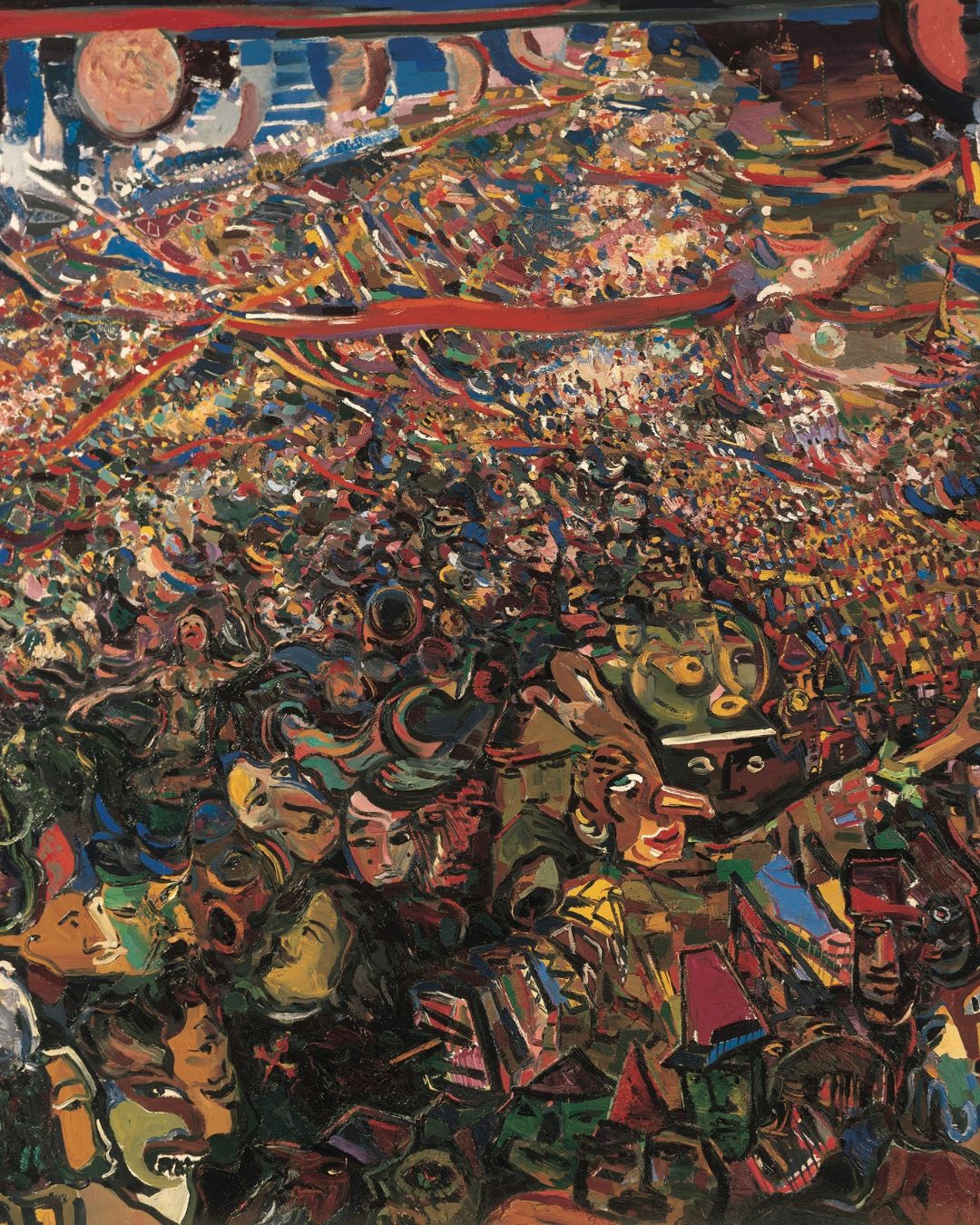
Carnival has always been a source of inspiration for visual artists around the world. Its masks, costumes and bright colours translate the popular festival onto canvas, sculpture and contemporary installation. Painters capture the joy, transgression and movement of the streets, while sculptors and artisans reinterpret traditional forms and materials to create objects that dialogue between tradition and innovation. In this sense, carnival is not only a social event, but also a creative laboratory that transforms the ephemeral experience of the festival into lasting art.
Catalonia dresses up for Carnival and brings us closer to The Great Carnival of the World, one of Joan Abelló's most outstanding works, which can be visited in his house-museum in Mollet del Vallès. Painted between 1978 and 1979, the work reflects the period in which Abelló maintained contact with Salvador Dalí, a fact that is perceived in the faces of Velázquez and Dalí, who face each other at one of the lower ends of the painting. Another notable feature are the African masks that appear in the center, adding an exotic and symbolic touch to this pictorial celebration.
The work depicts a carnival full of colors and figures, often described as a painting that captures the essence of Joan Abelló's journey and way of seeing the world. It is a scene that seems to unfold in multiple corners of geography, as if each glance discovered a new history or culture. A tireless traveler, Abelló traveled to various places in the world, and his visit to Venice, the epicenter of the European carnival, left a visible mark on the composition: elements of this city, such as the masks and the chromatic richness, merge with other influences to create a unique visual universe, full of fantasy and movement.


You may be
interested
...