Exhibitions
Gerhard Richter: the major retrospective that redefines six decades of contemporary art
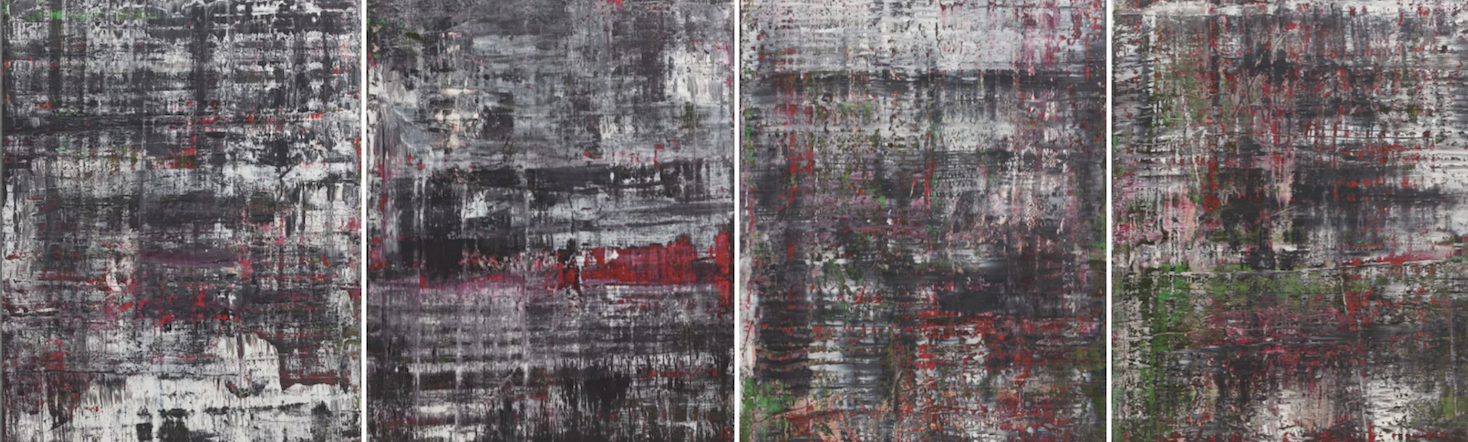
From October 17, 2025, to March 2, 2026, the Fondation Louis Vuitton in Paris will host one of the most ambitious exhibitions in its recent history: a comprehensive retrospective dedicated to Gerhard Richter, a pivotal figure in contemporary art and one of the most influential artists of the last century. Born in Dresden in 1932, Richter lived through the major political and cultural events of postwar Europe. In 1961, he escaped from East Germany and settled in Düsseldorf, a move that profoundly shaped his artistic vision. Years later, he established himself in Cologne, the city where he continues to live and work.
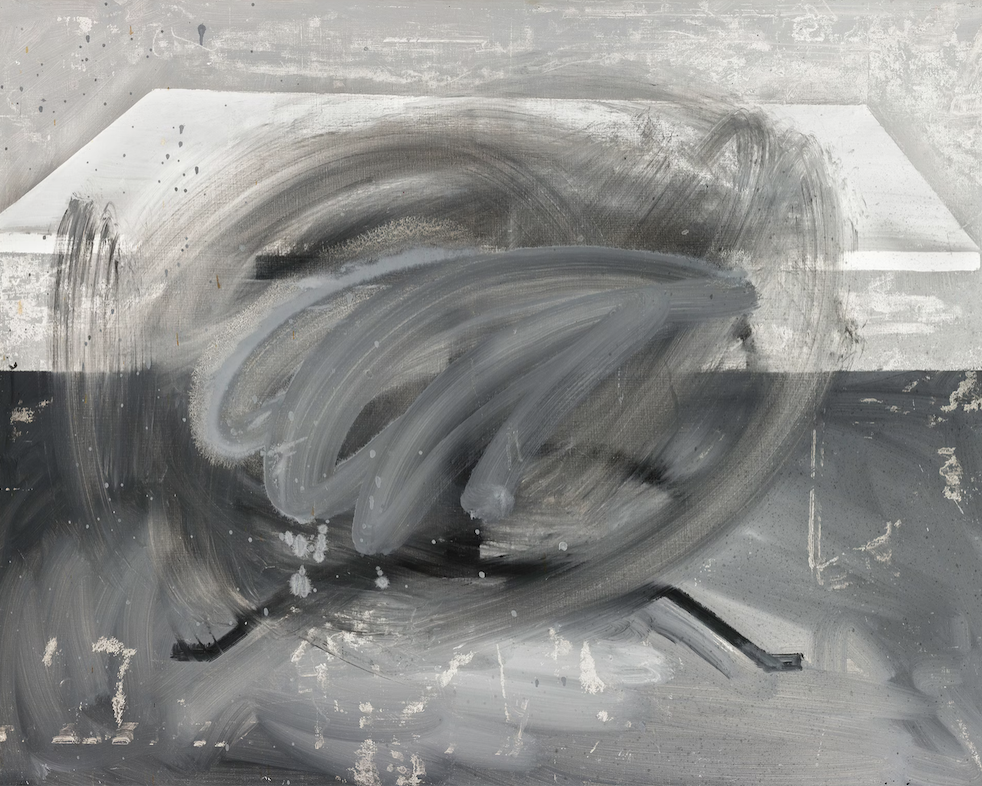
Gerhard Richter, Tisch, 1962 (CR 1), Private Collection © Gerhard Richter 2025 (18102025) | Photo credit: © Jennifer Bornstein.
True to its mission of celebrating the great artistic voices of the 20th and 21st centuries, the Foundation—which in recent years has dedicated solo exhibitions to names such as Jean-Michel Basquiat, Joan Mitchell, Mark Rothko, and David Hockney—is this time devoting all of its exhibition spaces to Richter. The result is an immersive journey that offers a panoramic view of more than six decades of his work: from his early figurative pieces based on family and press photographs to the monumental abstractions that have earned him international acclaim.
The exhibition highlights not only the breadth of media Richter has explored—painting, drawing, manipulated photography, glass, and new materials—but also the coherence of a body of work that, despite its stylistic diversity, maintains as its central focus a critical reflection on image, memory, and perception. Presented with a carefully articulated chronological approach, the exhibition allows visitors to follow the evolution of an artist who has questioned the boundaries between reality and representation, between gesture and chance, between the visible and the hidden.
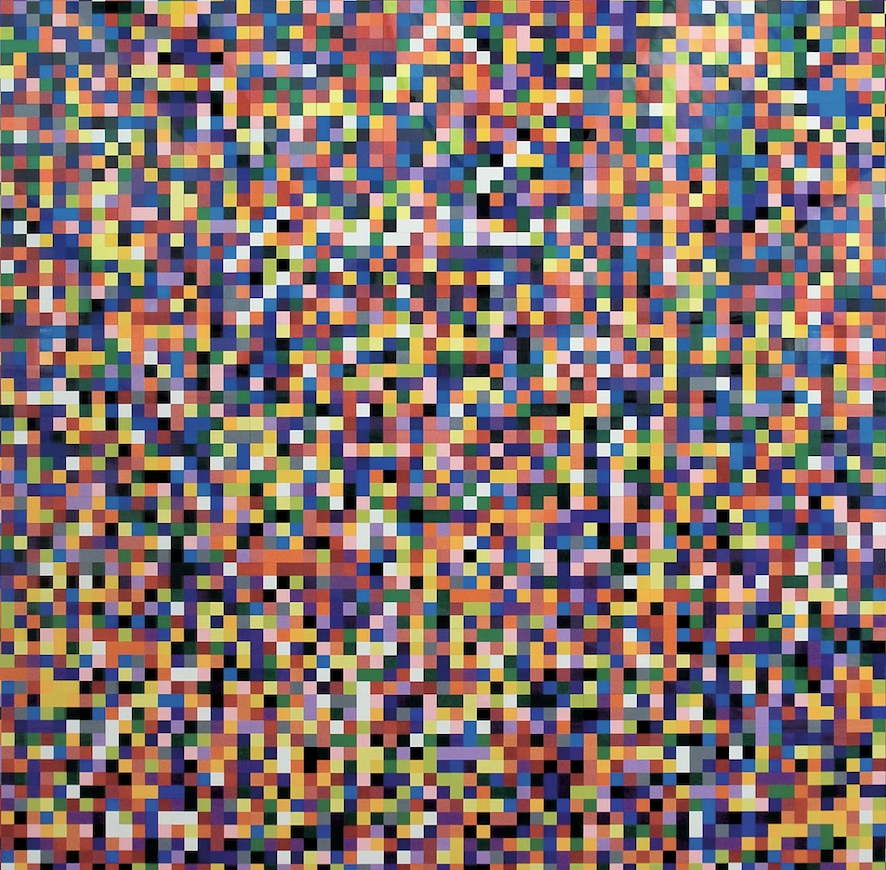
Gerhard Richter, 4900 colors, 2007. Lacquer on Alu Dibond, Fondation Louis Vuitton, Paris © Gerhard Richter 2025 | Photo credit: © Primae / Louis Bourjac.
With this retrospective, the Fondation Louis Vuitton reaffirms its role as a key institution in the dissemination of international contemporary art, offering a unique opportunity to rediscover a creator whose work continues to challenge our way of looking at the world.
On numerous occasions, Richter has flirted with banality, and even kitsch or sentimentality, always exploring that edge where emotion and detachment meet. Among his most emblematic pieces is Uncle Rudi (1965), where the artist portrays his uncle in uniform with an awkward smile, frozen in a moment that reveals as much as it conceals. The work functions as a haunting reminder of German history and, at the same time, as an example of the calculated coldness with which Richter revisits the intimate.
Meticulous and almost obsessive in his inclination to classify, enumerate, and archive, Richter has spent decades organizing his work into thematic categories and compiling thousands of visual references in his monumental Atlas. It is no surprise, then, that he has been the subject of numerous retrospectives and reinterpretations. Each has told a different story: one need only recall the 2020 exhibition at the Metropolitan Museum of Art in New York, which barely had time to open before being shut down by the outbreak of the pandemic. As is always the case with Richter, every exhibition is just one possible version, another way of looking at a universe in perpetual motion.
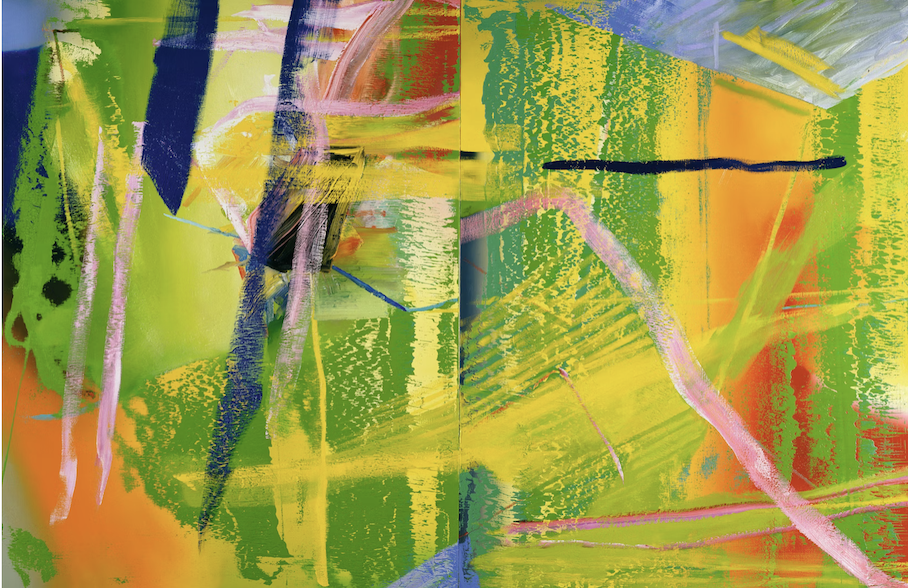
Gerhard Richter, Lila, 1982 (CR 494) Fondation Louis Vuitton, Paris | © Gerhard Richter 2025 Photo credit: © Primae / Louis Bourjac.
Gerhard Richter was already featured in the inaugural exhibition of the Fondation Louis Vuitton in 2014, which showcased a significant selection of works from the museum's collection. A decade later, the Parisian institution pays tribute to the artist with an exceptional retrospective, unprecedented in its scale and the span of time it covers. With 275 pieces created between 1962 and 2024, the exhibition offers an extraordinarily comprehensive overview of Richter's evolution over more than sixty years of work.

You may be
interested
...