
News
Discrepancies about the state of conservation of Sixena's paintings: the MNAC rejects accusations of humidity
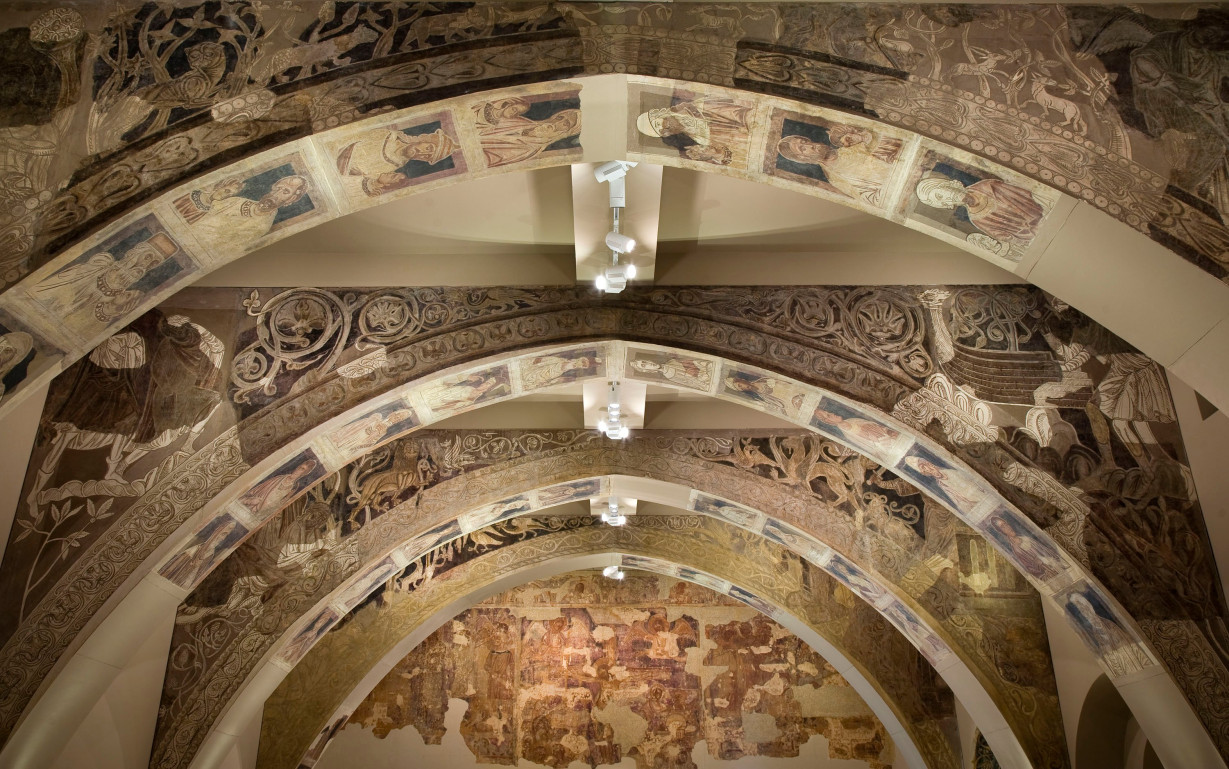
A few days ago, technicians from the Government of Aragon carried out an inspection of the mural complex of Sixena preserved at the National Museum of Art of Catalonia (MNAC), during which they detected signs of humidity in the paintings. This observation was communicated by the Director General of Culture of the Aragonese government, Pedro Olloqui, who indicated that the situation reinforces the urgency of proceeding with the transfer of the works to the Monastery of Sixena. In view of these statements, the MNAC has issued an official response, offering its technical and institutional assessment of the state of conservation of the mural complex and the procedure to be followed.
"It's an absolute lie," was how resolute the MNAC was in response to the accusations of the Aragon Government. "In room 16 where the paintings are located there is no humidity," the museum clarifies. "It's another thing if there are damp spots, but they are old and perfectly documented," they added.
According to technicians at the National Art Museum of Catalonia, since the murals have been installed in room 16 of the museum, they have not suffered any damage from humidity. They explain that this would be technically unfeasible, since the space is surrounded by other rooms – both above, below and to the sides – which prevents water from penetrating from the outside.
Regarding the alterations observed, such as cracks, lifting of paint or signs of humidity, the MNAC specialists point out that they are a consequence of the exceptional history of these works. They recall that the paintings survived a fire and were rescued in extreme conditions, in the midst of war. In addition, in the restoration processes, organic materials were applied to inorganic supports, which over time have reacted differently. They also highlight the fragility of the materials that make up the set, such as the adhered canvases and the old wooden structures.
With this letter, the MNAC responded to the letter sent by the Aragonese legal services to the Huesca court. A report that was accompanied by a series of photographs showing the humidity. The photographs that would show the presence of humidity were taken by technicians from the Government of Aragon at the end of July, during the technical inspection initiated at the National Museum of Art of Catalonia to supervise the state of conservation of the mural paintings of Sixena.
As detailed by Pedro Olloqui, the images show moisture on the back of one of the paintings, specifically “in a corner of an archway in one of the main areas” of the mural complex. Several specialized technical procedures were used to capture these images, such as 360-degree cameras and devices mounted on poles. The Director General of Culture of the Government of Aragon has described the detection of moisture as “bad news”, since, as he has expressed, it is indicative of deficiencies in the conservation work.
In this sense, he announced that the Aragonese executive has requested Court number 2 of Huesca —in charge of executing the sentence regarding the mural paintings of Sixena— to order the immediate transfer of the works from the National Art Museum of Catalonia (MNAC) to the Sixena monastery.


You may be
interested
...