Exhibitions
Daniel Buren transforms perception in his new series 'Du cercle aux carrés' in Paris
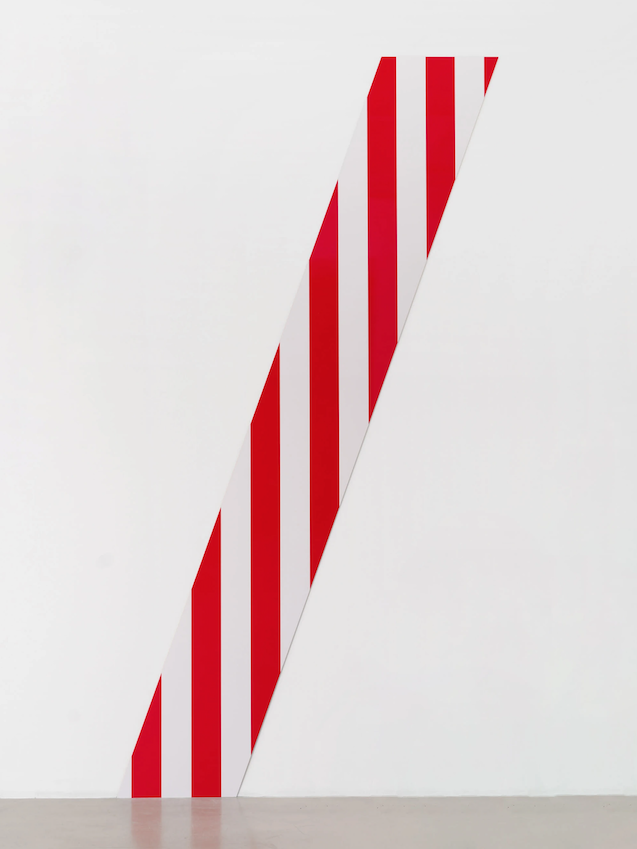
The Mennour Gallery in Paris presents a new series of works by Daniel Buren in which the artist continues to explore the boundaries between painting, object, and architecture. In Du cercle aux carrés (Of the Circle with Squares), Buren brings together high and low reliefs incorporating mirrors, randomly chosen industrial colors, and, of course, his emblematic visual tool: the 8.7 cm vertical stripes, white and colored, a constant motif that functions as a fixed sign against the incessant flow of formal and spatial variations that surround it.

Daniel Buren, « Du cercle aux carrés, hauts-reliefs situated et in situ », Mennour (47 rue Saint-André-des-Arts, Paris), 2025. Details. ©️ DB-Adagp, Paris, 2025. Photo. Mennour Archives. Courtesy of the artist and Mennour, Paris.
These pieces, on display until December 20, exist in a space between two-dimensionality and three-dimensionality, playing with the viewer's perception. Each work presents a unique composition of prisms and chromatic solids arranged on an imaginary circular surface, organized into regular grids. The elements—sometimes aligned, sometimes intersecting, or configured like a game board—create a dialogue between order and chance, structure and visual displacement.
The mirrors multiply these geometric patterns, creating echoes and repetitions that transform the space around the artwork. Buren's iconic stripes appear on the sides of the volumes, hidden at first glance but revealed in the reflections, reminding us that his visual language not only marks surfaces but also activates its surroundings. The result is a collection of site-specific works that modify the visitor's perception as they move through the space, making the experience a shifting and profoundly sensory journey.
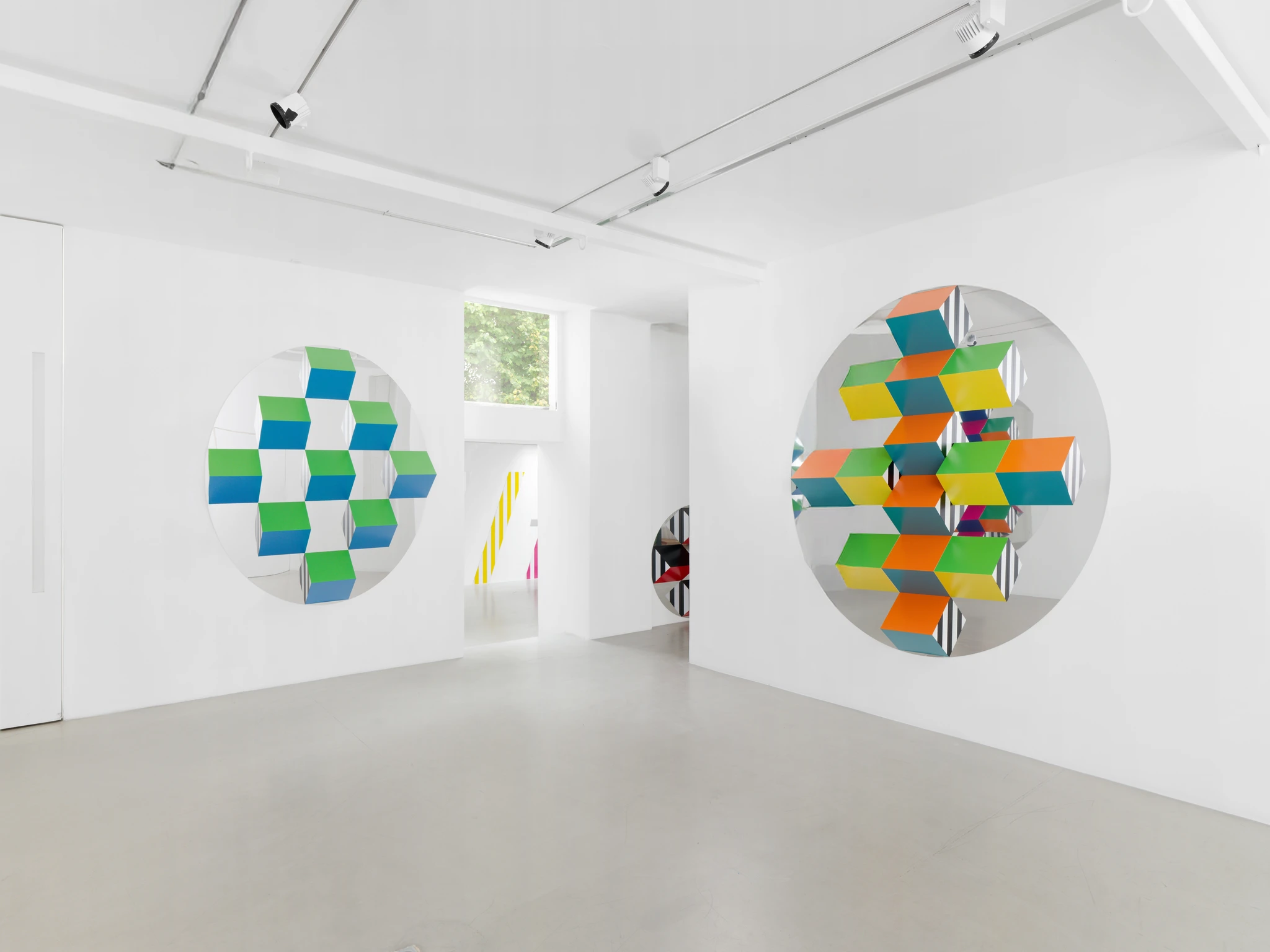
Daniel Buren, « Du cercle aux carrés, hauts-reliefs situated et in situ », Mennour (47 rue Saint-André-des-Arts, Paris), 2025. Details. ©️ DB-Adagp, Paris, 2025. Photo. Mennour Archives. Courtesy of the artist and Mennour, Paris.
Although Daniel Buren does not directly intervene in the architectural structure of the space on this occasion, his works generate a profoundly poetic and sensory movement that is activated solely by the presence of the visitor. As the public moves through the room, the reflective surfaces of the reliefs become engines of transformation: they multiply what is visible, fragment the environment, and silently reorganize the relationships between light, color, and volume. Each movement produces a new constellation of lines, reflections, and shadows, so that perception never fully stabilizes.
Far from being static objects, the pieces function as optical devices that incorporate the space and those who inhabit it. The mirrors capture fragments of the environment—a detail of the ceiling, a corner of the room, the fleeting gesture of a visitor—and reincorporate them into the work, creating a perpetually renewed dialogue between the interior and exterior of the object. Thus, the reliefs behave like visual organisms in a continuous process of mutation, open to the contingency of each gaze and each step.
This perceptual mobility transforms the viewer into an essential element of the composition. Their body, reflected and framed, contributes to the chromatic geometry of the prisms, while the surrounding space is absorbed and redistributed in infinite combinations. Consequently, the works are not merely observed: they are experienced. They reveal their changing nature only through movement, making each visit unique and the space itself seem to breathe along with the movement of those who traverse it.
You may be
interested
...