
Exhibitions
Caterina Miralles questions the Venetian landscape at ADN Galeria
Space Still. Architectures to Read the Landscape reviews the mechanisms, infrastructures and interventions that support the Venice lagoon, in a proposal that tensions the boundaries between nature, architecture and artifice.
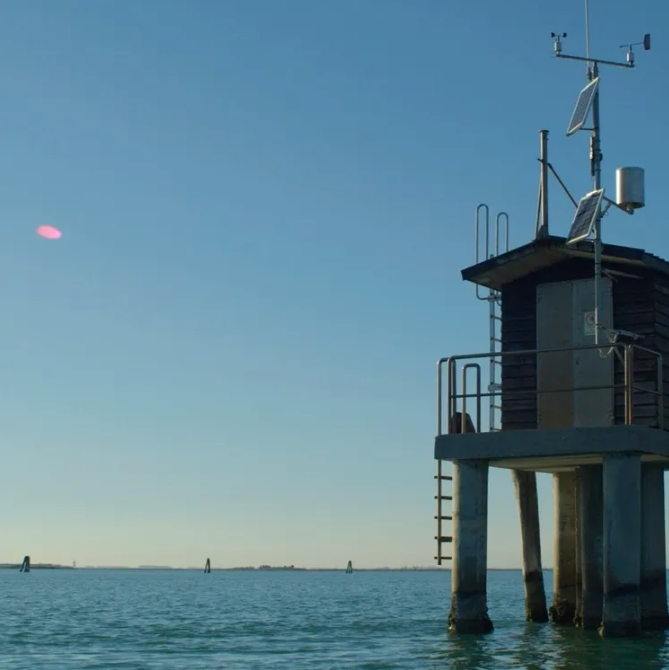
With The Space Still. Architectures to Read the Landscape, Caterina Miralles places the Venice lagoon at the center of an artistic investigation that questions the forms of persistence, control, and transformation of the territory. At ADN Gallery in Barcelona, from November 28 to January 23, the artist unfolds an architectural reading of the landscape that combines documental, speculative, and experimental approaches to reveal the infrastructures, systems, and operations that make possible the continuity of a deeply intervened ecosystem. Through translucent sheets, videos, models, aerial photographs, computational data, fieldwork, and interviews, the exhibition constructs a multiple look at a territory where the natural rhythms of the water have often been concealed beneath a complex architecture of management and representation.
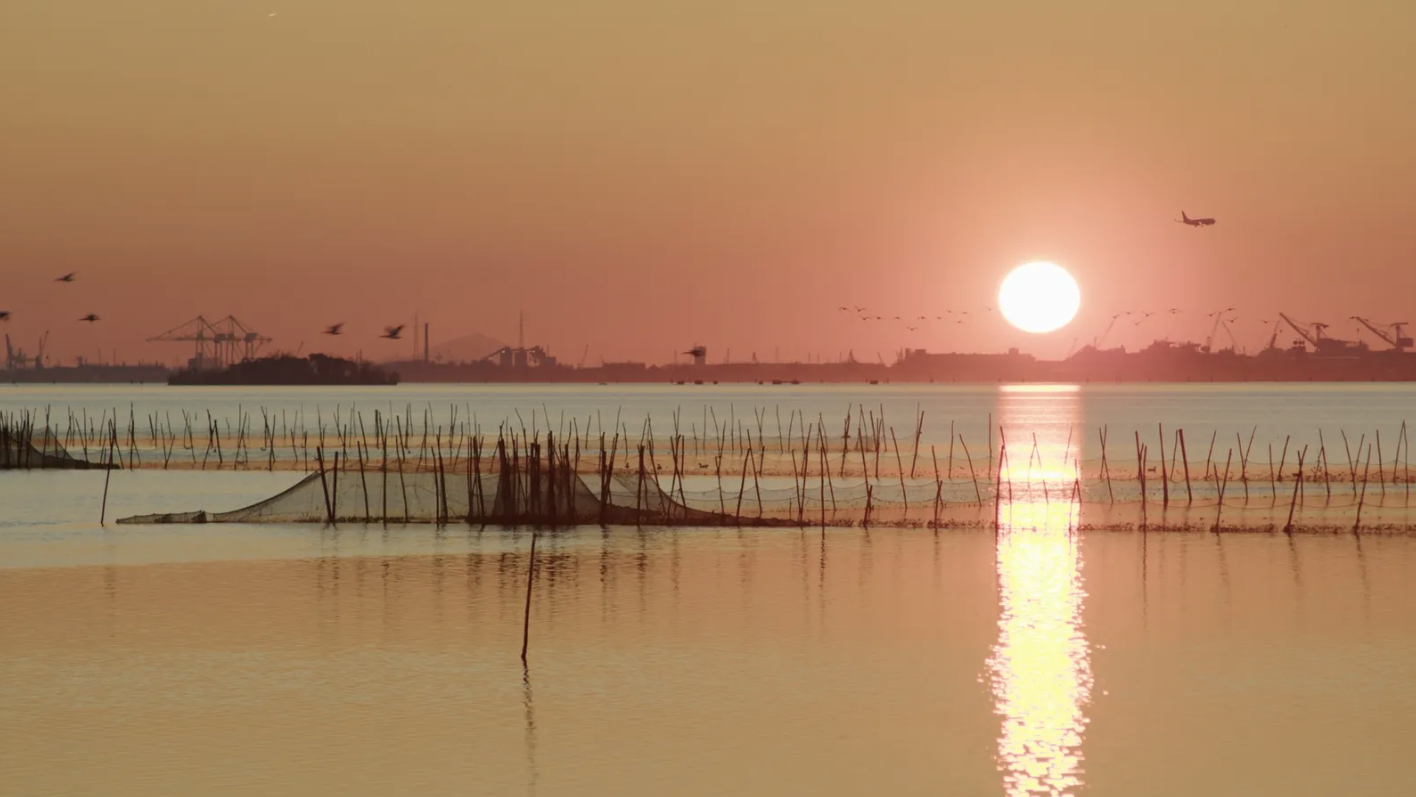
The lagoon, subject to constant processes of sedimentation, erosion, and exchange with the Adriatic, has undergone a historical transformation that has altered its dynamics to preserve conditions of navigability, habitability, and stability. Miralles questions this idea of permanence, showing how landscape conservation demands continuous intervention in its becoming. Venice appears, thus, as a territorial fiction in which the image of a stable landscape is constructed through operations that are repeated and renewed. Artifice and nature are not presented as opposites but as elements that coexist and mutually condition each other, in an ecosystem where the boundary between naturalia and artificialia blurs.
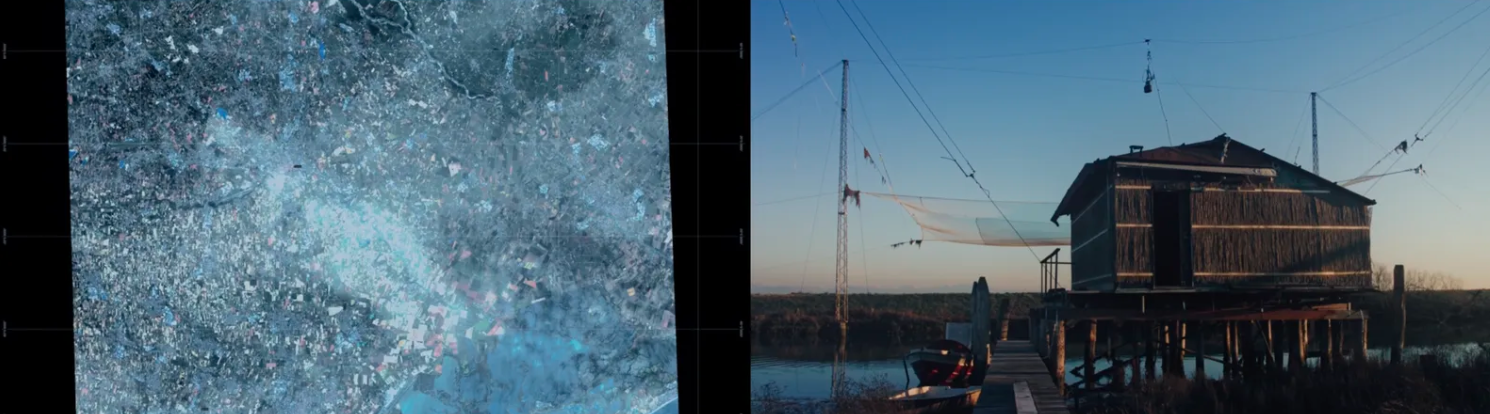
The representations that organize the exhibition journey work with different scales, registers, and temporalities. The reading of the territory becomes a form of anticipation and projection, but also a critical exercise on the instruments that allow measuring, modeling, and governing the landscape. The history of river diversions, canal excavations, and mouth modifications evidence a sustained will to control the water circulation. This logic has acquired a new dimension with contemporary technification: tidal stations record sea level variations at five-minute intervals, while the MOSE system, with its gates located at the three lagoon mouths, enables temporarily isolating the territory from the Adriatic during acqua alta episodes.
Conservation reveals itself, in this context, as a form of perpetual domestication. Each operation attempts to sustain the conditions of a landscape that, despite infrastructures and control devices, continues to be alive and in motion. The exhibition also introduces a reading linked to the capitalocene, where hydraulic interventions and territorial protection strategies intertwine with contemporary dynamics of commodification. The preservation of the city coexists with an economic logic that tends to subordinate the territory to real estate and tourism performance, posing a tension between the permanence of the scene and the continuity of the lives that make it possible.
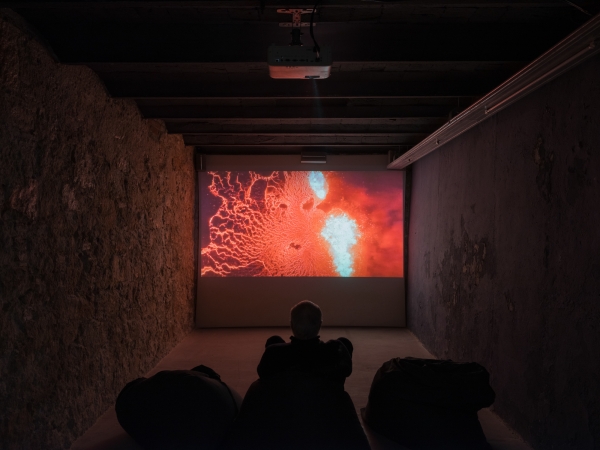
One of the works that concentrates this perspective is Sonde: Experimental studio on the wave motion phenomenon (2026), which recovers images from experiments carried out at the Maritime Laboratory of the University of Padua and at the Voltabarozzo Experimental Centre. In these spaces, reduced-scale simulations allow studying the behavior of water and the response of infrastructures in maritime environments. The models become forecasting and control instruments, but also show how reducing the territory to an experimental model allows intervening in its complexity and turning it into an object of knowledge and governance. The project dialogues with 0.5 (2025), a video installation presented at the Venice Architecture Biennale, where Miralles confronted quantitative data from databases with qualitative records linked to fishermen’s knowledge, folk traditions, and local experiences. The dual-channel montage articulated two temporalities and scales to highlight the consequences of intervention on the lagoon.
The laboratory collages function as atlases and counter-maps that superimpose plans, nautical charts, photographs, and territorial records. Using materials such as aerial images from the 1978 REVEN flight, which mapped the lagoon, frames from 0.5, and other documents, the artist constructs a visual system that confronts cartographic rationalization with the instability of water. The plans and coordinates attempt to fix a territory that, by its very nature, escapes the rigidity of models. Prints on acetate, superimposed or shifted from their cartographic references, allow approaching locations from a materiality that questions the conventional representation of landscape.
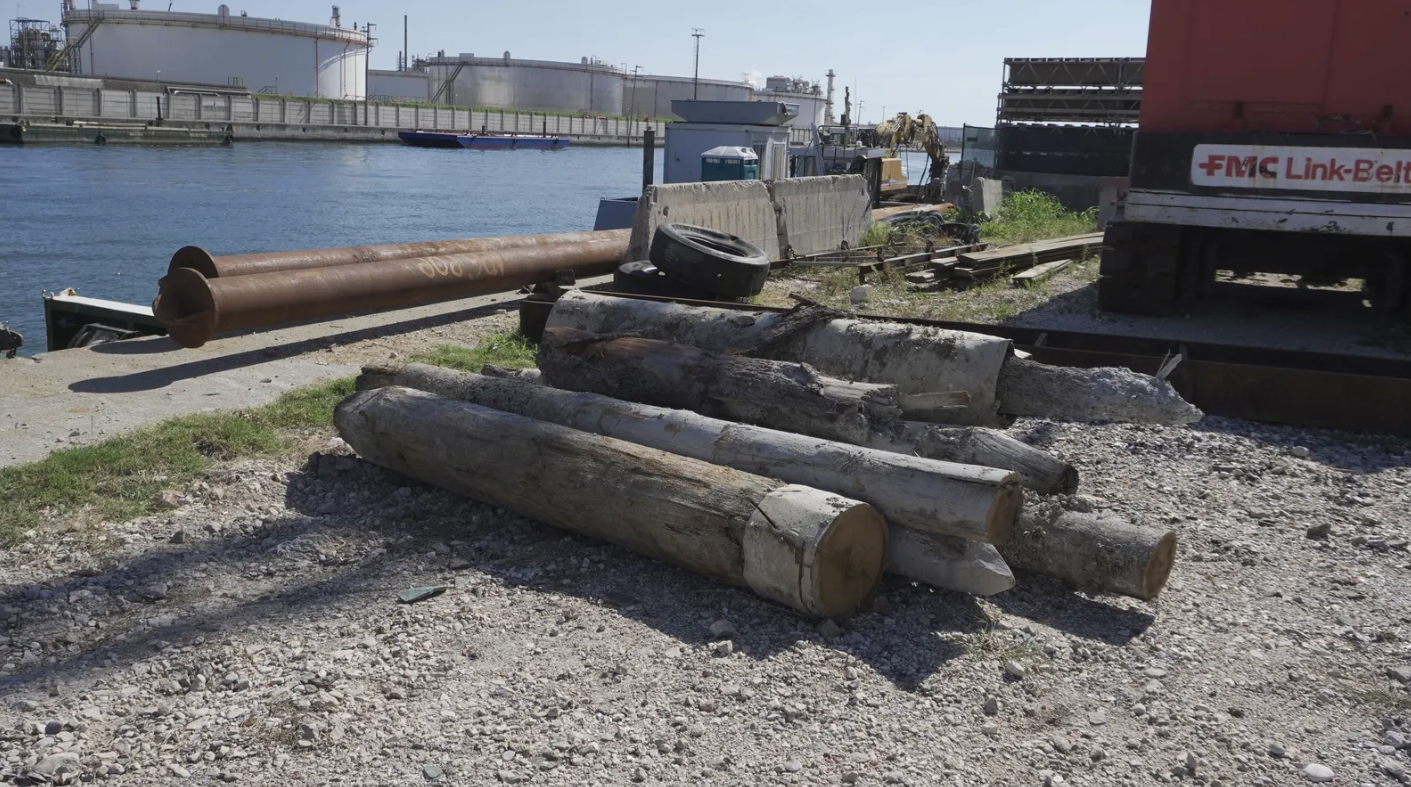
At the center of the exhibition, a briccola from the port of Marghera introduces a physical and symbolic dimension. This wooden element, traditionally used to indicate depth and guide navigation, also incorporates traces of the microorganisms that inhabit it, in a biofouling process that transforms its surface while the wood continues to degrade. Miralles transfers the piece to the gallery in a horizontal arrangement, altering its function and proposing a reading that shifts the navigation element toward an exhibition object and, potentially, a bench. The briccola, which in the nocturnal context of the lagoon may acquire the name coccodrillo, becomes a presence materializing the coexistence of infrastructure, degradation, life, and transformation.
You may be
interested
...