Exhibitions
Carlos Casas and the seismic memory of Krakatoa
At àngels barcelona, Journey to the Center of the Earth presents an artistic investigation into the geological forces of the planet through sound, vibrations, and image, in a dialogue between science, fiction, and sensory experience.
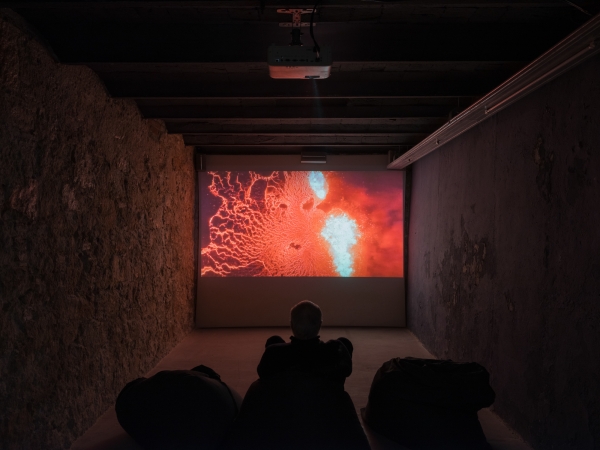
The Earth hides phenomena that escape human perception. Geological forces, seismic movements, and sound frequencies that, despite being part of the planet's dynamics, usually remain outside our sensory field. From this invisible dimension, Carlos Casas constructs Journey to the Center of the Earth, an exhibition that transforms the angels barcelona space into a territory of physical and perceptive experimentation. The exhibition, which can be visited from November 6, 2026, to January 16, 2027, presents part of the research developed by the artist around Krakatoa (2026), his film inspired by the eruption of the Indonesian volcano in 1883, considered one of the most extraordinary geological and acoustic manifestations in history.
The exhibition takes this episode as a starting point to investigate the relationships between sound, vibration, and matter, and to explore how a natural event of extreme magnitude can be reconstructed beyond its visual representations. For years, Casas has worked with sound models of volcanic eruptions, contemporary seismic studies, and recordings of low frequencies and infrasounds. This research has led him to develop vibratory transmission devices capable of transforming seismic signals into physical experiences, so that the body also becomes an instrument of listening and knowledge.
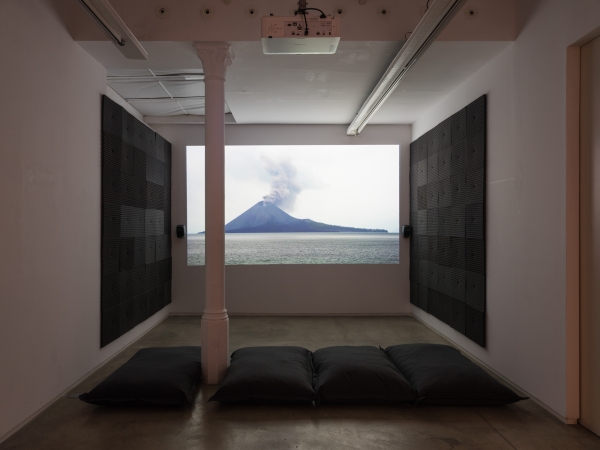
In the display window and the gallery's main room, several transducers reproduce the frequencies and vibrations associated with the 1883 eruption. The result is a two-hour sound and vibrational composition that modifies the way of inhabiting the exhibition space. The low frequencies travel through the gallery and extend out to the street, making the experience depend not only on hearing but also on bodily perception. The viewer thus comes into contact with a dimension of the event that images and conventional sound recordings can hardly convey.
This research gains a new temporal projection with Krakatoa 2066, a sound project conceived for a platform equipped with transducers. The device invites the visitor to lie down and physically experience the vibratory reconstruction of a possible future eruption of the volcano, imagined for the year 2066. The proposal introduces a speculative perspective that shifts the research from reconstructing a historical event to imagining an event yet to come. Past, present, and future coincide in an experience that questions our perception of geological time.
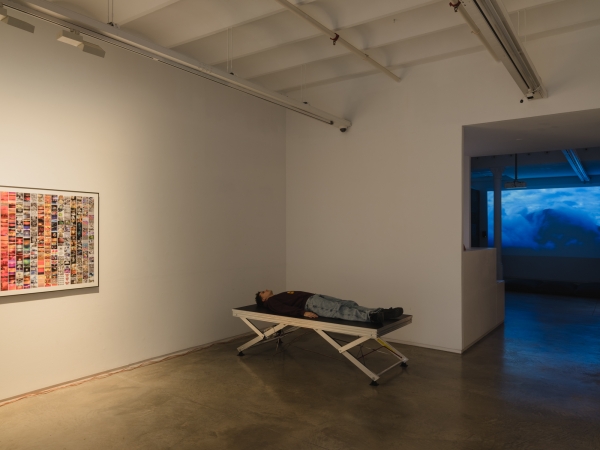
The documentary dimension of the project unfolds in Krakatoa Archive Board IV, a set of images, documents, and research materials that allow retracing the different lines of investigation that have accompanied Casas’s creative process. The visual archive reveals the sources and explorations that have contributed to shaping the film and also constitute the conceptual foundation of the exhibition.
In the second room, Krakatoa 2018 recovers images of the volcano before the great eruption of that year, establishing a correspondence between the historical episode of 1883 and contemporary manifestations of volcanic activity. The journey continues in the basement, in the minicinema space, with the video Journey to the Center of the Earth. In this piece, the artist proposes a mental and physical approach to the interior of the planet based on documentation about the minerals that make it up, from the surface layers to the core. The flickering of the image, or flicker, acts as a perceptual resource to guide the viewer in this inner journey and suggest an exploration of what remains hidden beneath the Earth's surface.

You may be
interested
...