
Editorial
Leonel Castañeda: of atavistic bodies, visceral scissors, and theater in formaldehyde
He is a surgeon of art and of the metaphor of the soul, shy —he seems to have never broken a plate, but he will break entire dinnerware sets if necessary—. Cultured, although he does not need to prove it, and with a mischievous look, obsessively intelligent when he wants to achieve something. He is precise, extremely precise and perfectionist when he creates his works or plans the setup of his installations. And he is forceful when he amputates printed bodies that emerge from the paper that is a magazine or review, which had previously been a tree.
He is also a collector —without becoming a Diogenes— of multiple prints that come from the invention Gutenberg gave humanity. An invention that has multiplied the image environment and which today we have pushed to the extreme. Humans specialize in collapsing systems. It’s in our nature.
In his operating room in Bogotá, which became an artist's studio, there is no anesthesia for clichés; there the image, once detached from the page that tamed it, regains its power to unsettle us, and the recovered object is forcefully reinstalled in the form of an organic installation. Or when he is thinking out loud —he teaches ways of seeing future paths at the university—, he always has in mind his narrative to create other derived works that emerge from the everyday, from other objects already created by past imaginations.
Castañeda dissects the obvious and the cancers of society to reconstruct them; he turns found objects into Duchampian artifacts. He traces every remnant with the precision of a surgeon and the ferocity of a butcher. His material is the memory that others have rejected. His material is matter that already has a past, that has history or microhistory, as Miguel de Unamuno put it.
In his narrative, the theme is always bodies subjected to the barbarity of history —sometimes his installations exude disturbing essences reminiscent of Christian Boltanski— or the lust of vanity in a terrifying post-capitalism; making objects reemerge, like a phoenix, is the object of his desire. Like a dressed-up street sweeper, he traverses —physically and spiritually— neighborhoods and among the rubble, among the detritus of the vox populi, he finds the papers to generate collages, as well as magical objects transformed into sculptures and artistic installations that, with a spotlight, much care, work and intelligence, are elevated to the category of culture. Artistic artifacts deflowered, already converted into installations that chase the shadow of Platonic truth.
Entering his world, into the heart of darkness, is discovering the obscene in life, art, and the passion that moves and stirs us all.
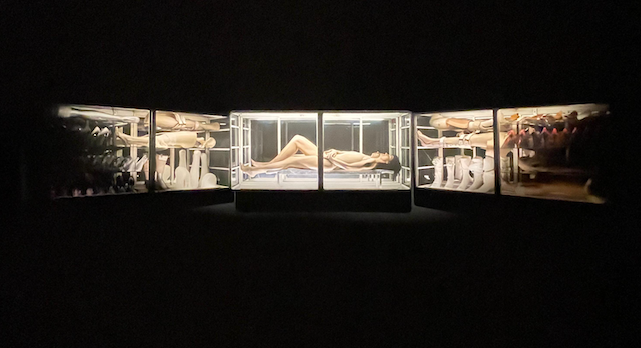
View of the exhibition The Body of Bodies by Leonel Castañeda. Photo Pere Duran / Nord Media.
And it is precisely there, behind the scenes and in darkness, where collage ceases to be a procedure and becomes thought, a perfect method for his accumulative ideas to stratify perfectly. Picasso introduced it in 1912 and Braque followed, pasting papers that mimicked wood grain. A piece of the world burst into the painting and argued with its image. The scissors no longer just cut: they changed the meaning of reality.
The Dadaists took the operation to the street and the newspaper. Hannah Höch crossed bodies, genders, and machines; John Heartfield turned photomontage into a weapon against fascism. Josep Renau absorbed that energy and extended it from the Republic and exile. In “The American Way of Life” he used the brilliant iconography of consumption to strip the dream being sold: the smiling body alongside violence, abundance alongside its victims, seductive color alongside the mechanism sustaining it.
Life magazine became both a quarry and an adversary. The scissors now became the pencil and/or the brush. Much later, Joan Brossa condensed a perfect metaphor about the tool itself and thought in “Eina morta,” cut scissors: the tool wounded by its own gesture. The new tool, the precedent of AI or current Photoshop, had been mutilated, pain in a loop, self-destruction as a symbol of the human, of being too human.
COVERED ANATOMY
Castañeda knows that lineage, although his scalpel also penetrates other depths. Heartfield and Höch questioned the face of power; Renau, its showcase. Leonel reaches the flesh that those images model. The Colombian thinks for his manipulations about the great nineteenth-century anatomy books, true printed bibles: the folios of Bourgery and Jacob, for example, which Taschen has returned to our tables in a monumental volume.
Old typeface, the sheet that opens muscles as if unfolding a map, the seductive precision with which engraving turns the body into a legible territory. Each page already has its past before Castañeda’s scissors reach it. He does not cut a blank anatomy: he intervenes in the gaze of another century, its will to classify, and lets that knowledge be contaminated by desire, violence, and memory.
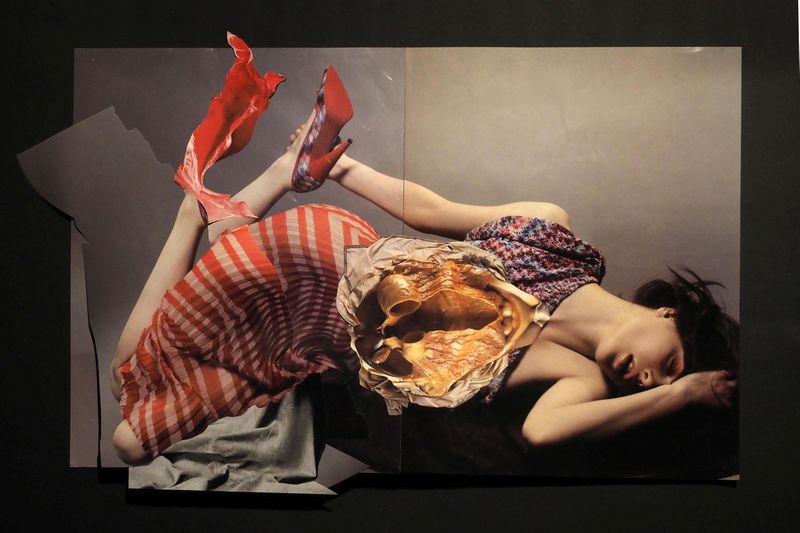
View of the exhibition The Body of Bodies by Leonel Castañeda. Photo Pere Duran / Nord Media.
I also seem to glimpse Hans Bellmer as an uncomfortable relative in Castañeda’s artography. His dolls, drawn, photographed, or sculpted and articulated, conceived in 1930s Germany, could lose the order of their limbs and acquire combinations as fascinating as disturbing. The body became disassemblable under a gaze that desired and dominated it: denial of normative anatomy and violence over the female body.
In the series Covered, the installation he presents at Espacio El Dorado, that discomfort changes direction. The figure of the covered woman from Lima —mantilla, veiled face, only one eye visible— comes from colonial history and also appears as a contemporary burka of the gaze: black on black, a presence that refuses to be entirely consumed. The penetrating eye that sees everything —very Egyptian, very Masonic— emerges as a luminous incision in a delirious surrealism.
Unlike Bellmer, who undresses and articulates the body at will, these women cover themselves and look back at us. The concealment can be imposition, but also a way to escape the viewer’s dominion. In that fantastic installation, the one who thought they were looking without being seen discovers that the eye on the other side of the veil was interrogating them.
For some reason, not quite clear to me, looking at Castañeda’s Covered series but from another visual artistic approach to the challenge of the gaze, the artist Sophie Calle comes to mind, who offers another twist on the fetish: she observes others' intimacies, collects traces, imposes rules on the desire to know, and exposes herself to that gaze. Who looks at whom? Who turns the other into an object?
In Covered, the female eye piercing the black returns the question to the viewer. Masculinity and femininity cease to be fixed places of power: they are positions that the gaze occupies and loses. We believe we possess a life by preserving its trace; the fragment reminds us of everything beyond our reach.
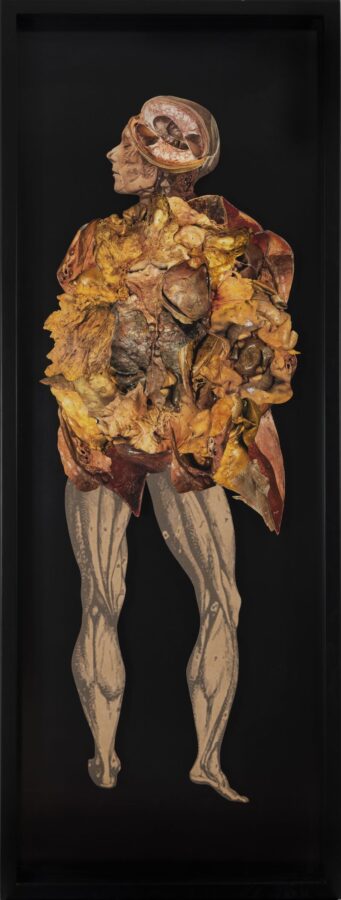
Leonel Castañeda, Untitled. From the series The Body Within, 2016.
AMPUTATED LIVES
The word amputation, however, carries more weight outside art. Gervasio Sánchez has shown this for decades in the photographic series Landmined Lives. His camera returned to people wounded by anti-personnel mines when the explosion had ceased to be news: after surgery, during prosthesis training, in adult life that an initial photo could not anticipate. The mine doesn't end when it explodes. Its war continues in steps, absences, missing money, the obstinacy to keep living.
Gervasio prevents us from reducing someone to the instant they were wounded. The person remains beyond the image that made them visible. Bringing him closer to Leonel does not mean turning real amputation into a neat metaphor. That would be indecent. It means recognizing two resistances to disappearance: the photographer returns to concrete people so history does not abandon them; the artist returns to discarded images and objects to ask what violence was already in the way they were looked at. Their languages are not confused. They call each other out from that difference.
In Bogotá, Castañeda found among abandoned papers a book about Colombian violence with photographs of murdered and mutilated bodies. He himself has spoken about his search for the anatomical, the pornographic, and the violated body. These are three archives that seem unrelated until placed side by side. They all manage access to the flesh. Some promise knowledge; others, pleasure; others, testimony. In all lurks the possibility that the person disappears behind the clarity of the image. His collage introduces a disruption in that clarity. It forces us to linger where the page wanted us to pass quickly.
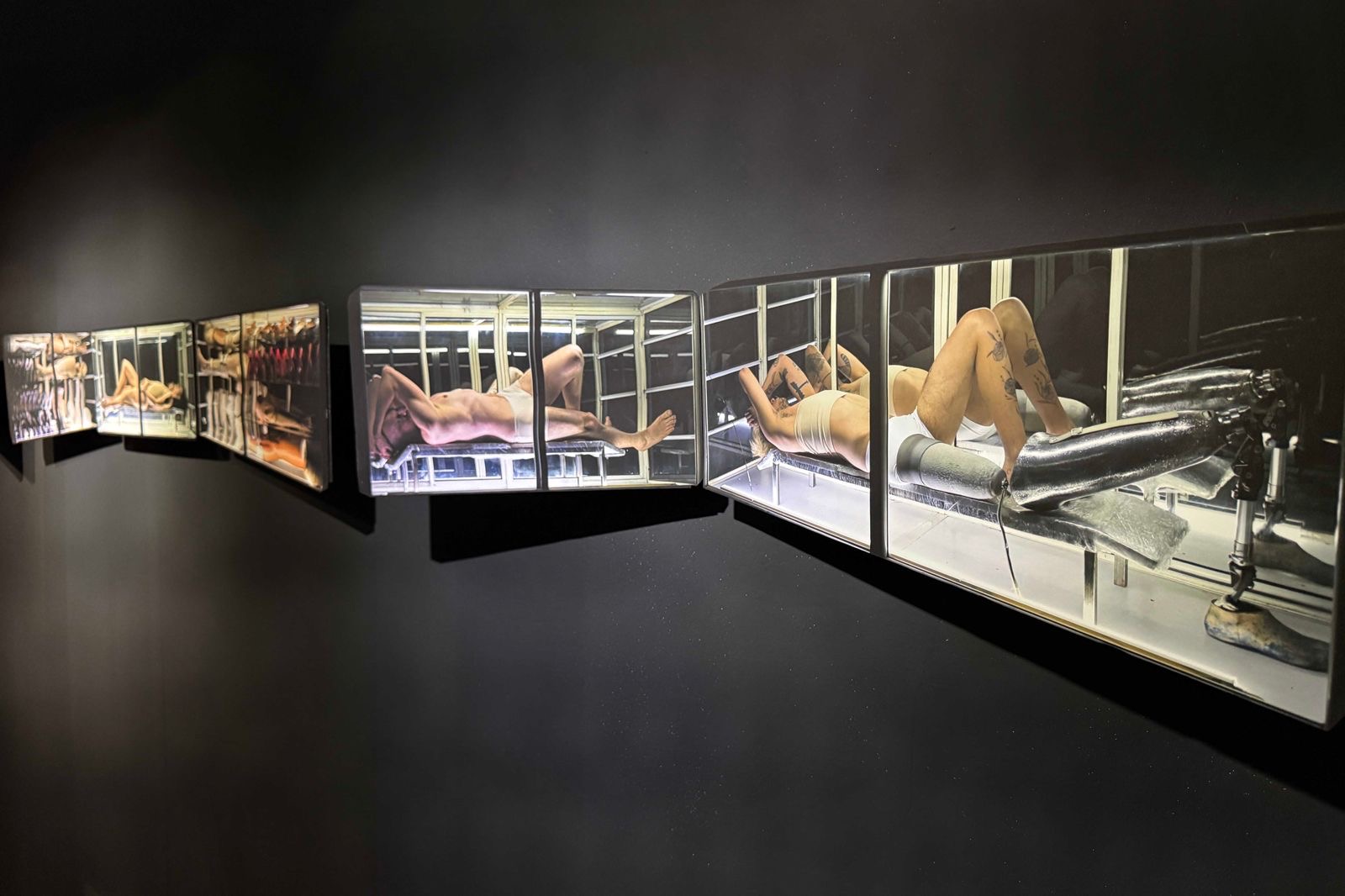
View of the exhibition The Body of Bodies by Leonel Castañeda. Photo Pere Duran / Nord Media.
THEATER IN FORMALDEHYDE
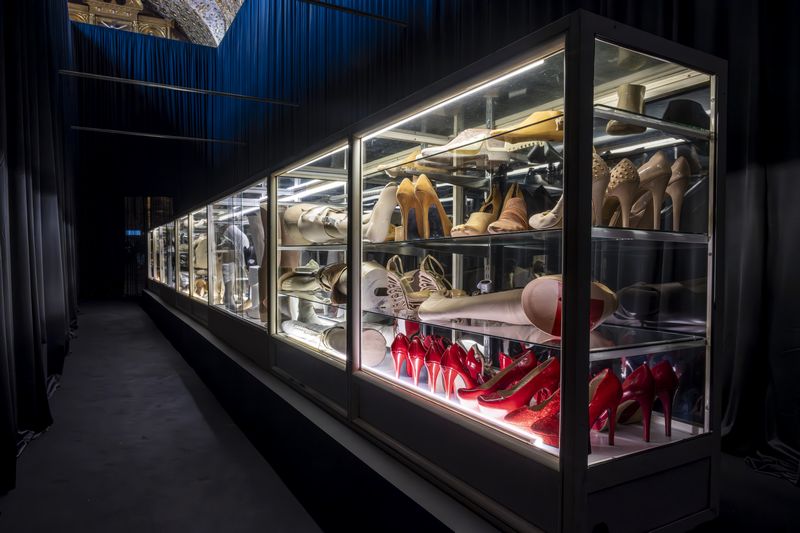
His urns with prosthetics, mannequin legs, heels, and anatomical models also possess that quality of stopped theater. What body is missing inside the display case that seems full of formaldehyde à la Damien Hirst and that seems to stop time? The body that is missing needed a prosthesis, was imagined to wear a shoe, or medicine reduced it to a model? Leonel’s found object, Duchampian in spirit, no longer just questions what can be called art. They are sculptural installations and video creations where the artist asks who and how can be seen, how to represent absence, and what a collection preserves.
The museum sometimes resembles a cabinet of curiosities and sometimes a waiting room —or a mortuary— where no one dares to pronounce the name of the absent. Part of this unsettling theater can currently be seen in Variations of the Present at the Museo de Antioquia, where Castañeda’s work dialogues with other ways of interrogating the body, memory, and absence.
This entire universe also unfolds in The Body of Bodies, at the Espai Isern Dalmau of the Fundació Lluís Coromina in Barcelona, until October 31. Afterwards, the exhibition will travel to the foundation’s space in Banyoles, where it will remain until the end of the year. From there it will embark on a tour through Europe, yet to be determined: like the fragments Leonel collects, the work will continue changing meaning as it encounters other cities and other gazes.
In Banyoles, it will also dialogue with the history of the Museo Darder, where a veterinarian, naturalist, and taxidermist from Barcelona accumulated his discoveries, which generated significant controversy from the late 1990s and for a decade.
The political scope of his poetics can also currently be seen in the collective exhibition Say Rage, at the Miguel Urrutia Art Museum (MAMU) of the Banco de la República, Bogotá, open until March 29, 2027, where a fallen lead flag screams: “nothing for the homelands.”
Leonel always screams in a silence that breaks and tears that capitalism produces things and also produces their oblivion; manufactures desirable bodies and discards those that do not fit the mold. Leonel collects what remains on the margins of both operations. He examines it with tenderness and with an analytical cruelty that prevents any easy consolation. He does not resurrect anyone, nor magically heals the wounds of history. He does something different: shows the scar, exposes the viscera and the artifice, and returns to the fragment —made collage— its capacity to ask us questions, to interrogate us.
This text has been previously published in Artishock magazine. The exhibition can be visited until January 30 at the Espai Eat Art of the Fundació Lluís Coromina in Banyoles, while at the Museu Darder in the same city a complementary dialogue will unfold expanding the project's perspectives and connections.

You may be
interested
...