News
The secular paintings of Sixena begin their transfer from the MNAC to Aragon
The dismantling of the eight panels, which begins this November 17, sets in motion the return of a pictorial ensemble measuring 25 linear meters that must arrive at the monastery by December 2.
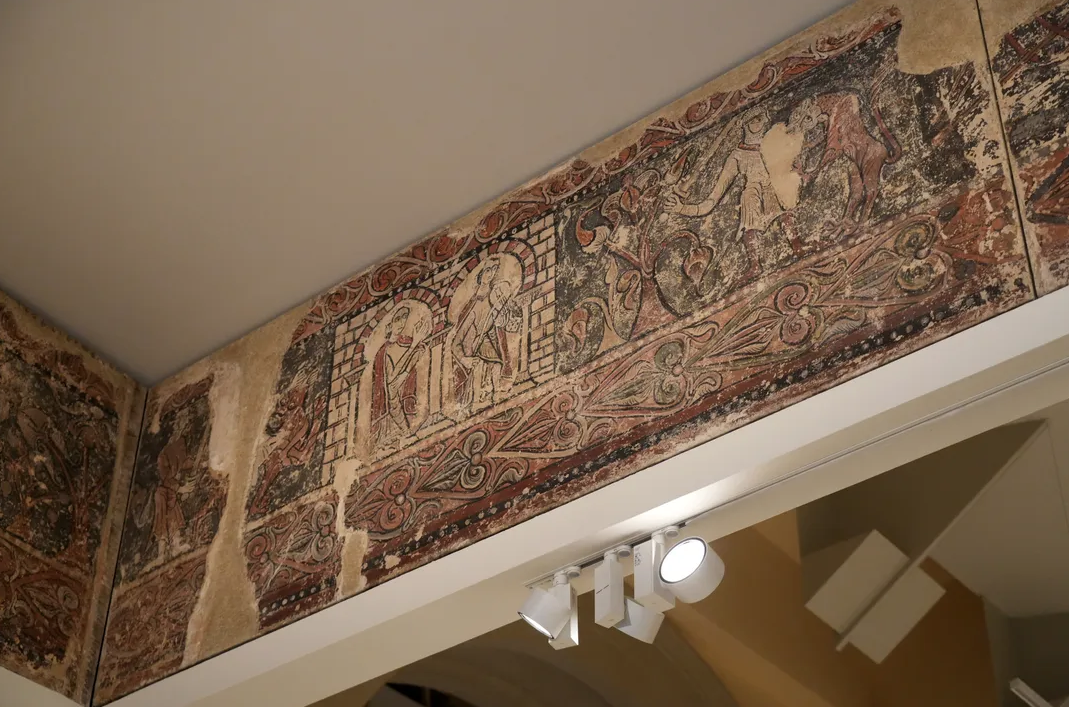
The secular paintings from the Sixena monastery preserved by the National Art Museum of Catalonia (MNAC) are taking the first steps toward their return to Aragon. After this past weekend, November 14 and 15, being the last opportunity to view them in the museum’s galleries, this Tuesday, November 17, the dismantling of the set will begin in compliance with the Supreme Court ruling ordering their restitution.
It is a pictorial ensemble of 25 linear meters, installed in the first Gothic art room of the MNAC and distributed across eight panels arranged in a rectangular form. The paintings, on secular themes, exalt the bravery of the Hospitallers of Saint John of Jerusalem, the order linked to the Sixena monastery. Unlike the murals in the chapter house, this set was not affected by the fire that devastated the monastery during the Civil War in 1936.
The uninstallation process will take place behind closed doors and will require keeping the room off the visitor route while the work continues. The operation, which includes dismantling, packing, and transport, will last approximately two weeks. It is expected that the paintings will arrive in Aragon on December 2 and that the crates will be opened two days later, on December 4. MNAC director Pepe Serra has assured that the artworks will reach their destination "without any alteration."
The commission for these tasks has been assigned to SIT Proyectos, Diseño y Conservación SL, a Madrid-based company that was the only bidder in the tender. The cost of the operation will be around 62,000 euros, an expense that the MNAC will have to bear in compliance with the court ruling.
The trajectory of these paintings also explains a significant part of their heritage uniqueness. They remained in the monastery until 1960, in a room next to the cloister, when they were moved to Barcelona under the direction of Joan Ainaud de Lasarte, then director of the Barcelona Art Museums. Since then, they have been part of the heritage preserved by the Catalan museum.
Their path is different from that of the frescoes in the chapter house, severely affected by the fire of 1936. At that time, a large part of the paintings disappeared and the fragments that could be recovered were in a very delicate state of conservation. The Generalitat promoted their safeguarding through the strappo technique, which allows mural paintings to be stripped from their original support. Josep Gudiol, responsible for protecting the artistic assets of Catalonia and La Franja's churches, transferred the fragments to Barcelona, where they were restored at Casa Amatller before entering the National Museum.
The chapter house frescoes have been exhibited at the current MNAC facilities since 1995, under controlled climatic conditions that favor their preservation. Considered one of the great jewels of 13th-century Hispanic art, they constitute an exceptional ensemble within the European artistic heritage.
Two ensembles, the same litigation, and different risks
The transfer of the secular paintings is part of a heritage conflict that has long pitted Catalan and Aragonese institutions against each other. Last year, the Supreme Court upheld the ruling of the court of Huesca that obliges the MNAC to return the pictorial ensembles from the Sixena monastery that it holds in deposit. The deadline set to complete the restitution is May 2027.
The Generalitat has never challenged the ownership of the paintings, neither those in the chapter house nor the secular ones. In fact, the frescoes are in the museum on a deposit basis, following the cession formalized by the nuns who occupied the monastery. However, the MNAC’s stance towards the two ensembles has been different. While it has raised no technical objections to the transfer of the secular paintings, it has repeatedly expressed its opposition to moving the murals in the chapter house.
The museum considers that handling them involves a very high risk to the integrity of the works and maintains that it does not have the necessary technical conditions to safely carry out the transfer. For this reason, it will not draft its own project to remove the frescoes but will instead call for a tender so that an external company will be responsible for this intervention.


You may be
interested
...