
Opinion
Ana Escobar photographs three realities of the same country
It is always a good time to reaffirm the importance of photojournalism. To remember that a photograph is not only the record of a moment, of a second, but also a way of explaining the world, of documenting history, and of leaving a record of that which, over time, perhaps only images will be able to restore to us. However, there are days when that responsibility takes on an even greater dimension. November 11th was one of them.
Spain experienced a general strike day that had not occurred in these terms for fourteen years, since November 14, 2012, when the unions CCOO and UGT called a 24-hour strike against austerity policies and budget cuts. This time, the claims once again foregrounded fundamental issues such as access to housing, wages, and living conditions. A day of mobilization that also unfolds in a particularly significant political context, with the general elections on the horizon for November 29.
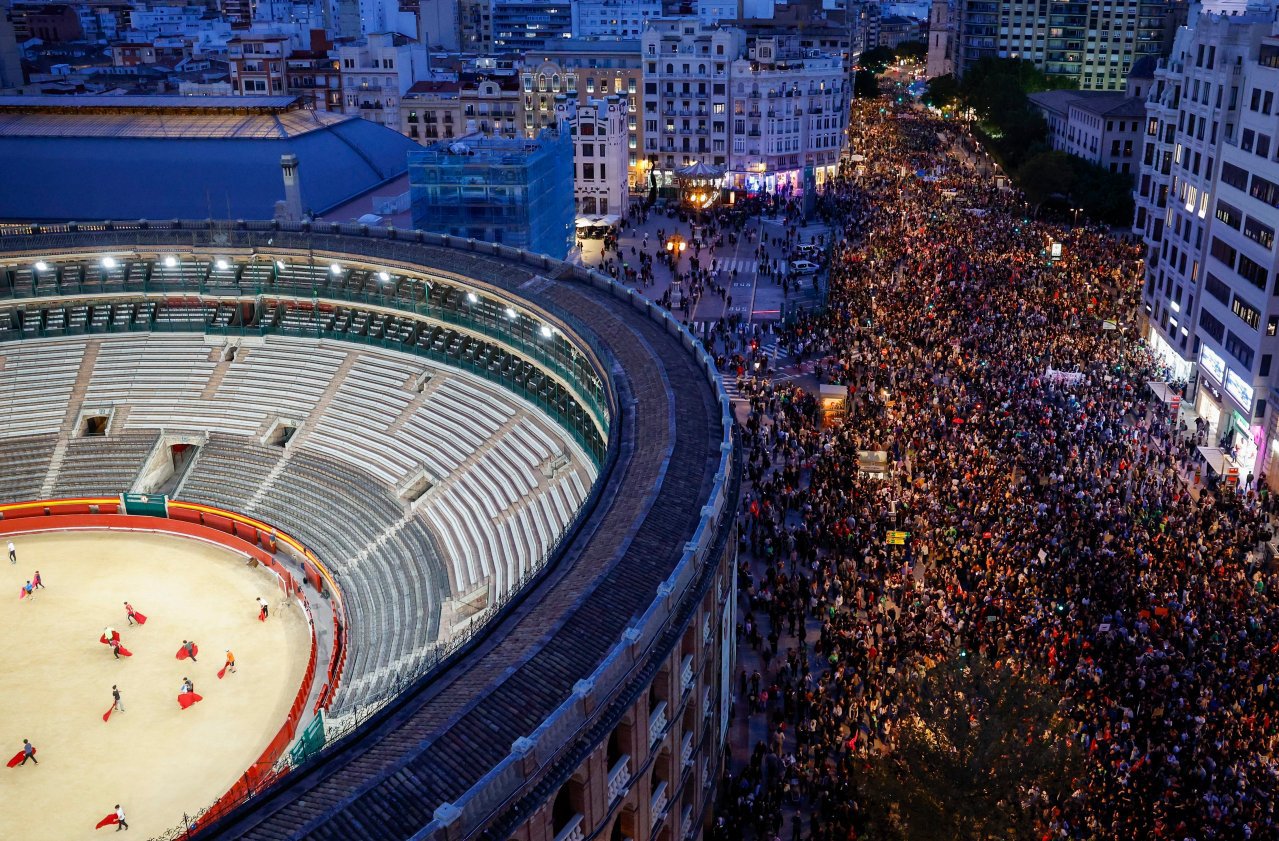
And it is precisely in Valencia where a photograph by Ana Escobar, from the EFE Agency, manages to stop time and explain much more than it apparently shows. An image that deserves to travel, that deserves to be looked at, and above all, that deserves to be interpreted. Because Ana Escobar does not just photograph a demonstration: she captures three realities that coexist in the same space and at the same moment.
In the foreground, the crowd of people participating in the mobilization advancing through the city center, near the bullring and the Nord station, at one of Valencia’s nerve centers. A citizenry that has decided to occupy the street, make its claim visible, and publicly express its discontent. Ana Escobar’s camera captures that collective dimension, the strength of a presence that transforms the urban landscape for a few hours.
But the photographer’s gaze does not stop there. Inside the bullring appears another scene: people in the ring, indifferent to the march’s route, carrying on with their own activity in a space that, due to its proximity, establishes an extraordinary visual contrast with what happens outside. Two universes that share a physical border but seem to inhabit different moments. The street protests while the ring maintains its own dynamic.
And there is still a third reality, perhaps the most silent but no less meaningful: those who remain in their homes, behind the lit windows, observing the city or simply continuing with their daily lives. Not everyone participates, not everyone protests, and not everyone experiences a strike day in the same way. The lights on in the buildings introduce that other dimension of society: those who watch from a distance, who do not take to the streets, or who choose to stay on the sidelines.
Ana Escobar’s photograph thus acquires a reading that surpasses the informative chronicle. In a single composition coexist three ways of being in the world: those who take to the streets to claim, those who continue with their activity, and those who watch from their homes. Three realities that do not necessarily contradict each other but that outline the complexity of any democratic society.
That is precisely where the value of photojournalism lies. In its ability to construct a narrative without needing to explain everything with words. Ana Escobar achieves turning a current event image into a document about our time. We do not know what each of the people appearing in it thinks, nor can we attribute to them a position the photograph does not show. But we can recognize the coexistence of different realities and ask ourselves what kind of country is depicted from them.
You may be
interested
...