Exhibitions
RojoNegro brings ancestral memory to the University of California
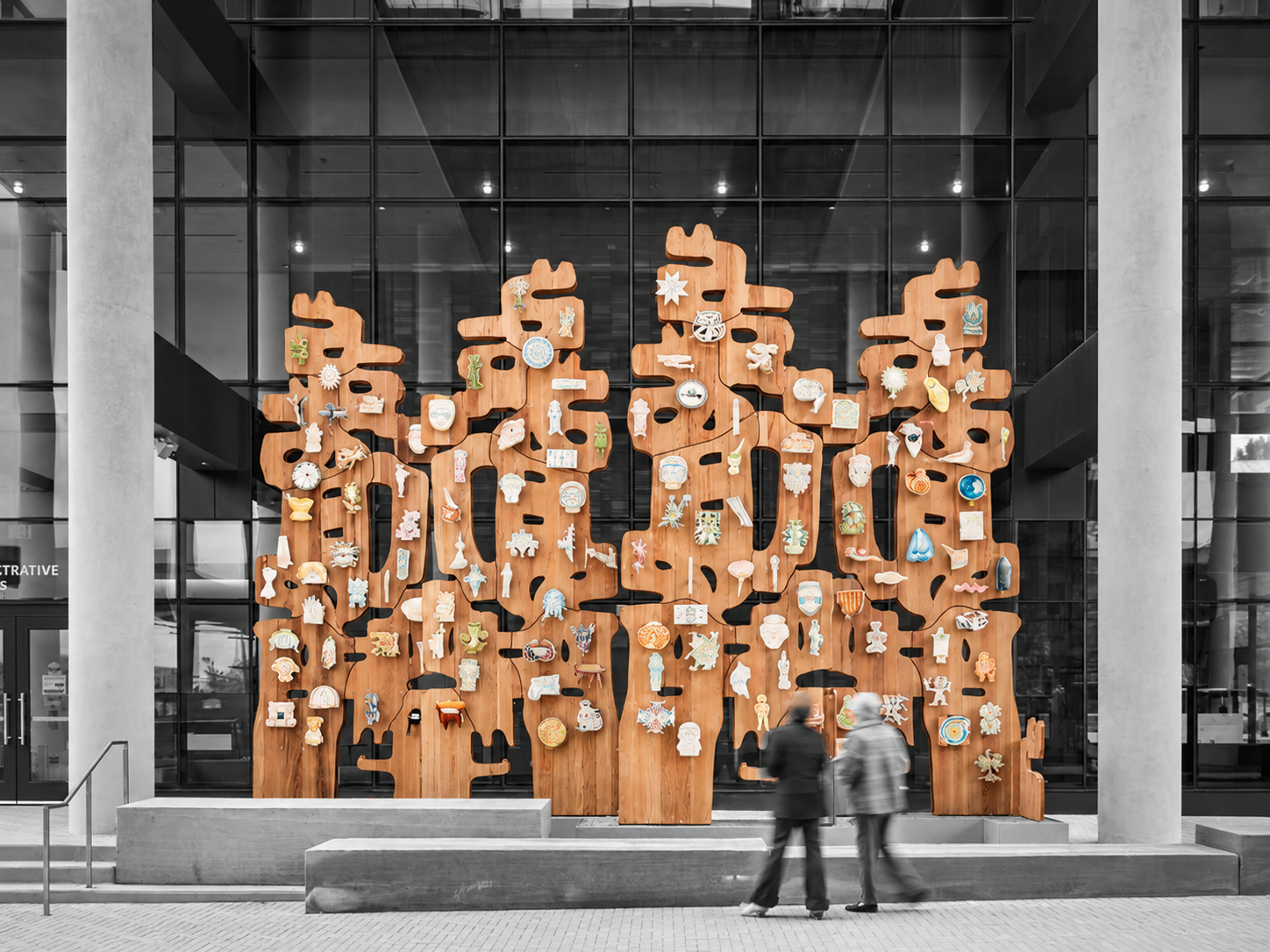
Art as a space for meeting between cultures, generations, and forms of knowledge is the protagonist of The Assembly of Clay (2026), the new permanent installation by the Mexican artistic duo RojoNegro on the campus of the University of California in San Diego (UCSD). The work, recently inaugurated, is conceived as an outdoor sculptural intervention that reflects on the construction of collective memory and the historical relationships between Mesoamerican and Western knowledge.
Formed by María Sosa and Noé Martínez, RojoNegro consists of two artists from Michoacán who will represent Mexico at the 61st Venice Biennale. For this intervention, they have created 260 unique ceramic tiles, hand-painted and arranged on four vertical structures that evoke the shape of trees. The composition establishes a relationship between matter, territory, and memory, turning ceramics into a medium to explore processes of cultural transmission.
The installation proposes a reflection on how knowledge and traditions transcend time, transform, and survive through different generations. Its discourse originates from the bond between Mesoamerican and Western cultures, two universes of knowledge whose historical relationship is deeply marked by colonialism. Against a linear reading of history, RojoNegro proposes an approach in which memories, exchanges, and cultural tensions remain present and continue shaping contemporary identities.
The choice of ceramics acquires a particularly significant dimension. The manual work on each of the 260 pieces introduces a plurality of gestures and particularities that reinforce the idea of a collectively constructed memory. The four arboreal structures function as elements of visual and conceptual articulation, linking the image of growth and continuity with the persistence of ancestral knowledge.


You may be
interested
...