Exhibitions
The abstract journey of Romà Vallès
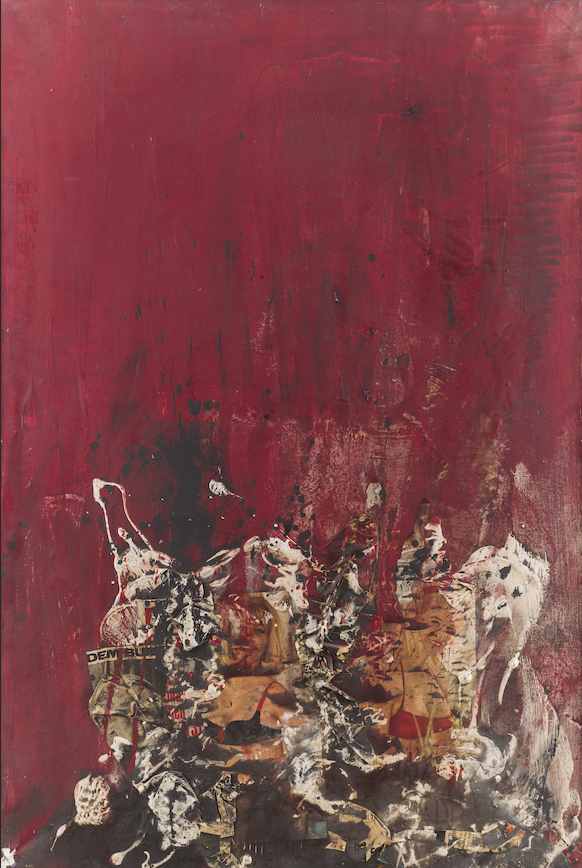
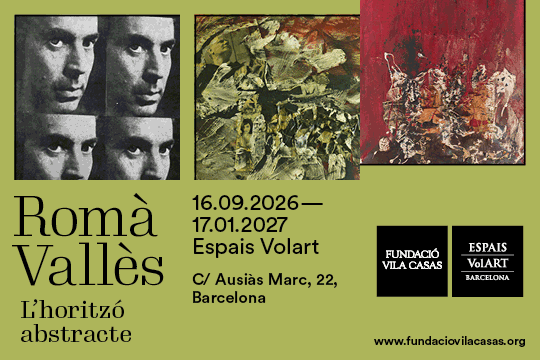
Abstraction, abstraction, and more abstraction, with a pinch of figuration that comes and goes at some unique and very significant moments. This would be a very synthetic summary of more than sixty years of investigation and creative effervescence by Romà Vallès (Barcelona, 1923-2015), which unfold throughout the rooms of the Espai Volart of the Vila Casas Foundation on the occasion of the exhibition Romà Vallès - The Abstract Horizon.
Curated by critic and curator Conxita Oliver and Bel Vallès, the artist's daughter and tireless promoter of his dissemination and recognition, the exhibition traces the creative evolution of this painter who participated in the artistic movements of postwar Catalonia and played a key role as a facilitator of the reception, assimilation, and transmission of international currents at home, at a time of great cultural isolation and widespread receptive blindness — with very few exceptions.
Deeply immersed in informalism since the mid-1950s, Vallès embarked on a journey into abstract worlds that he would never abandon, but which evolved and mutated according to his artistic and vital concerns. This is evident throughout the eleven sections that structure the exhibition, corresponding to eleven series of works linked chronologically and through which the two curators propose to review the most significant stages of his career.
The journey begins with early works presenting us with a "Vallès before Vallès" and culminates with the Heraclitus series (2005-2015), where the artist reflects on the perpetual flow of life based on the maxim of this pre-Socratic philosopher — “everything changes, nothing disappears and everything transforms” — which also functions as a metaphor for his own creative process. Between these two extremes, a series of intermediate stages unfold, showing his creative evolution. From the well-known Cosmogonies (1956-1964), where he began his informalist explorations — and with them, his creative maturity — passing through the misunderstood Collages (1964-1967) with a pop aesthetic, and the geometric, sigil, and conceptual explorations, as well as subtle plays with organic forms ranging from formless heads and bodies to insects and flowers, the exhibition reveals many comings and goings, escapes and returns. From this beautiful transition emerges a guiding thread that attests to a coherent Vallès creative logic, shaped from a unique language. A thread that, as Conxita Oliver and Bel Vallès point out in the exhibition’s introductory text, lies in “the line and the stain, the matter and the color, the defining elements of his experimentation that suggest both microcosmic and macrocosmic spaces, in open views of infinite readings.”
But beyond this strictly plastic guiding thread, there is also in Vallès a constant impulse that runs through his entire work and probably constitutes his true relentless quest: the desire to make the invisible visible from singularity and absolute freedom. This is, in my opinion, the most relevant and defining trait of this great and particular master of Catalan informalism, who avoided passing trends and remained always faithful to his commitment to abstract art, which he not only turned into his language but into a true ontological premise and space of incessant investigation.
You may be
interested
...