Opinion
Alejandro Tobón: Monuments of the Future
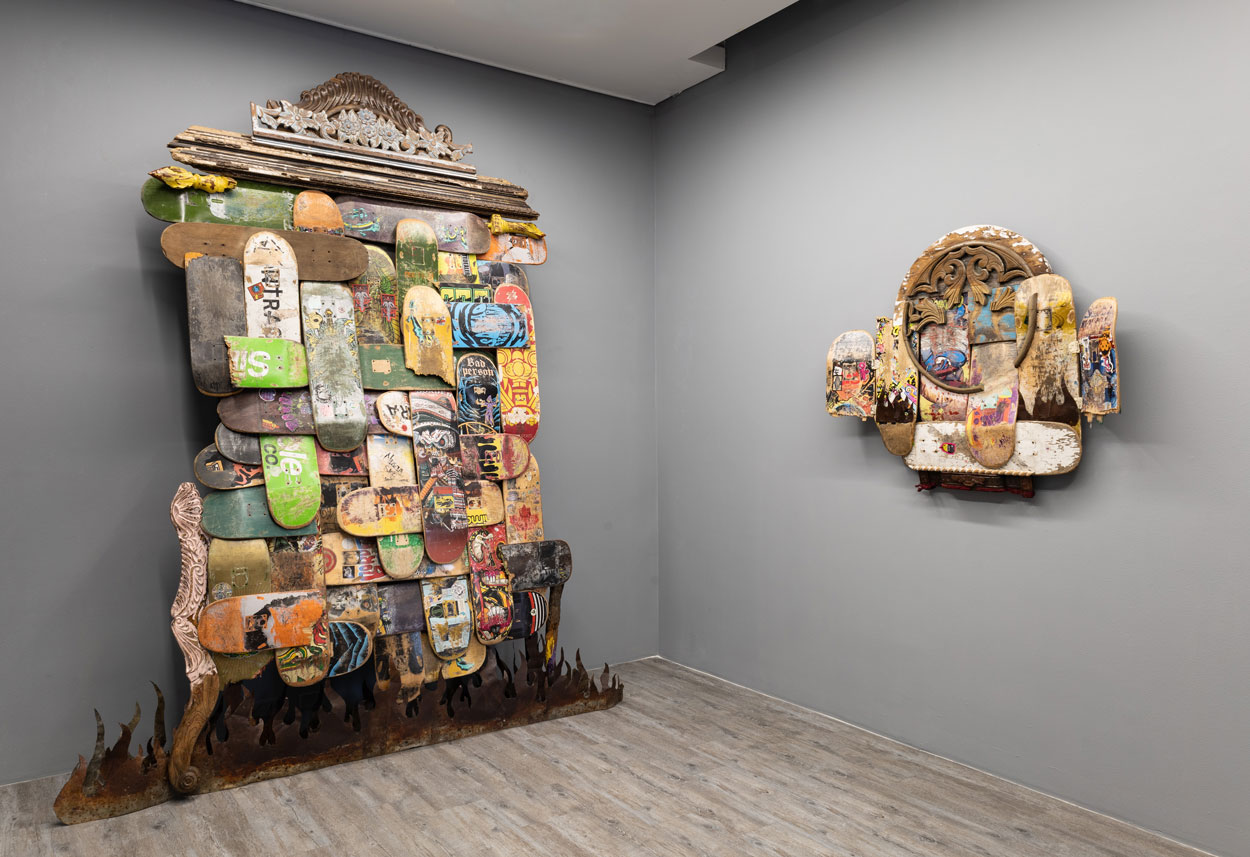
There are artists who build upon permanence, who seek to fix the world in immutable forms, defying the passage of time. Alejandro Tobón builds upon transit. His work does not rest upon the world as a static object; it slides, is scratched, fragments, and recomposes itself in each new context. Therefore, his raw material is not only the fine wood of Baroque altars, nor the skateboards that traversed the streets of his neighborhood. His raw material is movement: the movement of things that change direction, the movement of stories that are reborn in unforeseen forms, the movement of a memory that does not freeze, but rather rolls on.
Rolling is the word that sustains the universe of this new work. It is not a minor verb nor a decorative metaphor. It is the deepest gesture of his poetics, that which distinguishes his work from any other that attempts to speak of the past without allowing the past to move. The skateboard is not a static object; it is a cultural artifact designed to be in friction with the asphalt, to defy gravity, to leave its mark as it wears down. In Tobón's hands, the skateboard ceases to be the precarious toy of an eighties counterculture and becomes a vertebra, a column, a social structure. But it never forgets its origin; it remains that which is rolled, that which is traversed, that which surrenders to movement as a condition of existence.
Tobón was born in a neighborhood in the Medellín Metropolitan Area, where what came from outside wasn't copied, it was appropriated. Punk, rock, skateboarding arrived like blurry images from the north, and in his hands they became something else, a homegrown version, that local hybrid with its own language. That was his first school, his first lesson: identity isn't pure inheritance but constant friction between what arrives and what already exists. What comes from outside isn't copied, it's territorialized. It's mixed, transformed, becomes something new that only makes sense here. That lesson, learned on the streets of his childhood, he has never stopped carving in wood.
That's why his materials are never neutral, never innocent. The mahogany and cedar come from dismantled altars, from confessionals that heard long-forgotten sins, from desks where agreements and betrayals were signed. This wood was power, luxury, ostentation. It was the center of a world that believed itself eternal. And now it is the remnant. Tobón rescues it not to restore its glory—he doesn't seek to return its lost splendor—but to show its fragility, so that the passage of time can still be read in its grain, the wear and tear of what was once the center and today is barely a shadow. The noble wood thus becomes a ruin that actively exhumes what power sought to erase.
Alongside that once sacred wood, Tobón places the skateboards. Humble objects that in the eighties were makeshift imitations of what appeared in foreign magazines. The children of his generation crafted them from plywood and borrowed wheels, unaware that they were inventing a way to inhabit the streets, to trace their own lines on the ground, to roll. The board wasn't a toy. It was a vehicle. An extension of the body that allowed them to glide across the asphalt, to traverse the city with a different speed, with a different perspective. It was, even then, an act of freedom.
Rolling in perpetual motion to defy the immobility of the established order. The board rolls, and so does memory when it refuses to be petrified in museums and official monuments. History rolls when someone dares to tell it from the margins. Now, Tobón disassembles skateboards, one after another, assembling them into a network. Each segment is a board that once traversed the city, bearing the marks of friction with concrete, the scratches of its rider, the graphics erased by wear and tear. This fabric is fragile—because everything made of fragments can crumble—but it is also strong. Because it sustains us and allows us to stand. It is the skin of a society that has learned to rebuild itself from the pieces, again and again, after each decline.
And then there's the great spine, a delicate structure built on the tension between what we remember and what we prefer to forget. To construct this column, Alejandro Tobón didn't cling to a single tradition. He knows that memory is also made with the tools of the present, just as the fine wood of altars meets the skateboards that once roamed the city. Now, it also meets other ways of shaping the world, with techniques that seem distant but in his hands become close, tangible, embodied. He doesn't replace the old with the new; he fuses them. Because his craft isn't nostalgia, but reinvention, taking what contemporary technique offers and making it the very essence of the inquiry that has always guided him. The column doesn't lose its origin; it expands it. It remains a spine, it remains the fragility that sustains, it remains the place where the sacred, the political, and the defiant are inscribed. Except that now, it is also proof that memory is not anchored in a single materiality, but adapts, transforms, and keeps rolling.
That column is vulnerable and powerful at the same time, like memory, like the city, like the identity of a country that has been fractured time and again but still endures. Fragility and strength coexist in every piece. Because what is made of fragments can crumble, but it can also support a world. That is the city, an accumulation of layers that overlap, fracture, and reassemble. And that is this country, a territory that has learned to rebuild itself from the pieces, not because the pieces are strong, but because the will to endure is more powerful than the fragility of the materials.
Tobón looks back and recognizes his lineage. The Quito School, that Latin American Baroque born of distance, of the need to recreate, with what little was available, what arrived from Europe. There he finds the same urgency, that of someone who makes beauty from scraps, who transforms precariousness into language, who understands that creation is not copying, but reinvention. The colonial workshops and the working-class neighborhoods of Medellín meet on that invisible line that unites those who, from lack, invent their own form. The handcrafted skateboard of the eighties and the Quito altarpiece of the 17th century share the same urgency: to create beauty with what is available, to resignify what is foreign, to make what is borrowed one's own.
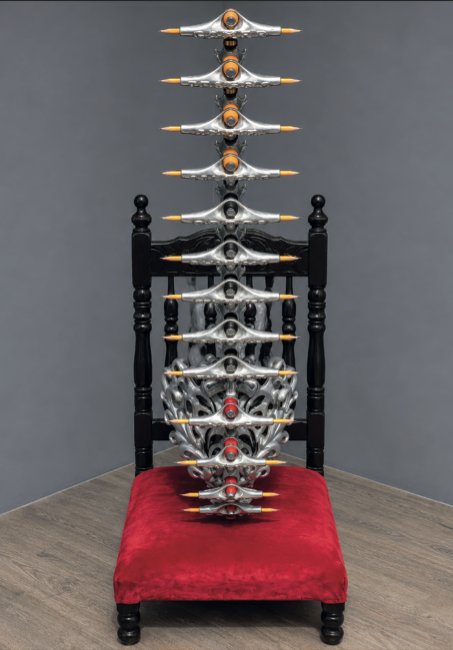
What is a monument of the future? It is not stone. It is not bronze. It is not the figure of a hero standing motionless in an empty plaza, gazing at a horizon that no longer calls to us. A monument of the future is a rolling plank. It is a column that stands despite its fractures. It is a fragment of wood that was once an altar and is now something else. It is memory that is not kept in archives but circulates through the streets, allows itself to be scratched, reinterpreted, and passed on to new generations. It is, above all, the certainty that what is alive transforms. And that this transformation—this eternal return of the same but never the same—is our only way of remaining. Tobón does not create monuments in the classical sense. He does not seek to eternalize power or fix a narrative. His Monuments of the Future are something else entirely: these transient devices, artifacts that roll, structures that are sustained by the tension between what we were and what we want to be. They are an invitation to consider that the future is not built from a blank slate, but rather from the reinterpretation of what has already had another life, with nuances. These works, when reimagined, speak to our capacity to reinvent ourselves, to transform precarity into potential, to make a language out of remnants.
Alejandro Tobón builds upon this conviction, and rather than offering easy certainties, he presents questions crafted from wood, vertebrae that remind us we are made of fragments, that our strength lies not in being an indivisible block but in the precise articulation of what was once separate. Each vertebra is a story that rolled through the city before arriving here; each one bears the marks of its journey, the scratches of those who rode it, the wear and tear of those who inhabited it. And when assembled with the others, they don't form a rigid structure that immobilizes, but a column that bends without breaking, that flexes with every movement, that allows us to turn our heads to look back without ceasing to move forward. Because a vertebra is not made for stillness, it is made for movement. For turning, for twisting, for adaptive resistance. Just as a skateboard only has meaning when it rolls, a vertebra only has meaning when it allows us to remain upright while we move.
Alejandro offers us a work for reflection, for the wear and tear that leaves memories. It invites us to keep rolling, even when the path seems uncertain. Because rolling is resisting. Rolling is not standing still in the face of oblivion. Rolling is, ultimately, remembering that memory is not a burden we carry, but a movement that propels us—and that to move, we must first be articulated, we must have vertebrae that support us without imprisoning us.
Filming, then, is an act of freedom. It is the freedom to reject the single narrative. The freedom to move through the interstices. The freedom to be worn down by the friction with reality. The freedom to refuse to be a stone in a monument that no one visits, to become a movement that challenges, that unsettles, that transforms.
His Monuments of the Future are not made of stone. They are made of what rolls, what gets scratched, what breaks and comes back together. And perhaps that is why—precisely because of their fragility—they are more durable than any statue. Because what is alive, what moves, what transforms with time, what is given into the hands of the city to inhabit, that truly deserves to be called a monument. Not a monument to the immutable past, but a monument to the future that we can still build as we continue to move forward.

You may be
interested
...