Exhibitions
Aurèlia Muñoz and the poetic expansion of fabric
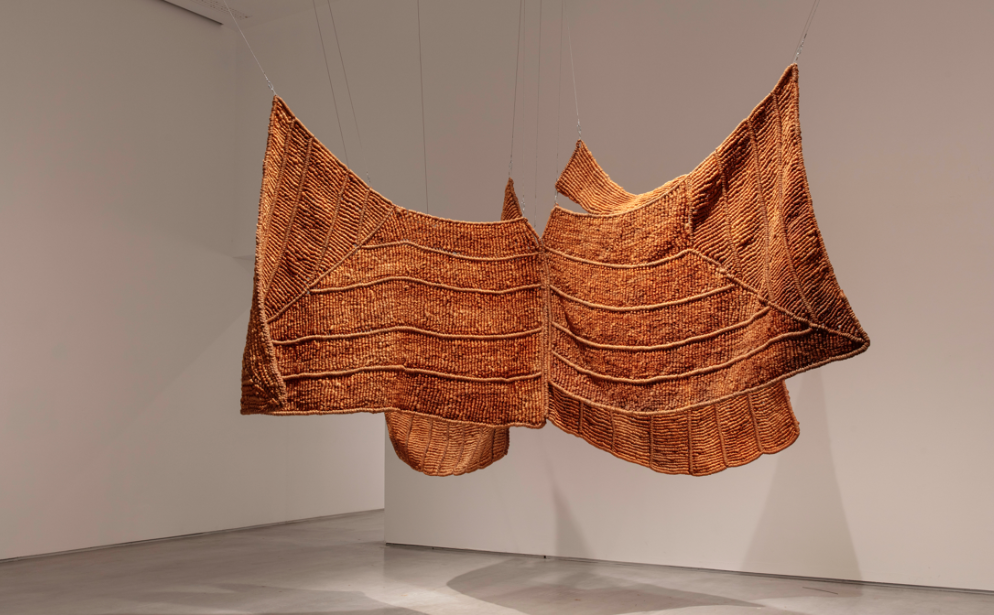
Aurèlia Muñoz, within the art of weaving, holds a pioneering role in our country. She quickly grasped the enormous possibilities offered by this artistic language and embarked on a tenacious path of research and inquiry, starting with ancient artisanal techniques in order to study them, recover them if necessary, and subject them to a theory based on the practice of daily work, open conceptually and, in terms of feeling, to the adventure of her time.” Daniel Giralt-Miracle for the exhibition at the Museu de Granollers in 1986.
The figure of Aurèlia Muñoz (Barcelona, 1926–2011) finally occupies the central place it deserves in the history of contemporary art. With the exhibition Entes , the most ambitious retrospective dedicated to her work to date, a career that not only expanded the boundaries of textile art but also reformulated the very concept of sculpture in Europe during the second half of the 20th century is revisited.
Organized jointly by the Reina Sofía Museum and the MACBA, the exhibition commemorates the centenary of the artist's birth and offers a comprehensive overview of more than five decades of her work. Curated by the EINA Foundation through its einaidea platform, under the scientific direction of Manuel Cirauqui, along with Rosa Lleó and Sílvia Ventosa, the exhibition brings together more than 150 works, many of them previously unseen or never before exhibited in museums.
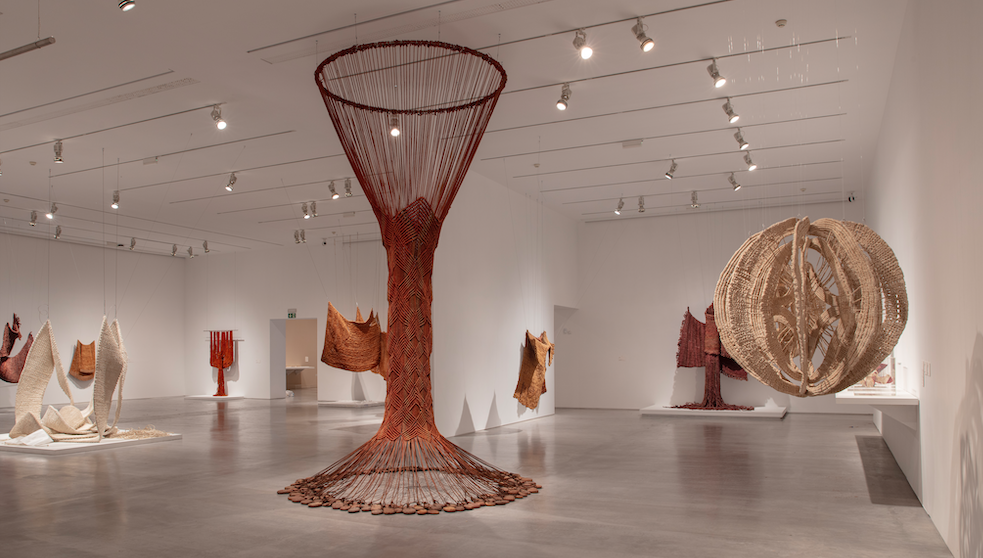
View of Room 2: The knotted sculpture, Photograph: Fátima Sanz.
Presented in Madrid from April 29 to September 7, 2026, in the Reina Sofía Museum's Nouvel Building, the exhibition will later travel to Barcelona, where it will be on display at the MACBA from November 5. At the official presentation, the director of the Madrid museum, Manuel Segade, emphasized the artist's importance within an institutional policy that seeks to recover key female figures: her work, he stated, has the capacity to "transform the way we understand the history of recent art."
For her part, Elvira Dyangani highlighted the intellectual nature of Muñoz's work, emphasizing his conception of art as a form of knowledge: a practice where logic, philosophical thought and material experimentation converge.
The exhibition unfolds the artist's creative universe across six rooms that trace a coherent and profoundly innovative evolution. From her early embroideries of the 1960s—which pushed the boundaries of painting—to her celebrated macramés of the 1970s, in which the fabric abandons the two-dimensional plane to conquer three-dimensional space, Muñoz develops her own unique language where textiles become soft architecture and a living organism.
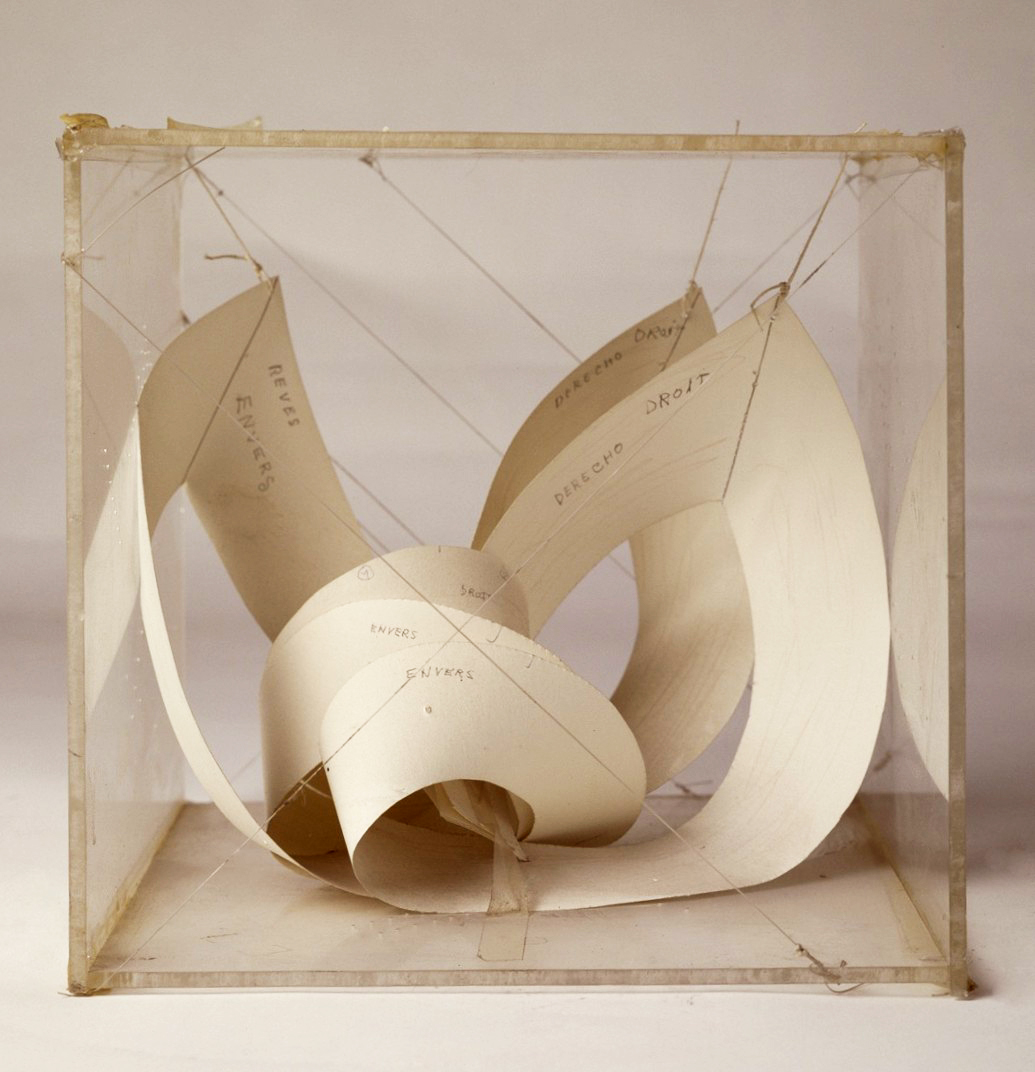
Aurèlia Muñoz, Model for Ondulaciones, 1974. Paper and linen threads, methacrylate urn (22 x 23 x 22). Reina Sofía Museum, Madrid.
Of particular note are his Kite-Birds or aerostats from the 1980s: light and mobile structures, inspired by both origami and the navigation and machines of Leonardo da Vinci. These pieces introduce an aerial and dynamic dimension that marks a shift towards a more expanded conception of space.
This exploration culminates in her works with paper pulp—handmade from linen and cotton fibers—where organic forms emerge that evoke suspended books, anemones, algae, or jellyfish, often presented in transparent urns. In these pieces, the artist explores a hybrid territory between the natural and the artificial, the sculptural and the sensory.
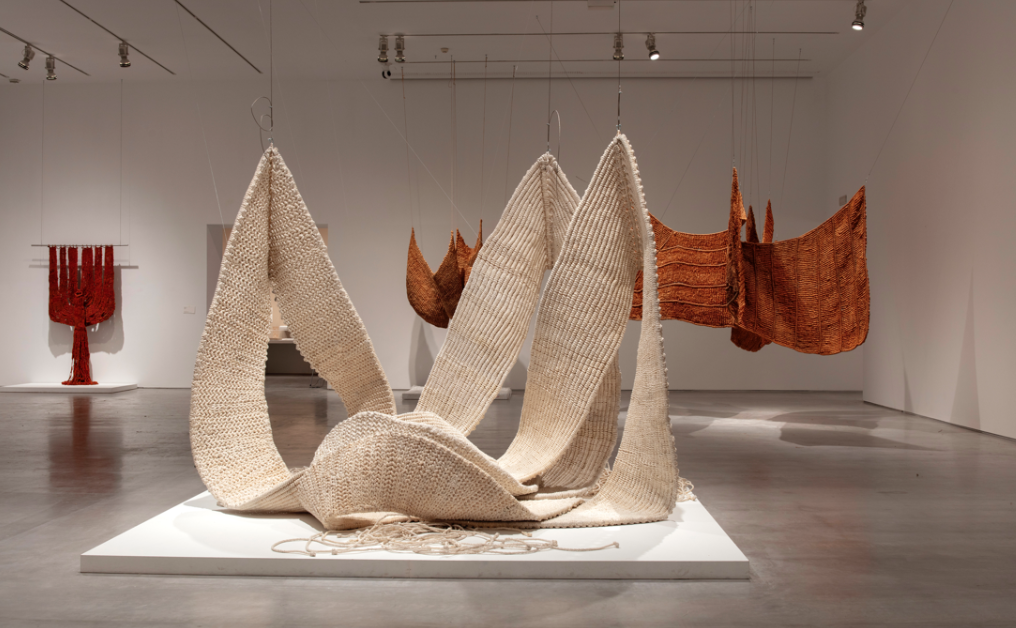
In the foreground: Aurèlia Muñoz, Ondulacions [Undulations], 1974. Macramé of nylon threads (240 x 240 x 240 cm). Reina Sofía Museum, Madrid. Photograph: Fátima Sanz.
The exhibition's conceptual focus revolves around what is known as "Aurelian cosmology," a universe populated by "entities": figures without defined gender, halfway between human and animal, that question the boundaries of identity and propose an interspecies vision of the world. These presences, more than objects, seem like organisms in transformation, witnesses to a sensibility ahead of its time.
In addition to the artworks, the exhibition includes a carefully curated selection of archival materials—letters, models, notebooks, and photographs—that reveal Muñoz's methodological rigor. Far from improvisation, his work is built upon a constant, systematic, and deeply reflective practice.

You may be
interested
...