Exhibitions
Améfrica at the CAAC: diaspora, ritual, and the Atlantic archive
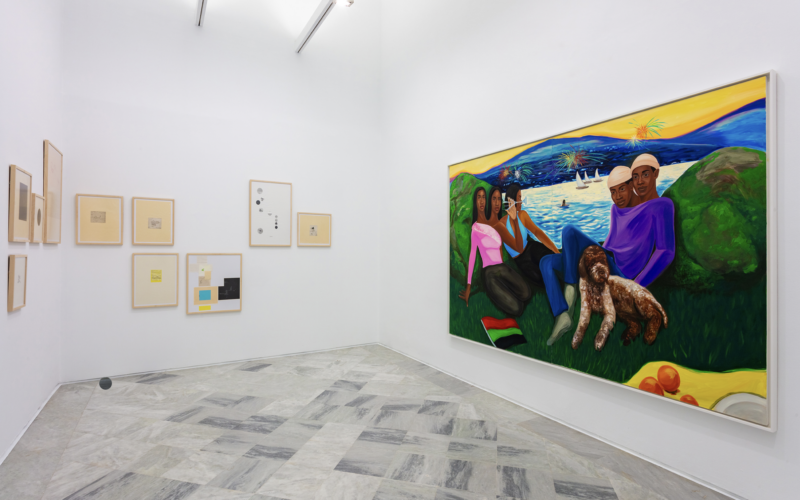
Améfrica. Diasporic Connections in the Jorge M. Pérez Collection, currently on view at the Centro Andaluz de Arte Contemporáneo, proposes a rethinking of the African diaspora not as a closed historical condition but as a living, transcontinental archive. Installed within the former monastery and industrial complex that houses the CAAC, the exhibition situates itself in a space already marked by layered histories of trade, extraction, and religious power, transforming Seville into what might be understood, following Paul Gilroy’s notion of the Black Atlantic, as a site of circulation rather than a peripheral backdrop. The Atlantic here is not geography but method, a fluid zone of exchange in which identities are continually produced through movement.
Curated by the Brazilian anthropologist and curator Helio Menezes, Améfrica brings together 128 works by 99 artists from more than thirty countries across Africa, the Americas, Europe, and Australia, all drawn from the Jorge M. Pérez Collection. The exhibition takes as its conceptual starting point the notion of amefricanity, developed by the Afro Brazilian intellectual Lélia Gonzalez, who argued foregrounded an understanding the Americas through their African foundations not as marginal influence, but as a constitutive aesthetic, political, and epistemological force. In this sense, Améfrica does not simply represent diaspora; it enacts what Édouard Glissant might call a poetics of relation, foregrounding opacity, entanglement, and the refusal of a single origin.
Rather than tracing a linear narrative of influence, the exhibition constructs a dense network of correspondences across generations, geographies, and media. Painting, sculpture, photography, installation, and textile practices converge to articulate forms of memory shaped by displacement, resistance, and adaptation. Diaspora is not framed as loss alone, but as what Achille Mbembe describes as a condition of becoming, an unfinished, generative state in which cultural forms survive precisely through mutation. The archive that emerges is not monumental or complete, but iterative and relational.
The exhibition is organized into five thematic chapters, Adaptation, Resistance, Reinterpretation, New Forms, and Amefricanas, which operate less as fixed categories than as overlapping states of transformation. Adaptation addresses forced and voluntary movements across the Atlantic, privileging cyclical and communal structures over national borders. Routes, rather than territories, become the primary units of meaning. In doing so, the exhibition shifts emphasis from origin to circulation, challenging the nation state as the dominant frame for identity. In Resistance, artistic practices translate racialized violence and social tension into visual languages of care, confrontation, and political urgency. Here, the figure of the Black mother frequently emerges as a locus of intergenerational resilience. Resistance is articulated not only as protest but as preservation, the maintenance of memory against erasure. Reinterpretation turns toward spirituality and ritual as systems of knowledge. Works inspired by ancestral cosmologies, trance, and syncretic belief systems move beyond religious iconography to propose alternative epistemologies forged through survival and collective memory. These practices disrupt the museum’s secular logic, introducing modes of knowing that exceed aesthetic categorization and resist containment within Western rationalist frameworks.
In New Forms, material experimentation becomes central. Organic fibers, minerals, textiles, and discarded objects are mobilized to produce hybrid languages that sit in tension with the institutional architecture. Rather than being neutralized by the museum, these materials introduce friction, insisting that matter itself carries historical residue. Form becomes archive. Texture becomes testimony.
The final chapter, Amefricanas, foregrounds self representation through the voices of Black women artists who reclaim the body, image, and gaze from colonial regimes of visibility. These works articulate new imaginaries of desire, agency, and presence, countering the historical objectification of Black femininity with strategies of opacity, pleasure, and refusal. Across its breadth, Améfrica refuses to offer a singular narrative of the African diaspora. Instead, it operates as what Glissant would describe as a constellation, partial, relational, and open ended. Installed in the cloisters of the CAAC, the exhibition stages a sustained dialogue between ritual and institution, between lived memory and museological framing. It does not resolve the tensions between archive and experience, but sustains them.
What emerges is not reconciliation, but coexistence, an Atlantic archive understood not as a closed chapter of history, but as a continuous unfolding shaped by repetition, rupture, and collective participation.


You may be
interested
...