Exhibitions
Andrea Canepa envelops the Crystal Palace with 'Fardo' and the textile ritual between memory and architecture
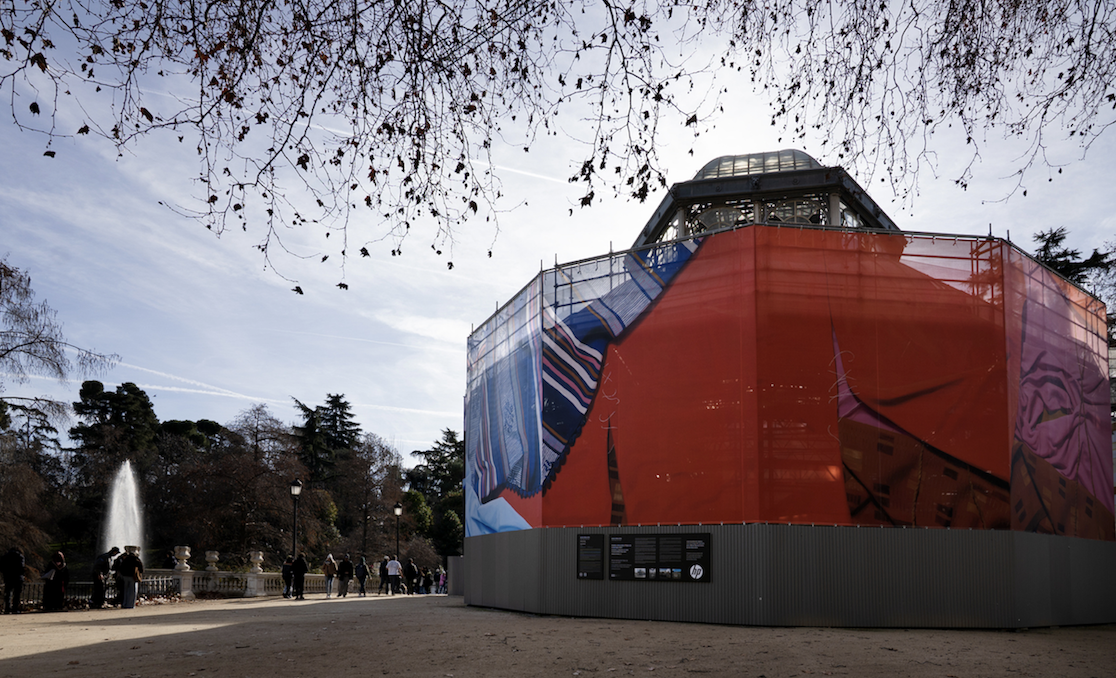
The canvas that will cover the Crystal Palace during its restoration process is inspired by the funerary bundles of the pre-Columbian Paracas culture, which developed in southern Peru between 800 and 100 BC. These textile wrappings, intended to cover the bodies of the deceased, have been exceptionally well preserved thanks to the extremely arid conditions of the territory, and today constitute a fundamental source of knowledge about a material historically relegated in the studies of art history.
Based on this reference, Andrea Canepa conceived the design of the canvas as a large textile mosaic composed of diverse fragments: some feature motifs alluding to pre-Hispanic imagery, while others are smooth, monochrome surfaces. The different pieces are arranged sequentially around the building, so that the image transforms as the visitor moves around it. The panels function like frames that construct a visual narrative based on the gesture of covering and uncovering, a circular story that transforms the Crystal Palace into a kind of contemporary praxinoscope.
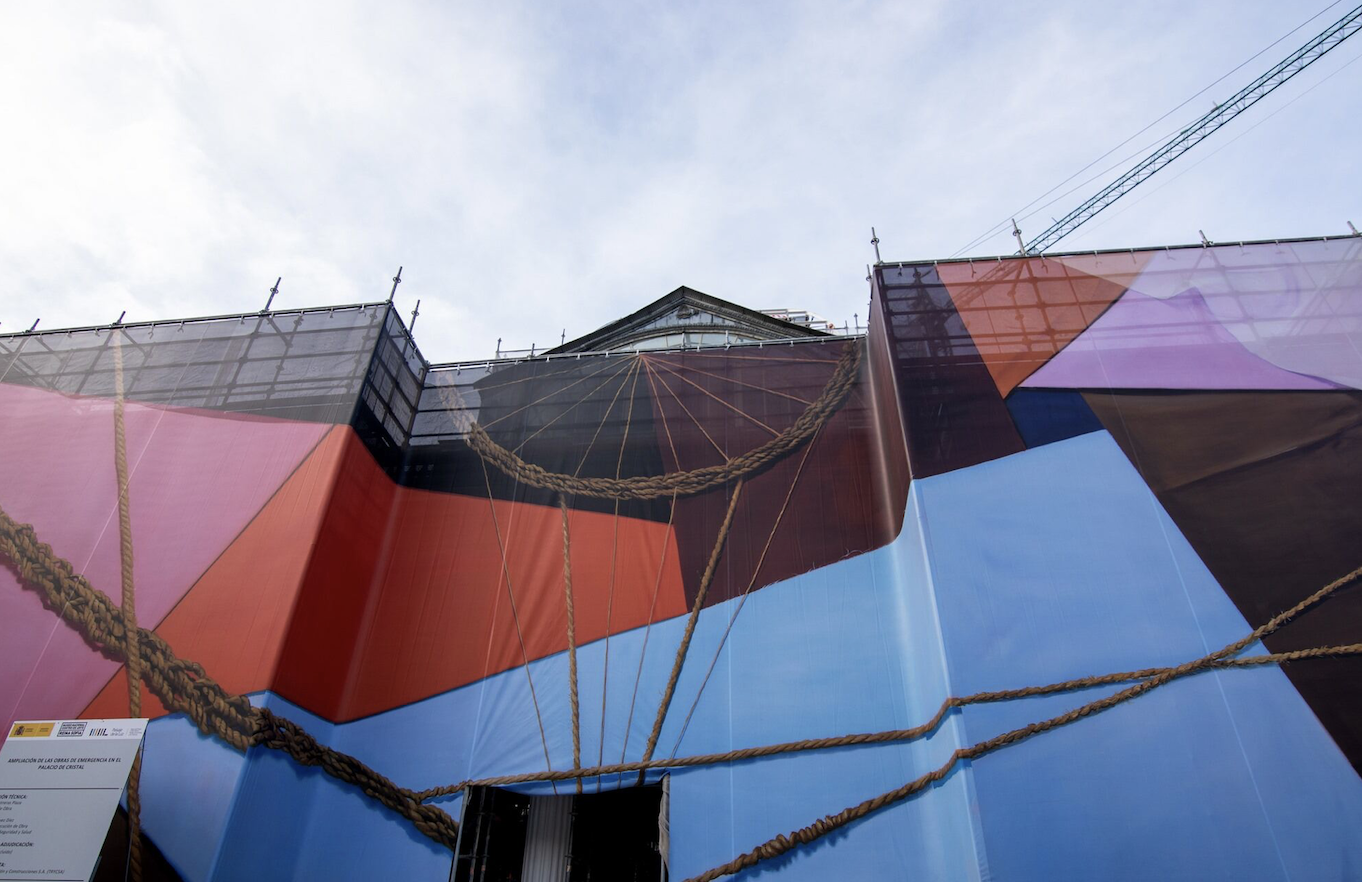
As the artist herself explains, the journey begins with a tightly bound bundle that gradually unwraps itself, revealing bandages that still conceal the contents. Upon completing the journey, the process restarts: the bundle is reformed, closing a continuous loop of revelation and concealment.
This proposal establishes a deliberate contrast between the architectural transparency of the Crystal Palace —a symbol, in Canepa's words, of "Western society's obsession with seeing and knowing everything"— and an experience based on gradual discovery, where time is not linear or imposed, but marked by the visitor's own walk.
To recreate the fabrics that make up the canvas, Canepa worked from oil paintings that were subsequently photographed. “Oil paint is constructed in the same way as bales: through overlapping layers. Time also accumulates in layers,” the artist points out, thus underscoring the temporal and processual dimension of the work.
During the project presentation, Manuel Segade emphasized that Canepa's work occupies a unique space, "at the intersection of design and society." He explained that the artist reclaims the legacy of modernity to reflect on how forms and symbols connect people, forge communities, and construct collective imaginaries. Using these languages, Canepa has developed pavilions, architectural interventions, and structures that exist on a hybrid threshold between functional art, design, and formal gesture—a territory particularly relevant to this intervention.
Andrea Canepa's practice is structured as a constant dialogue between art, sociology, history, and anthropology, grounded in extensive research that frequently connects with Peru's past and the cultural history of Latin America. Fardo is part of this line of work and draws on the research she began in 2023 with the exhibition As We Dwell in the Fold, presented at the MSU Broad Museum in Michigan, which also focused on the textile bundles of the Paracas culture.
The artist recently opened the exhibition Between the Profound and the Distant at IVAM and is currently an artist-in-residence at Infinito Delicias. Her work has been featured in solo exhibitions at venues such as the Condeduque Contemporary Culture Center in Madrid (2025), the MSU Broad Museum in Michigan (2023), the Extremadura and Ibero-American Museum of Contemporary Art (MEIAC) in Badajoz (2023), and Appel in Amsterdam (2022), among others.
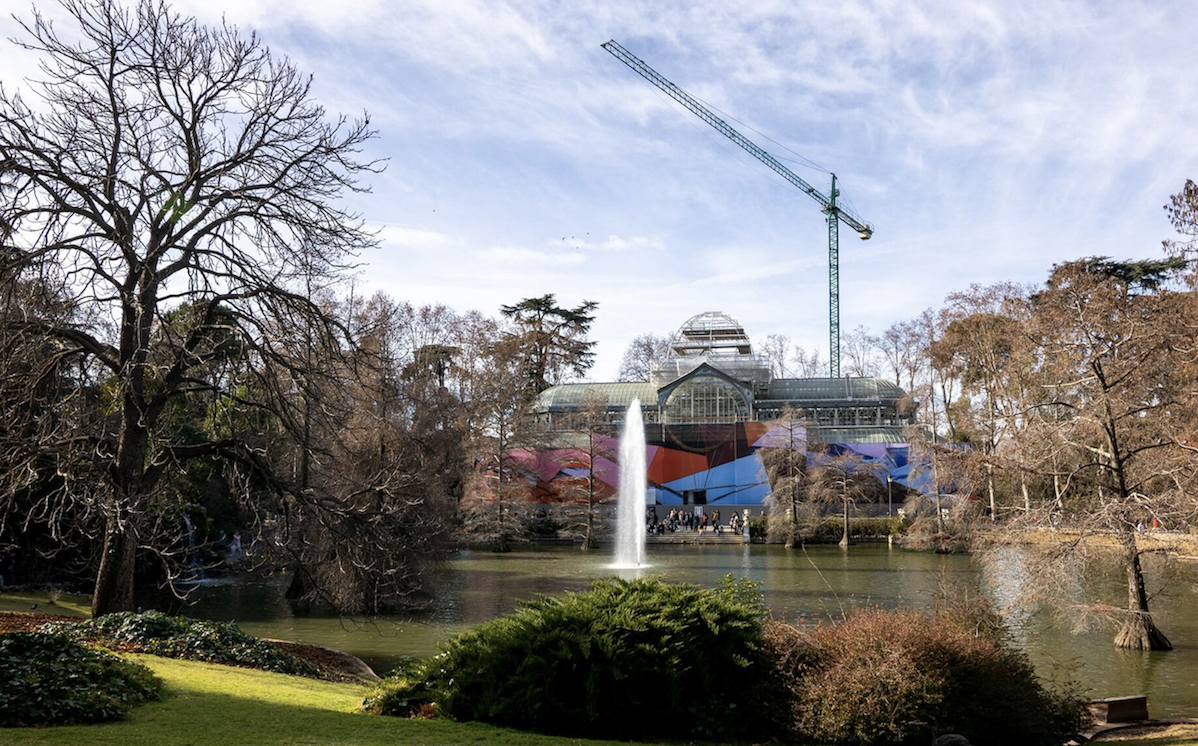
The installation Fardo will be open to the public from January 13th and throughout 2026, coinciding with the restoration work at the Crystal Palace. In it, Canepa translates the logic of pre-Columbian funerary rituals into the architectural space, proposing a journey in which layers of textiles are continuously unfolded and folded, evoking the symbolic and material structure of the bundle as a metaphor for time, memory, and the experience of seeing.

You may be
interested
...