Exhibitions
Sauul Hamett makes ghosts bloom beneath the fog
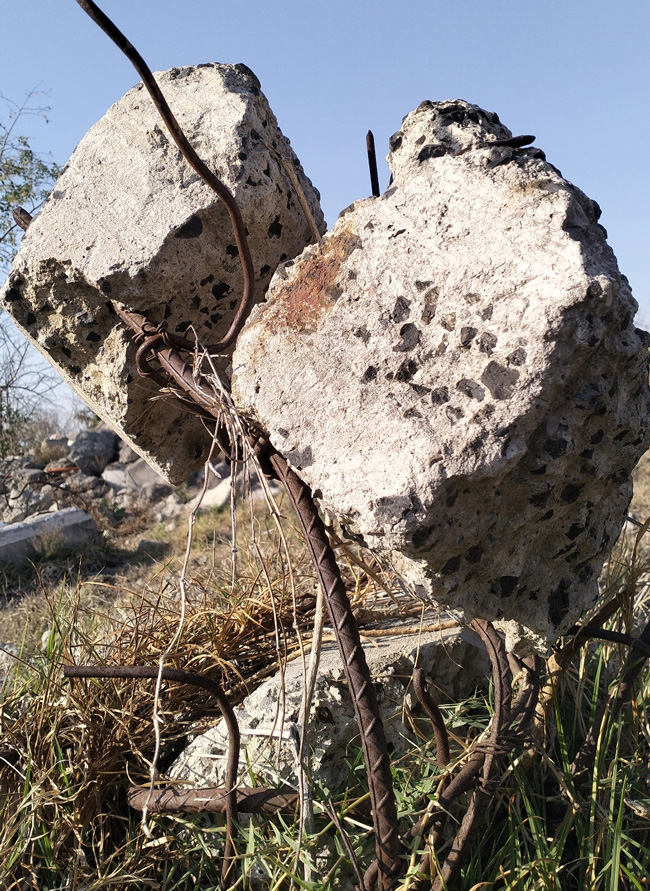
In the vicinity of Tempiluli, a protected natural area with lake remnants located in the Tláhuac borough, the urban landscape of Mexico City is caught between transformation and permanence. It is also the territory where Sauul Hamett (Mexico City, 1998) grew up, whose personal experience becomes the starting point for Under the Fog, Ghosts Bloom , an installation that can be visited at the Museo Universitario del Chopo until September 20, 2026.
The work stems from the artist's wanderings through this familiar environment and the collection of material remains found in the area, from rubble and fragments of construction to elements from nature itself. These materials function as traces of a landscape subjected to constant processes of building, demolition, and reconfiguration. This dynamic has intensified with the transformations linked to the construction of Metro Line 12, which has turned certain areas into illegal rubble dumps and informal settlements.
From these fragments, Hamett constructs a reflection on the desire for one's own space and how this yearning is intersected by systematic processes of dispossession and territorial transformation. In the area, self-construction has frequently become a strategy for accessing housing and conquering that 'place' of one's own. However, many of these constructions remain unfinished or end up deteriorating, suspended in a kind of limbo between the initial promise and the impossibility of fulfilling it.
It is precisely in this nebulous space that the installation is situated. Hamett constructs a ghostly, light, and fragile urban presence that seems to oscillate between the reality of what remains and the nostalgia for a future that never materialized. The recovered materials cease to be mere remnants and become testimonies of an urban geography subjected to continuous cycles of destruction and reconstruction.
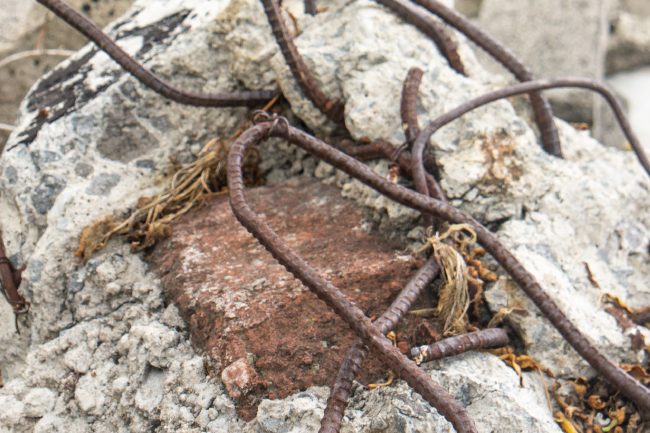
The artist proposes imagining this landscape as an organism capable of integrating both nature and rubble into a single cycle. From this arise the 'flourishing ghosts' that give the project its title: forms of life and memory that persist beneath a seemingly devastated surface. The installation does not offer a naive hope, but rather a critical one, understood as a balance between optimism and the capacity to analyze the conditions that make it possible—or prevent—to imagine another future.
The phrase by Japanese writer Sui Ishida, "You can't build clouds. And that's why the future you dream of never comes true," taken from Tokyo Ghoul (2011), serves as one of the project's poetic keys. Faced with the impossibility of materializing certain dreams, Hamett works with what remains: fragments, ruins, nature, and memories that allow him to reconstruct another image of the territory.
Curated by Karol Wolley Reyes, the proposal is part of El gabinete (The Cabinet), a program of the Museo Universitario del Chopo (Museum of the University of Chopo) designed to host and promote exhibition projects by artists in educational processes, recent graduates, independent collectives, and emerging generations. Hamett's project arose from a portfolio review conducted by the curatorial team last November at the Faculty of Arts and Design of the UNAM (National Autonomous University of Mexico), Taxco campus, with support from the Program for Special Activities of Interinstitutional Cooperation (PAECI).



You may be
interested
...