Exhibitions
Toni Giró: between word and image, the politics of art as vital narrative
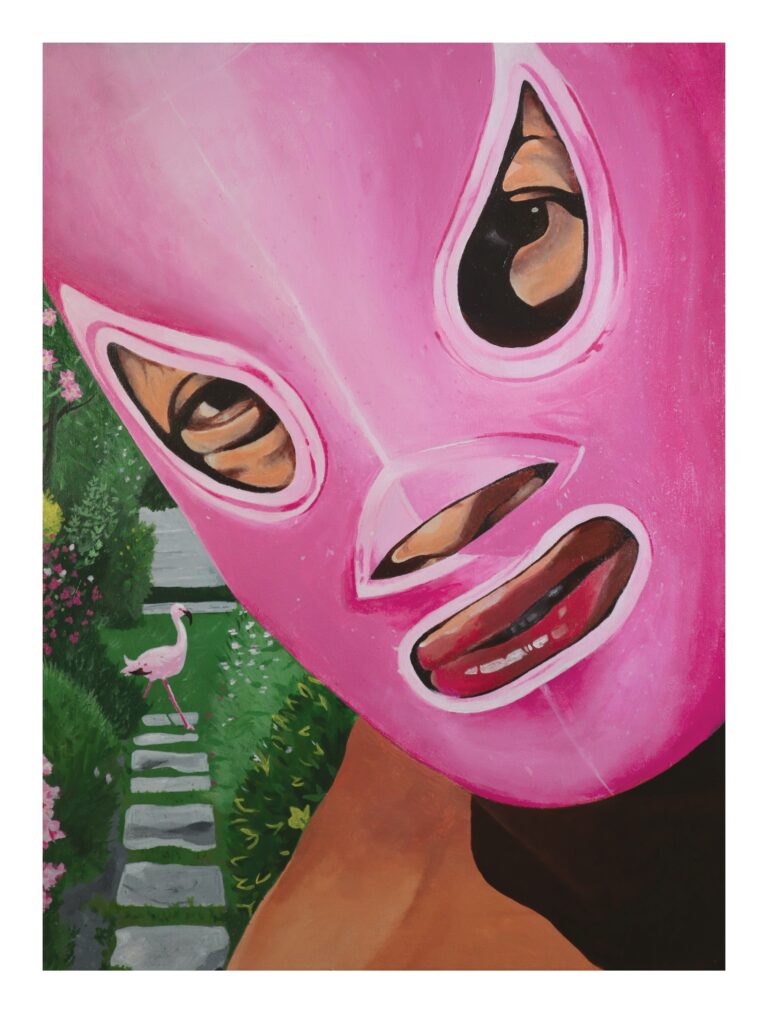
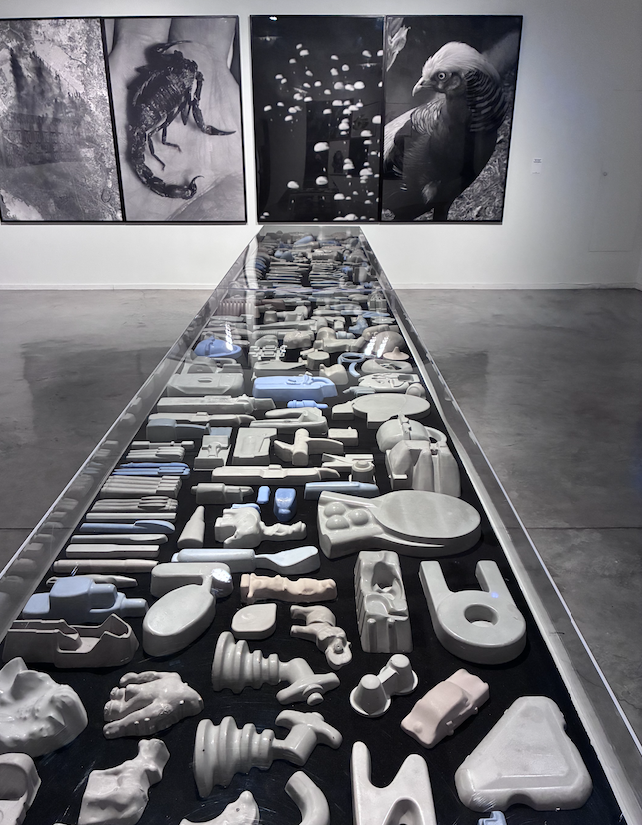
This exhibition by Toni Giró (Barcelona, 1966), curated by the artist himself and very well structured and presented—that is, "conceived" based on the affective and intellectual interrelation between the created object and the biography of its maker—covers the considerable time span from the beginning of the 1990s ( Self-Portrait with Mask, 1994) to works created last year. A prime example of this latter period of his production is the sculpture Les parts no són el tot (Engranatge) . Between these two temporal extremes, the artist has created (let us not forget that he himself has been the organizer of his own discursive work) not so much a scenario of specific creative realities (though that too, naturally), but rather the desire to formalize a “ narrative” by interrelating three elements that structure meaning: life and work, on the one hand, plus the social, cultural, and economic dynamics where the first two “live” (in their purest ontological sense), develop, and finally “die” as they are superseded by other, more current and competitive dynamics. It should come as no surprise, then, that Toni Giró has chosen to title the exhibition with a phrase/idea taken from Marx and Engels’s “Communist Manifesto,” a manifesto that can be interpreted from many different ideological and social perspectives, but above all else, in its purest literary sense, is a “narrative of customs” in keeping with the best social novels of the 19th century.
“There is not always politics, although there are always forms of power,” is a phrase by the French thinker Jacques Rancière that appears in a short essay, published a few years ago, entitled “The Politics of Aesthetics.” The phrase could certainly have been conceived and written by Marx and Engels as well, at least if we understand “the political” as a social reconfiguration of the sensible, or of what is humanly perceptible. And at this point we return to our artist and the highly sophisticated "discursive apparatus" where he situates the aesthetic regime of his creative production, in which the political dimension is always present, sometimes "in absentia", other times "off-screen", indirectly on many occasions, but almost always this political dimension is presented with the subtle formal elegance of a narrative of the possible (that is, of the real), with a certain critical ordering of historical knowledge, with a declared illusion of bringing the created forms to a re-consideration of their conceptual framework (closer, more humanly warm), there where we can verify "the solid that melts into air".
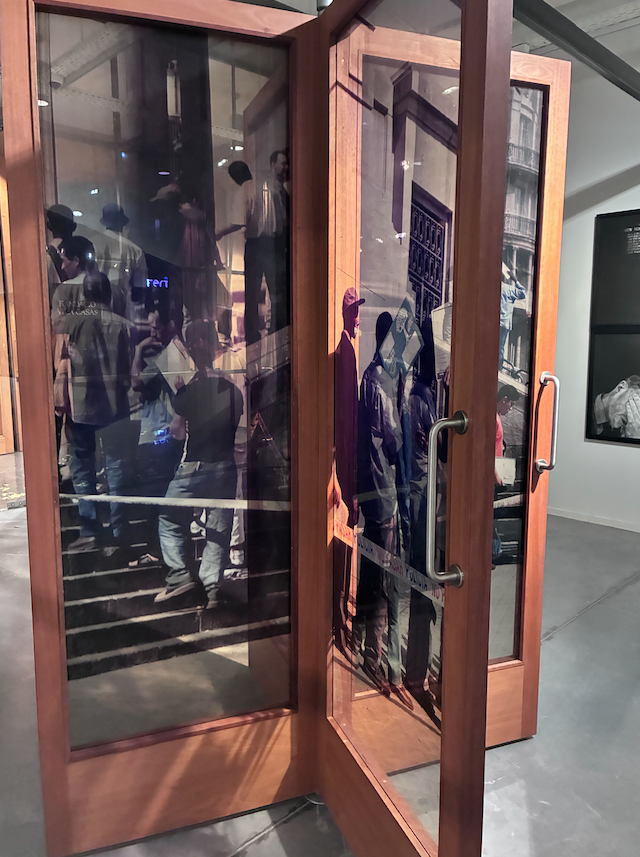
Hence, in the formally varied work of Toni Giró (almost always difficult, if not impossible, to describe in an "impressionistic style"), both in the materials employed and the artistic disciplines used, a tension arises between the solidity of the Image and the ethereal quality of the Word that attempts to describe that Image. It is at this point that much of his work becomes "Marxist" without being political, for it has been created with the raw force of an Adamic language. This tension between Word and Image becomes even more palpable when we realize that this Adamic language we have referred to is that of political matters in their worst sense, a broken and cruel language par excellence, devoid of any syntax to order meaning and reason. Except in artistic practice, where everything is understood without resorting to the obviousness of the easily recognizable. Most likely because in Toni Giró's work, as we can clearly see in this exhibition, there is a certain requirement to look not only with the eyes (a great mistake, according to Didi-Huberman, author of the idea I am now presenting), but rather to look with the whole body and subsequently with language. And I cite this source because the magnificent installation of the many works that make up the exhibition emphasizes this "looking with the whole body," a first and essential condition for subsequently reflecting on what has been seen through language.
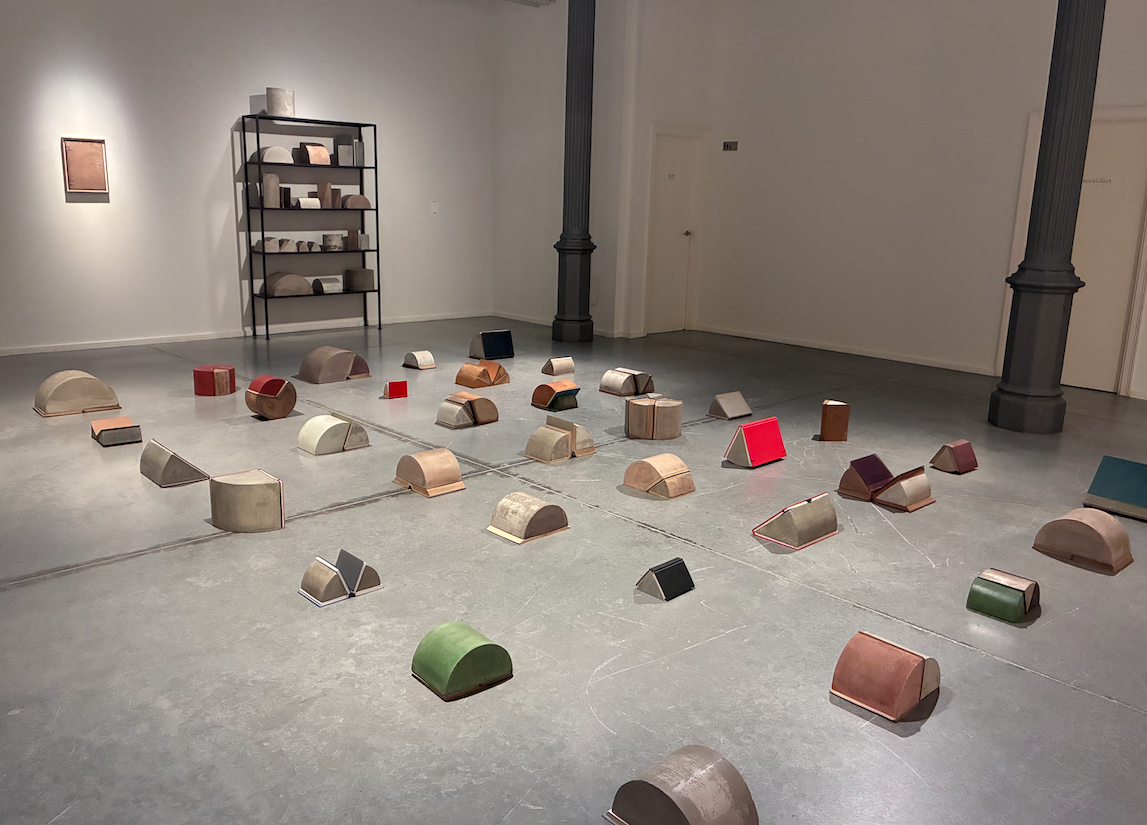
We fully agree with Jordi Font Agulló when, in his brilliant catalogue essay, he states that Toni Giró, during specific years of his artistic life, "entered into spaces of action and thought that he would cultivate throughout his career and that would be marked by proactive skepticism, irony, and rebellion." This statement is highly suggestive because, viewed from the perspective of the observer, it can easily be interpreted as reflecting traits applicable to the evolution of form in Catalan and Spanish sculpture (and not only in sculpture) throughout the many creative trends that emerged during the last decade of the 20th century and the first of the 21st. That's why Jordi Font speaks of "proactive skepticism, irony, and rebellion," and here we add: and also functional disenchantments, productive escapes in time, enervation of discourse and action, exhaustion of the space of representation as a "desiring machine," and continuous appeals to the "event" as a lifeline for an artistic production that knows full well that it is, even if it doesn't accept it, posthumous to itself. For all these reasons, I have greatly enjoyed and been interested in this superb overview of Toni Giró's work, because it increases action, thought, and desires through proliferation, juxtaposition, and disjunction. And because in it, in the work, fiction or narration is not so much a fanciful trick as the discursive importance of creating a critical and productive context. Or, in other words: a form of civilization.
You may be
interested
...