
Exhibitions
Manuel João Vieira: painting as a purple island of memory and irony
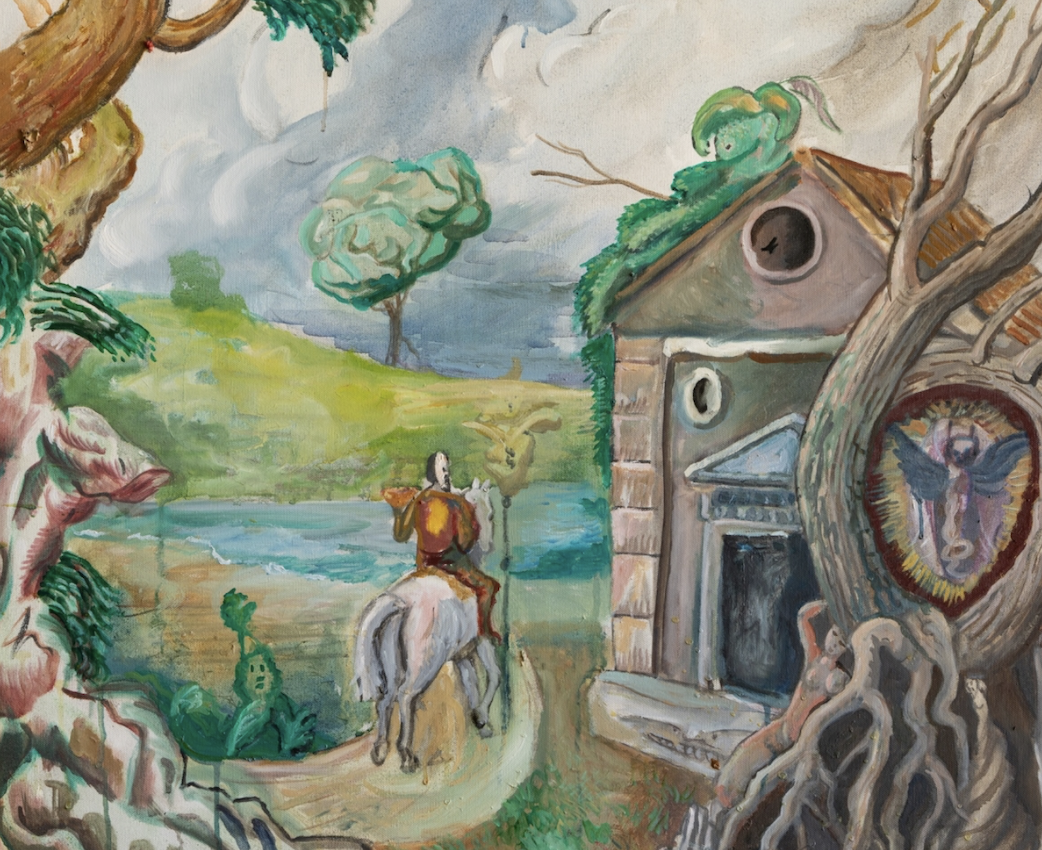
Manuel João Vieira, a prominent figure in the Portuguese cultural scene since the 1980s, is presented here in one of his most significant facets: that of painter. His prolific and recognizable work is part of the broader “return to painting” movement that characterized his generation, in which narrative figuration once again occupies a central place after the ruptures of the 20th-century avant-garde.
In the MAAT exhibition in Lisbon, The Purple Island: Landscapes and Notes , Vieira unfolds a visual universe densely populated with figures, symbols, and compositional constructions that openly engage with Greco-Roman culture and centuries of Western painting history. Mannerism, Baroque, Rococo, Romanticism, Symbolism, metaphysical painting, and Surrealism appear as superimposed layers that do not seek scholarly citation, but rather the free and almost playful appropriation of a collective visual archive.
This interplay with art history becomes a critical exercise: his canvases function as stages where the past is reinterpreted from a contemporary perspective, inevitably ironic, melancholic, and without a clear resolution. In this sense, Vieira's painting seems to inhabit a time after all revolutions, where the new can no longer claim to be innocent.
His pictorial language combines intense figuration with a strong narrative charge. The scenes, often saturated with elements and visual tensions, oscillate between the humorous, the satirical, and the enigmatic. This complexity compels the viewer to activate a broad repertoire of cultural references—mythology, literature, art history—to unravel the multiple layers of meaning.
The provocation in Vieira's work lies not only in the themes but also in the formal construction: the use of color, the compositional density, and the internal rhythm of the images generate a visual experience that defies immediate interpretation. His works are not presented as closed narratives but as open territories where the narrative and the symbolic coexist.
The exhibition, curated by João Pinharanda, can be visited between May 20 and September 7, 2026, proposing a journey through an imaginary world that, rather than illustrating the history of art, rewrites it from within, between erudition and play, between memory and irony.
You may be
interested
...